

On this page
The human body contains about 10 pints (or five litres) of blood. According to the NHS Blood and Transplant service, a standard whole blood donation removes roughly one pint, which is about 10% of your total blood volume. While you might feel slightly tired immediately after, your body’s compensatory mechanisms start working the moment the needle is removed.
The recovery happens in stages, with the liquid portion of the blood bouncing back much faster than the cellular components. Because blood plays an essential role in transporting oxygen, nutrients, and waste products, the body prioritises restoring the lost volume to maintain cardiovascular stability. Once the blood volume is restored, the focus shifts to regenerating the more complex cellular elements.
How long does it take to replace blood volume?
According to the NHS, about 55% of your blood is plasma, and 90% of that plasma is water.
When your overall blood volume drops, pressure sensors in your blood vessels detect the change and signal the kidneys to reduce urine output. According to the American Red Cross, your body will replace the donated plasma within approximately 24 hours. By drawing water and electrolytes from your tissues and the fluids you drink, the circulatory system quickly restores the lost volume.
This rapid response, mediated by hormones like antidiuretic hormone (ADH), ensures that your blood pressure remains stable. If you are revising kidney regulation mechanisms for exams, blood donation is a classic real-world example of how the body maintains homeostasis.
How does the body rebuild red blood cells?
While the plasma returns rapidly, rebuilding the cellular components—the formed elements of blood—takes much longer.
The most critical cells to replace are the red blood cells, which carry oxygen to your tissues. The NHS Blood and Transplant service notes that it takes several weeks to fully replace the red blood cells lost during a whole blood donation.
The process is driven by the kidneys. Specialised peritubular cells in the kidneys sense the slightly reduced oxygen-carrying capacity of your blood. In response, they secrete the hormone erythropoietin (EPO). The EPO travels through the bloodstream to your bone marrow, stimulating the stem cells to ramp up the production of new red blood cells.
Erythropoietin signals the haematopoietic stem cells in the red bone marrow to develop specifically into red blood cells, rather than white blood cells or platelets. These cells mature into erythrocytes, shedding their nuclei to make more room for haemoglobin before entering the bloodstream. Remarkably, the body can produce about two million new red cells every second.
To help visualise how biological systems interact and recover, you can explore topics like this in the Fermi Concept Library. It has lessons on how feedback loops control hormone release and cell production, each with its place in the concept map.
Why do you need iron after donating blood?
To make functional red blood cells, your bone marrow needs iron to build haemoglobin, the red-coloured protein that actually binds to oxygen and carries it from the lungs to the rest of the body. Without enough iron, the newly formed red blood cells will be smaller and less capable of transporting oxygen. Before you can donate, medical staff check your haemoglobin levels to ensure they are high enough. According to the NHS, men must have a level above 135 g/l and women above 125 g/l to donate.
A standard blood donation removes a significant amount of iron. The body must pull iron from its internal stores, primarily from the protein ferritin located in the liver, bone marrow, spleen, and muscles. To compensate, the body also increases the absorption of iron from your diet in the digestive tract.
Rebuilding these iron stores and returning haemoglobin levels to normal typically takes six to twelve weeks. This lengthy iron recovery is why blood banks enforce a strict waiting period—a minimum of 56 days between whole blood donations, as outlined by the American Red Cross.
What is the timeline of recovery?
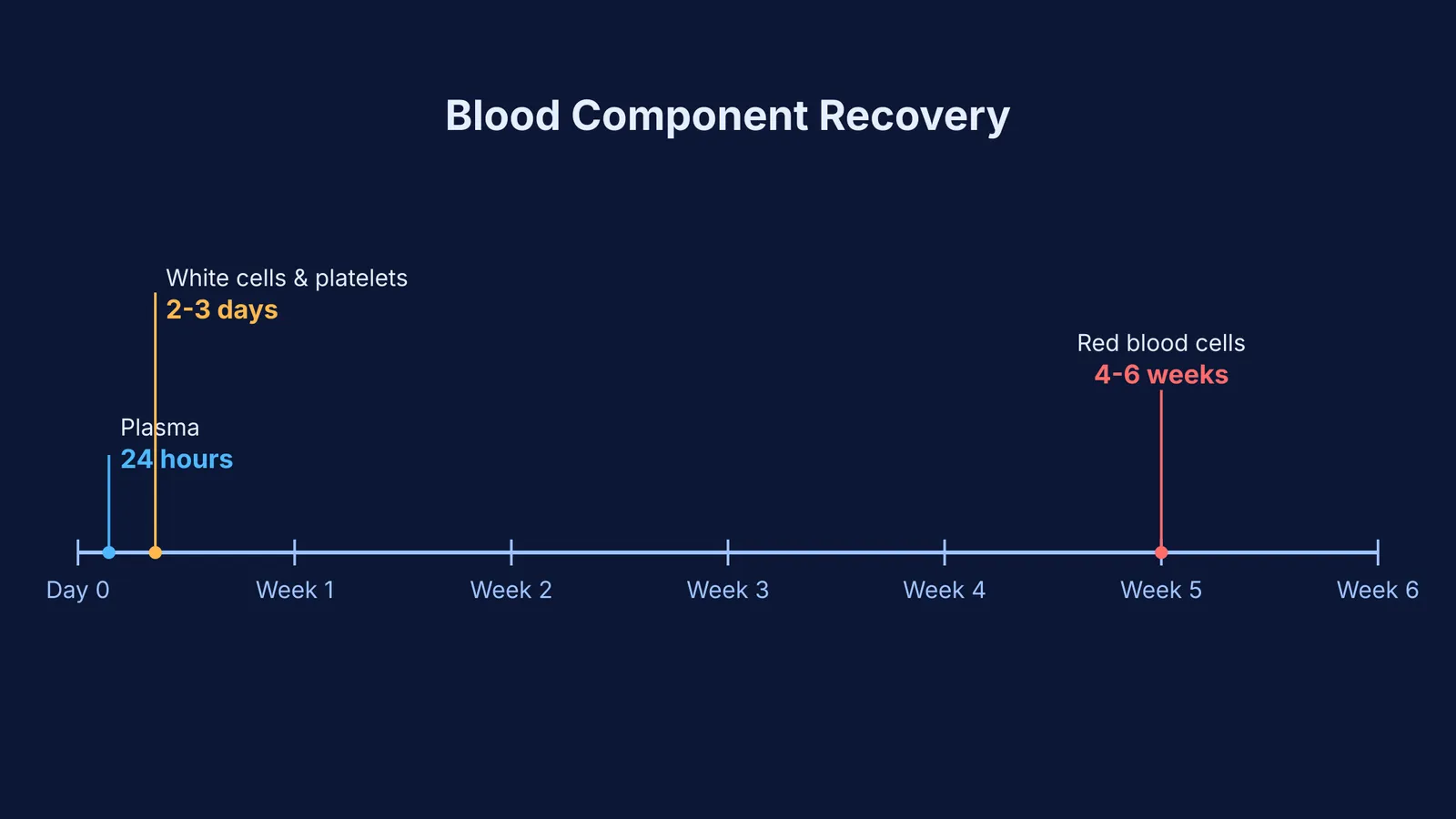
According to the NHS and the American Red Cross, the physiological timeline looks like this:
24 hours: Blood volume (plasma) is fully restored.
2 to 3 days: Platelets and white blood cells are replaced.
4 to 6 weeks: Red blood cell count returns to normal.
6 to 12 weeks: Iron stores and haemoglobin levels are fully replenished.
By understanding the physiological timeline, you can see why spacing out donations and maintaining healthy iron stores are so important. The body is remarkably efficient at replacing what is lost, provided it is given the right resources and adequate time to rebuild its stores. This natural replenishment cycle is why blood banks emphasise a strict waiting period between donations.


