

On this page
You can count Barr bodies from a karyotype in a few seconds once you know one rule. Below is the rule, why it works, a quick-check list for XX, XY, XO, XXY and XXX, worked examples for rarer patterns, and the traps that cost marks in school and entrance-exam questions.
What is a Barr body?
A Barr body is an inactive X chromosome, seen in the interphase nucleus as a small, darkly staining mass pressed against the nuclear membrane (Barr body, Wikipedia). Murray Barr and his student Ewart Bertram reported it in Nature in 1949, after spotting it in nerve cells of female cats (Barr and Bertram, 1949; Wikipedia).
The Barr body looks compact because it is inactive. Because one X is switched off, a female cell has only one functioning copy of each X-linked gene, the same as a male cell (John Kimball, Biology LibreTexts/07:_Cell_Division/7.06:_Sex_Chromosomes)). This switching-off is called X-inactivation, or lyonisation, after Mary Lyon's 1961 Nature paper on X-chromosome genes in mice (Lyon, 1961). Our story of how Mary Lyon worked out X-inactivation covers the history.
What is the rule for counting Barr bodies?
Number of Barr bodies = number of X chromosomes − 1. In humans with more than one X chromosome, the number of Barr bodies seen at interphase is one fewer than the total number of X chromosomes (Barr body, Wikipedia). Kimball's textbook chapter gives the same rule (Biology LibreTexts/07:_Cell_Division/7.06:_Sex_Chromosomes)).
The logic is simple: a cell keeps one X active and inactivates every extra one. So the Y chromosome and the autosomes never enter the sum. Use three steps:
Read the sex chromosomes from the karyotype: 47,XXY means X, X and Y.
Count only the X chromosomes.
Subtract one. With a single X, the answer is zero.
How many Barr bodies in XX, XY, XO, XXY and XXX?
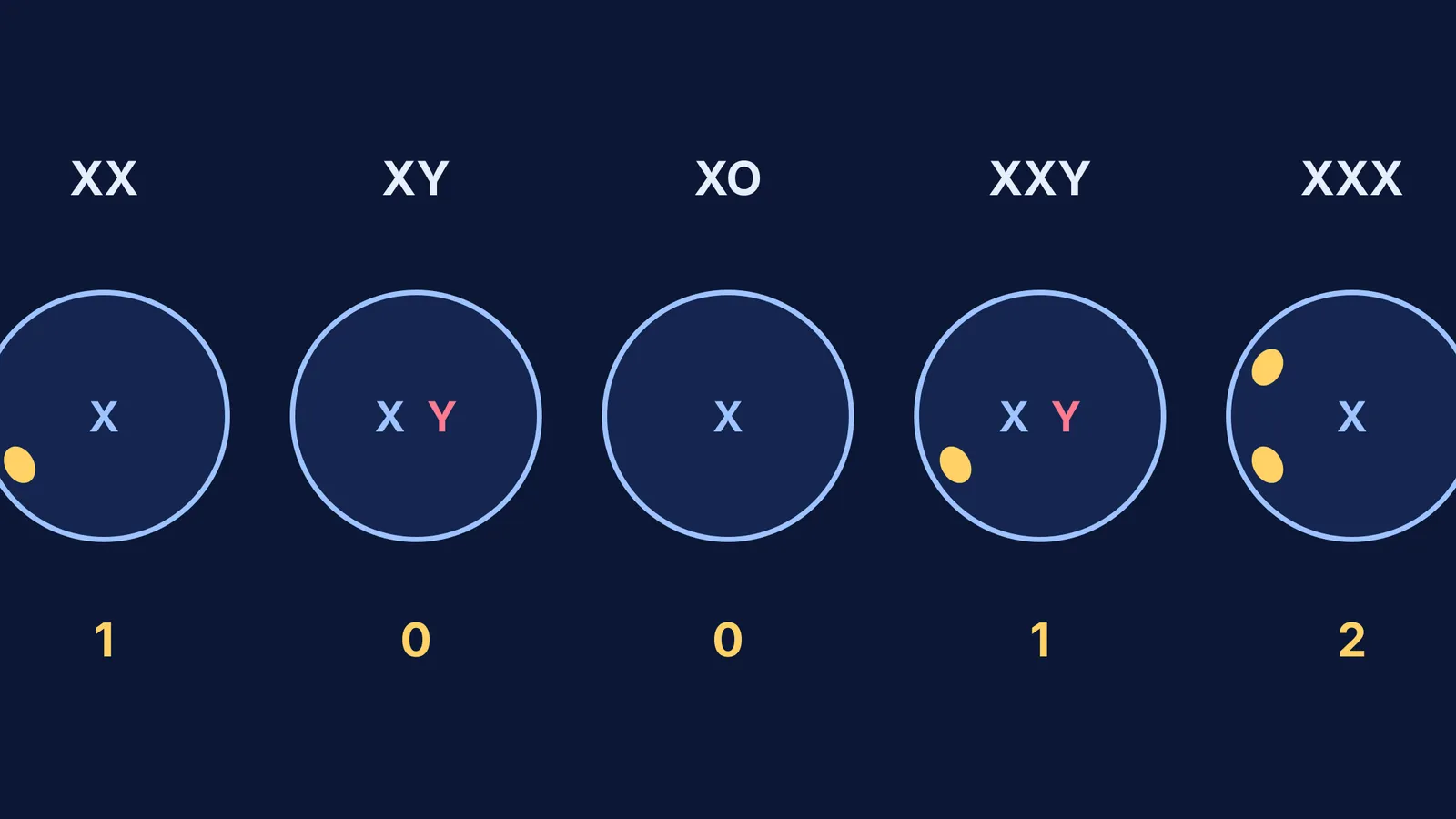
Here is the quick check. The karyotypes and how often each occurs come from MedlinePlus Genetics, the US National Library of Medicine's guide, on Turner syndrome, Klinefelter syndrome and trisomy X.
46,XX (typical female): 2 X chromosomes, so 1 Barr body.
46,XY (typical male): 1 X, so 0 Barr bodies.
45,X, often written XO (Turner syndrome): 1 X, so 0 Barr bodies. Turner syndrome occurs in about 1 in 2,000 female newborns, and about half of those affected have 45,X in every cell.
47,XXY (Klinefelter syndrome): 2 X, so 1 Barr body. It affects about 1 in 650 male newborns.
47,XXX (trisomy X): 3 X, so 2 Barr bodies. It occurs in about 1 in 1,000 newborn girls.
How do you handle XXXY, XXYY and other rare karyotypes?
The same rule covers the rarer patterns that MedlinePlus lists alongside Klinefelter syndrome: 48,XXXY, 48,XXYY and 49,XXXXY. Work them as practice before you read the answers:
48,XXXY: 3 X, so 2 Barr bodies.
48,XXYY: 2 X, so 1 Barr body. The second Y changes nothing.
49,XXXXY: 4 X, so 3 Barr bodies.
Questions also run the rule backwards. If a cell shows 2 Barr bodies, add one: the person has 3 X chromosomes.
One more twist is mosaicism. Some females with trisomy X carry the extra X in only some of their cells, a pattern written 46,XX/47,XXX (MedlinePlus, trisomy X). Applying the rule, their 46,XX cells show 1 Barr body and their 47,XXX cells show 2.
These counts are a textbook exercise. A real chromosome condition is diagnosed by karyotype testing arranged by a doctor or genetic counsellor, not by counting from a description.
What are the common mistakes?
Counting every sex chromosome before subtracting. For XXYY that gives 3, but the answer is 1.
Treating XO as zero X chromosomes. It has one X, so the answer is 0, not −1.
Linking the count to sex instead of to X chromosomes.
Forgetting to add one when working backwards: X chromosomes = Barr bodies + 1.
An extra X chromosome can arise from nondisjunction, an error in cell division (MedlinePlus, trisomy X). Our guide to nondisjunction and the extra chromosome shows how that happens, and Turner vs Klinefelter syndrome karyotypes compares the two side by side.
If X-inactivation still feels abstract, the Fermi Concept Library gives each biology concept its own lesson and its place in the map. For practice, the Fermi Problem Library has worked problems with a step-by-step solver that explains the reasoning rather than printing an answer.
Next time you meet a karyotype, count the X chromosomes, subtract one, and move on.


