On this page
Every skeletal muscle is built from tiny repeating units called sarcomeres. In each one, myosin heads on thick filaments grab actin on thin filaments and slide them towards the centre. How hard a sarcomere pulls depends on how many heads can reach actin. That one idea explains why a fibre is weak when squashed, strongest in the middle, and weakest when stretched.
What sets the force a muscle fibre can make?
The key numbers come from frog muscle. Using the electron microscope, Sally Page and H. E. Huxley measured thick (A) filaments at 1.6 µm and thin (I) filaments at 2.05 µm, counted across the Z line from tip to tip (Page and Huxley, 1963). That means each thin filament reaches about 1.025 µm in from its Z disc.
Three years later, Gordon, Huxley and Julian held single frog fibres at fixed sarcomere lengths and measured the tension of a full contraction. Peak tension sat on a flat plateau between sarcomere lengths of 2.05 and 2.2 µm (Gordon, Huxley and Julian, 1966). They concluded that, on the plateau and at longer lengths, each cross-bridge that a thin filament overlaps adds an equal share of tension. In plain words: force follows overlap.
The plateau has a width because the middle of each thick filament is a bare zone with no myosin heads, roughly 0.15 µm wide (2.2 minus 2.05).
What happens at three sarcomere lengths?
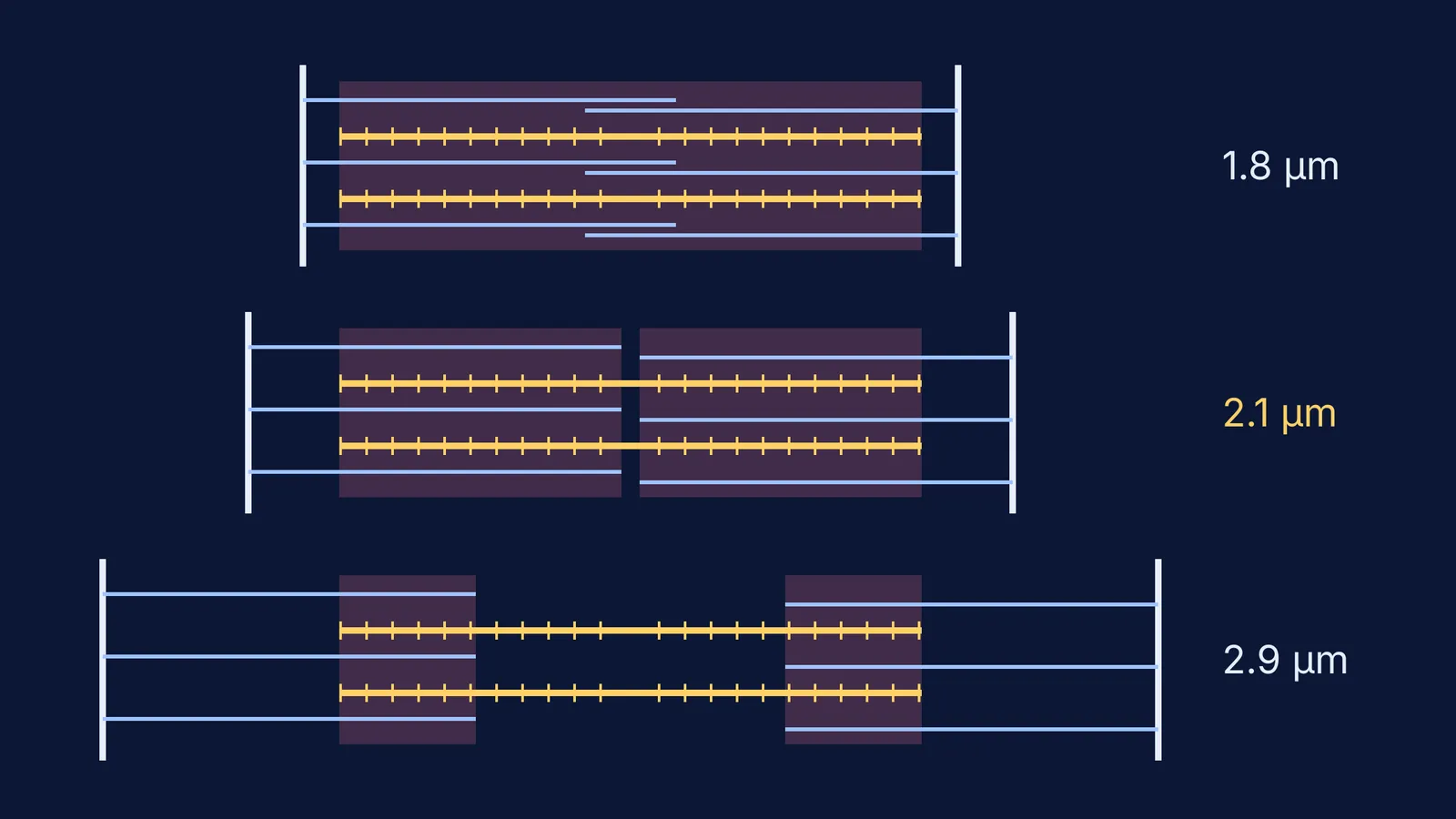
Short, 1.8 µm. The thin filaments from both ends have crossed in the middle, and the thick filament ends are only 0.1 µm from each Z disc. Force is below the plateau, and Gordon's team found it falls more steeply below about 1.67 µm, close to where the 1.6 µm thick filaments would meet both Z discs.
Optimal, 2.1 µm. The thin filament tips sit in the bare zone, so every myosin head can reach actin. This is the plateau.
Stretched, 2.9 µm. The thin filaments have been pulled back towards the Z discs. Only the outer part of each thick filament still overlaps actin, so far fewer heads can pull.
Beyond the plateau, every bit of stretch takes more heads out of the action, until at about 3.65 µm none are left.
Why are muscles weakest when fully stretched, in a real arm?
First, real muscles rarely reach those extremes. A review across species found that many muscles work over a narrow range of sarcomere lengths, covering 94 ± 13 % of their optimal length (Burkholder and Lieber, 2001). Some human wrist muscles sit on the stretched side of the curve and others on the short side; no single range fits every muscle (Lieber and colleagues, 2017).
Second, joint strength is torque, not just fibre force. The moment a muscle produces at a joint depends on its moment arm as well as its sarcomere length (Rassier, MacIntosh and Herzog, 1999). Near a straight elbow, the biceps pulls at a shallow angle to the forearm, so less of its pull turns the joint.
So "weakest when fully stretched" is true of the sarcomere; in a whole limb it is overlap plus moment arm.
How can you test the length-tension curve with your arm at home?
A 1993 study measured voluntary elbow-flexion strength at seven angles, where 180° meant a straight arm (Tsunoda and colleagues, 1993). Peak torque came at 120° in the men and bodybuilders and at 90° in the women. At 75°, the most bent position tested, the men were 20 % weaker than at 120°, while the women showed no difference between those two angles. You can see the same shape with a bathroom scale.
Stand on a bathroom scale beside a heavy table that will not lift. Note your weight.
Hook your fingers, palm up, under the table edge, upper arm by your side.
Pull up gently as if doing a curl, building over two seconds, and hold for three. The table pushes back down on you, so the reading rises by roughly your pulling force.
Repeat at three elbow angles by bending your knees or standing on a step: nearly straight, a right angle, and well bent. Rest a minute between tries.
If your arm follows the study, the right angle or a little straighter should read highest, and the well-bent position may read lower. Stop if anything hurts, never jerk, and skip the test with an arm injury; ask a doctor or physiotherapist instead. Your result mixes overlap with moment arm, so treat it as a demonstration, not a measurement.
For the history, read how Jean Hanson helped discover the sliding filament theory; for what happens when myosin heads cannot let go, see why rigor mortis happens; and for the biceps and its partner, see how biceps and triceps work as antagonistic muscles.
Overlap is easier to see moving than to read. The Fermi Simulation Lab has interactive simulations for ideas like this, and the Fermi Concept Library gives each biology and physics concept its own lesson.