On this page
A nautilus carries a heavy coiled shell, yet a living animal hangs in the sea almost weightless. Denton and Gilpin-Brown (1966) found that freshly caught *Nautilus macromphalus* weighed only about 0 to 2% of its weight in air when weighed in seawater. The trick is a shell that works like an adjustable float, run on Archimedes' principle, which you meet in Class 9.
How does a nautilus float and sink using its shell?
Walls divide the shell into sealed chambers. The body sits in the open front; the older chambers behind it hold gas and some liquid. A thin tube of living tissue, the siphuncle, threads through every chamber wall and connects them all to the animal's blood.
The gas is what holds the animal up. Denton and Gilpin-Brown worked out that about 80% of the gas space in the shell was used just to support the weight of the shell itself in seawater. Only the newest ten or so chambers held much liquid, and animals were brought to about the same overall density by having more or less of it. More liquid means heavier and sinking; less means lighter and rising.
How does the siphuncle pump water out of the chambers?
The siphuncle is not a mechanical pump. It pumps salt, and water follows.
A newly built chamber starts completely full of liquid with an osmolarity close to seawater, as Denton and Gilpin-Brown saw in an animal caught mid-construction.
The siphuncle removes salts, leaving the liquid dilute: Denton and Gilpin-Brown found it always hypotonic to seawater, with mainly sodium and chloride ions.
Water then moves by osmosis from the dilute chamber liquid into the saltier blood of the siphuncle.
Gas diffuses into the space the liquid leaves behind, and the chamber becomes a float.
Osmosis can only pull so hard, and seawater pressure rises with depth. A 2011 tracking study by Dunstan, Ward and Marshall notes that below about 250 m liquid flows back into the chambers, making the animal negatively buoyant; only shallower than 250 m can it remove that liquid.
How much water must a nautilus remove to rise?
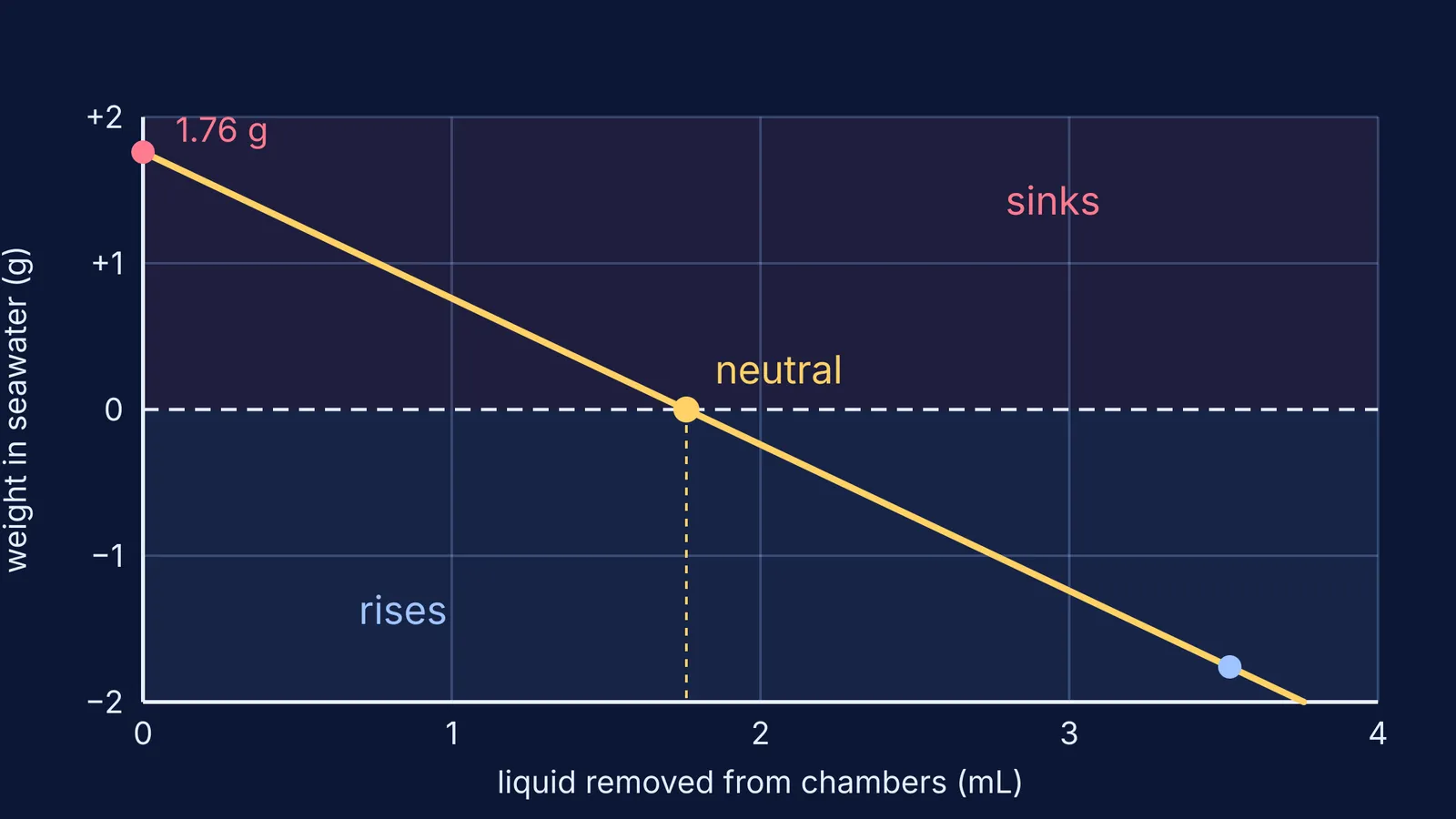
Ward and Martin (1978) weighed 14 freshly captured *Nautilus macromphalus* in seawater and found all of them slightly heavier than seawater, with a mean weight of 1.76 g. They also measured the fastest liquid removal from chambers they had filled with seawater: 1.0 mL per chamber per day at the surface.
Archimedes' principle says the upthrust equals the weight of seawater the animal displaces. The shell is rigid, so swapping liquid for gas inside it leaves the outside volume, and so the upthrust, unchanged. Only the animal's mass changes.
Weight in water = true weight minus upthrust: here 1.76 g pulling down.
Removing a mass m of liquid lowers the true weight by m; upthrust stays fixed, and the replacing gas weighs almost nothing.
New weight in water = 1.76 g minus m.
Neutral buoyancy needs m = 1.76 g. Chamber liquid is watery and hypotonic, so its density is close to 1 g per mL: about 1.8 mL.
At the measured maximum of 1.0 mL per chamber per day, one chamber needs nearly 2 days to shed that.
To rise with the same 1.76 g of lift it once sank with, remove 3.52 g, about 3.5 mL, or roughly 3.5 chamber-days.
Why does a nautilus swim instead of pumping to change depth?
Even with several chambers working at once, that takes hours to days, far too slow for a nightly commute. Ward and Martin concluded that the chamber-liquid system is used for long-term buoyancy adjustments, not for short-term ascent or descent.
The Dunstan study tracked eleven *Nautilus pompilius* at Osprey Reef in the Coral Sea and recorded virtually continuous nightly movement between 130 and 700 m, with average ascent rates of about 2.3 m per minute. At that pace, a 200 m climb takes under an hour and a half of swimming, against days of pumping. The authors also describe a need for resting periods at about 200 m to regain neutral buoyancy, and give 800 m as the depth limit set by chamber filling and shell implosion.
How do you solve buoyancy problems like this one?
Use the nautilus as a template for floating-and-sinking numericals in board exams or JEE Main:
What stays constant? For a rigid shell, volume, so upthrust is fixed.
What changes? Here, mass.
Write weight in fluid = weight minus upthrust, with one sign convention.
Convert mass to volume last, stating the density you assume.
The same reasoning explains how underwater weighing finds body fat from density and why the bulbs in a Galileo thermometer sink as it warms.
If the upthrust idea itself feels shaky, the Fermi Concept Library gives every concept in physics, chemistry and biology its own lesson. To practise the numericals, the Fermi Problem Library has worked problems with a step-by-step solver that explains the reasoning rather than printing an answer.