On this page
Most students learn the cross-bridge cycle as a story about contraction. Read it again with one question in mind, what does each step need, and it also explains rigor mortis, the stiffening of muscles after death.
What does the NCERT cross-bridge cycle say?
The cycle is in section 17.2.2 of NCERT Class 11 Biology, Chapter 17, Locomotion and Movement.
First, the globular head of myosin is an active ATPase enzyme with binding sites for ATP and active sites for actin, according to NCERT section 17.2.1. Second, NCERT says of the end of each cycle: “The myosin, releasing the ADP and Pi goes back to its relaxed state. A new ATP binds and the cross-bridge is broken.”
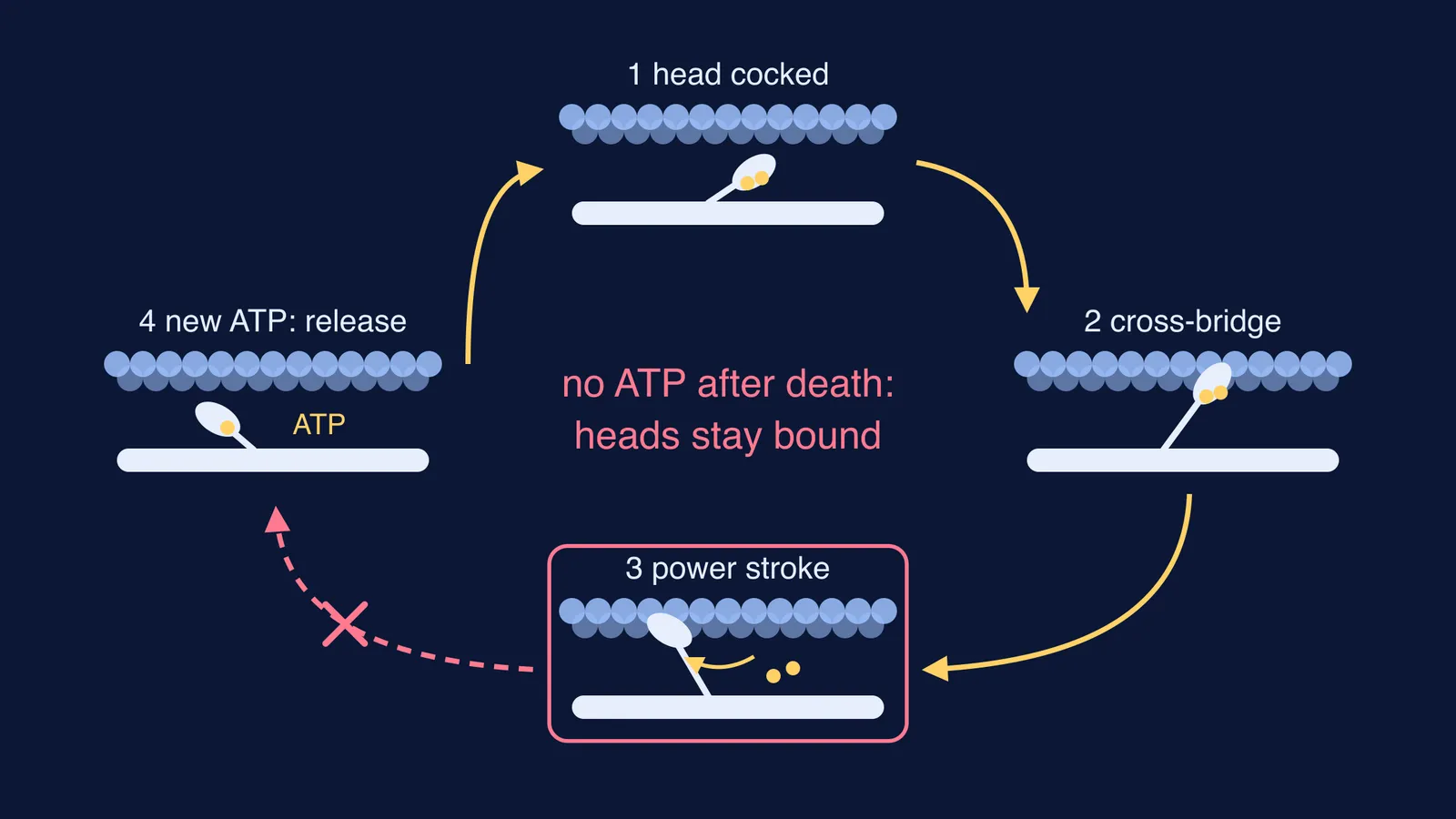
Here is the cycle as four steps, following the four stages in NCERT Figure 17.4 and the diagram at the top of this page:
Head cocked. The head has hydrolysed ATP and holds ADP and Pi. It is energised but not attached.
Cross-bridge forms. Calcium binds troponin, the active sites on actin are unmasked, and the head binds actin.
Power stroke. The head rotates and pulls the actin filament towards the centre of the A band. ADP and Pi leave. The head is still bound to actin.
Release. A new ATP binds and the cross-bridge breaks. The head hydrolyses that ATP, cocks again, and the cycle returns to step 1.
When you draw this in an exam, write what enters or leaves at each arrow: ADP and Pi out after step 3, ATP in at step 4. For a fuller walk through the calcium side, see our post on muscle contraction step by step.
Why does rigor mortis happen after death?
Look at step 3. After the power stroke, the head is bound to actin with nothing in its pocket, waiting for step 4. In a living muscle, a new ATP arrives and the head lets go. After death, it does not.
John Squire, in a 2019 overview of the actin-myosin interaction in muscle, calls this bound head, after ADP and Pi have left, the rigor state. He writes that it “occurs transiently in the contractile cycle, but relatively permanently in rigor mortis when, after death, ATP production in the body has stopped.” His next sentence: “This explains why in rigor mortis the cross-linked muscles are stiff.” In the normal cycle, he notes, heads in this state “bind ATP, which accelerates detachment of heads from actin”.
The muscle is not actively contracting. It is locked.
Scientists tied rigor to ATP decades ago. E. C. Bate-Smith and J. R. Bendall published a paper titled Rigor mortis and adenosine-triphosphate in The Journal of Physiology in 1947.
How fast does it set in? One animal study gives a sense of the timing. In a 2022 study of 15 fresh pig shoulders, measured from 103 minutes after death, the first significant drop in tendon mobility came at 151 minutes.
What is the common exam misconception about ATP and rigor?
The trap goes like this: “ATP gives energy for contraction. A dead body has no ATP. So dead muscles should go limp.” The mistake is giving ATP only one job.
In the NCERT cycle, ATP has two jobs:
Hydrolysis of ATP cocks the head and powers its binding to actin (steps 1 and 2).
Binding of a new ATP breaks the cross-bridge (step 4).
Rigor mortis is about the second job. Without ATP, heads that are already attached cannot detach.
A model two-mark answer: “After death, ATP is no longer produced. A new ATP must bind to the myosin head to break the cross-bridge with actin. Without ATP, the heads stay bound, actin and myosin remain cross-linked, and the muscle becomes rigid.”
Rigor is not a cramp, which happens in living muscle; see why muscles cramp during sport.
How can you check you have really understood it?
Try these without your notes:
At which step is the head bound to actin with no ATP, ADP or Pi on it?
Which event breaks the cross-bridge: ATP binding or ATP hydrolysis?
Why would a muscle with plenty of calcium but no ATP be stiff rather than relaxed?
Which sarcomere bands shorten during contraction, and which keep their length?
If question 4 stumps you, read which sarcomere bands shorten during contraction. If the sliding-filament idea itself feels shaky, the Fermi Concept Library gives every biology concept its own lesson and its place in the map.
If you keep slipping on the reasoning in practice questions, the Fermi Problem Library has worked problems with a step-by-step solver that explains the reasoning rather than printing an answer.
Next time you revise this chapter, draw the four-step cycle from memory and mark the step where death stops it.