

On this page
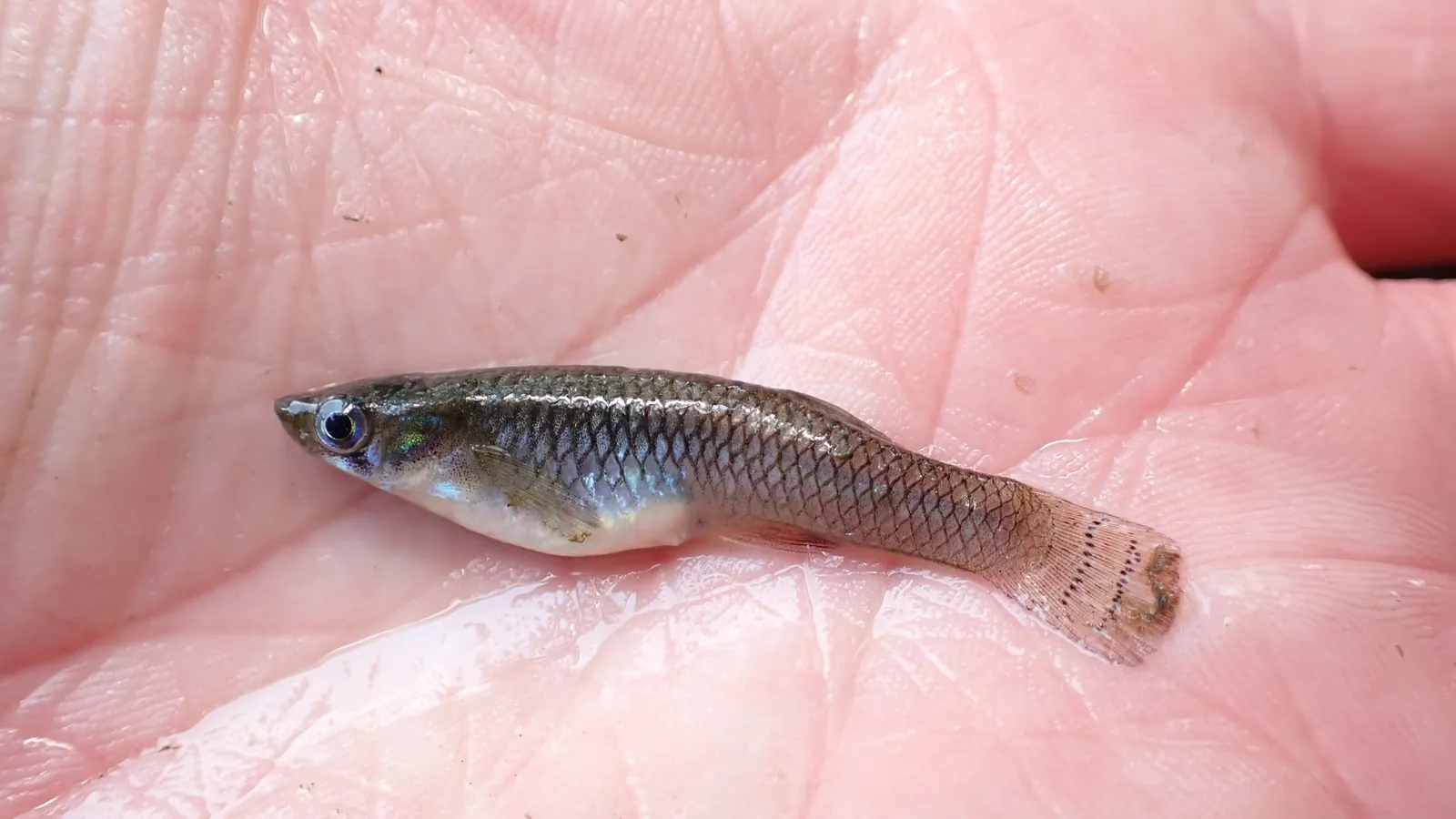
If you are revising Class 12 Human Health and Disease, you have met Gambusia in a single line. In its list of ways to control mosquitoes, the NCERT Class 12 Biology chapter on Human Health and Disease includes "introducing fishes like Gambusia in ponds that feed on mosquito larvae". That line is right, but it leaves out half the story: ecologists in India now warn against releasing it.
How does Gambusia fish control mosquitoes?
Mosquitoes lay their eggs in still water, and the larvae grow there before they turn into flying adults (our post on the four stages of the mosquito life cycle covers each one). Gambusia, often called the mosquitofish, hunts in exactly that zone. The guidelines on larvivorous fish for vector control hosted by India's National Center for Vector Borne Diseases Control (NCVBDC) list what makes it effective:
A single full-grown Gambusia eats about 100 to 300 mosquito larvae per day.
It is a surface feeder, so it can eat the larvae of both anopheline (malaria-carrying) and culicine mosquitoes.
It keeps to the margins of ponds and water containers, and prefers the shallow water where larvae also breed.
It is small, hardy, tolerates some salinity and survives being transported.
The document also says a guppy eats about 80 to 100 larvae in 24 hours, so Gambusia is rated the more efficient of the two. According to NCVBDC, Gambusia affinis has been used in India since 1928, and the guidelines describe it as an exotic American fish, not a native one.
Why do health programmes use Gambusia as biological control?
Biological control means using a living predator, parasite or disease to keep a pest down, instead of a chemical spray. The NCVBDC guidelines give three reasons programmes chose fish: once a population settles in, it keeps breeding and eating larvae for a long time; it costs less than chemical control; and they call it an environment-friendly method. NCERT lists it alongside avoiding stagnant water, cleaning household coolers, using mosquito nets and spraying insecticides. For other syllabus examples, see our guide to biocontrol agents and biofertilisers for NEET.
Why is releasing Gambusia into ponds risky?
The trouble starts with the same toughness that makes it useful. Gambusia affinis is on the IUCN Invasive Species Specialist Group's list of 100 of the World's Worst Invasive Alien Species.
In a 2020 article in Current Science, M. Nobin Raja and G. Ravikanth of ATREE, Bengaluru describe Gambusia as widely spread across India, including inside many Protected Areas, where it has become a threat to endangered amphibians, fishes and aquatic invertebrates. They report that:
In Pune, the native striped panchax (Aplocheilus lineatus) was affected by mosquitofish.
Gambusia chases and nips the fins of other fish, and injured fish can get infections and die.
It eats zooplankton and insects too, and heavy zooplankton loss can lead to algal blooms that lower water quality.
Their preliminary DNA analysis found only Gambusia holbrooki at their sampling sites, not the G. affinis that official documents name.
A 2008 review by Graham Pyke in the Annual Review of Ecology, Evolution, and Systematics calls the two Gambusia species, taken together, the most abundant and widespread freshwater fish in the world. It says rigorous evidence on how well they control mosquitoes remains scant, while abundant evidence shows harm to many native animals.
Does Gambusia actually reduce malaria?
A 2017 Cochrane systematic review by Walshe and colleagues found no studies measuring whether stocking larvivorous fish reduces malaria in nearby communities. It found 15 small studies on larvae, three of them from India, and all were at high risk of bias; the evidence was too weak to say whether the fish reduce larva numbers. The authors advised countries not to invest in fish stocking for malaria control except as part of carefully controlled research that also checks the effect on native fish.
How do you write about Gambusia in an exam?
For a one-mark question, "Gambusia is a larvivorous fish introduced into ponds to eat mosquito larvae; it is biological control of a vector" is enough. For a longer answer, use this four-part plan:
What: a small, surface-feeding fish that eats mosquito larvae.
Why it works: it hunts at the surface and the edges, where larvae live.
Why it counts as biocontrol: it uses a living predator instead of a chemical.
The limit: it is an introduced species that can outcompete and harm native fish and frogs.
Watch for one trap: "Gambusia controls malaria" is loose wording. It eats larvae of the vector, the mosquito, not the Plasmodium parasite. For the risk half of your answer, our post on invasive alien species in India explains how introduced species harm native ones, a topic from the Biodiversity chapter.
If vectors, larvivorous fish and invasive species blur together, the Fermi Concept Library gives each biology concept its own lesson and shows where it sits on the map. To test yourself on statement and match-the-list questions, the Fermi Problem Library has worked problems with a step-by-step solver that explains the reasoning rather than printing an answer.
Next time you write "Gambusia" in an answer, add one line about the risk.


