On this page
An earthworm has no lungs and no gills. It takes in oxygen across its whole body surface, and that only works while the surface is wet. This one fact explains why a worm dies on a dry path, helps explain why worms show up on roads after a monsoon downpour, and links them to frogs and salamanders that breathe the same way.
How does an earthworm breathe through its skin?
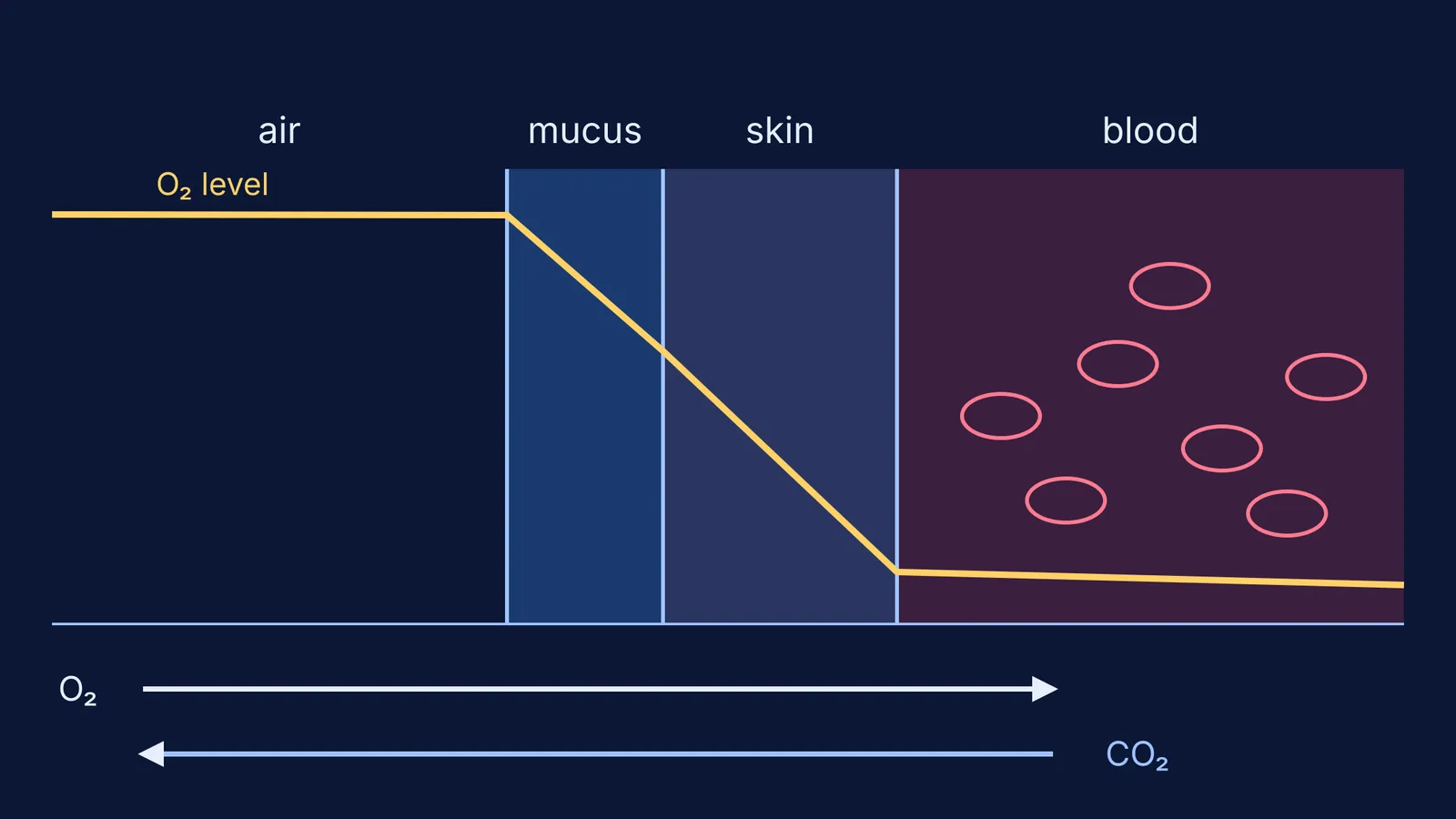
"Earthworms and amphibians use their skin (integument) as a respiratory organ," says the OpenStax Biology 2e chapter on gas exchange. Oxygen from the air dissolves in the film of mucus on the worm's body and passes through the skin into the blood underneath, while carbon dioxide goes the other way. Nothing pumps air in. Each gas moves from where its partial pressure is higher to where it is lower: diffusion.
A steep partial-pressure difference, thin membranes and a large surface all favour diffusion, the same points OpenStax Anatomy and Physiology makes about the human lung. A major review of skin breathing in vertebrates, Feder and Burggren (1985) in Biological Reviews, lists surface area, diffusion distance and partial pressures among the factors that affect it, and notes that blood flow can help regulate it. Blood keeps carrying oxygen away, so the level under the skin stays low and oxygen keeps flowing in.
Why does an earthworm's skin have to stay moist?
"The respiratory surface must be kept moist in order for the gases to dissolve and diffuse across cell membranes," says the same OpenStax chapter. Dry skin is a closed door. A worm stranded on hot concrete has air all around it and can still suffocate as it dries.
The water layer also slows oxygen down. A Cornell University page on oxygen diffusion calculates that oxygen's diffusion coefficient in air is 5,700 to 10,800 times greater than in water (at 60°C and 20°C). So the wet layer works best as a thin film, not a thick coat.
Why do earthworms come up after heavy rain?
The school answer is "so they don't drown", but the evidence is mixed. Chuang and Chen (2008) in Invertebrate Biology compared two species. *Amynthas gracilis*, which crawls out of the soil at night after heavy rain, coped poorly underwater and used more oxygen at night than by day. *Pontoscolex corethrurus* survived longer underwater, used less oxygen and was never seen crawling out after rain. The authors suggest at least two strategies for waterlogged soil: leave it, or need less oxygen.
Others point to travel. Chris Lowe, a lecturer at the University of Central Lancashire, said in Scientific American in 2011 that worms "breathe through their skins and actually require moisture in the soil to do so", and that surfacing "gives them an opportunity to move greater distances across the soil surface than they could do through soil". Either way, wet ground lowers the risk of drying out on the surface.
You can test moisture preference with our earthworm choice chamber experiment, and see how the same body crawls in how earthworms, snails and birds move.
Which other animals breathe through their skin?
Lungless salamanders. AmphibiaWeb lists 523 species in the family Plethodontidae and says "all members of this family lack lungs, relying on cutaneous respiration instead".
Frogs and other amphibians. In many lower vertebrates the skin is "the major or even sole avenue for respiration", say Feder and Burggren, and its share of gas exchange is often largest in small animals, at cool temperatures and at low activity. More on frogs: why frogs croak so much in the rainy season.
The Lake Titicaca water frog. It lives at about 3,800 m, has baggy skin folds and lungs about a third the size of similar frogs', and bobs so more water flows past its skin, as Wikipedia's species page summarises from work including Hutchison and colleagues (1976).
How can you tell if an animal can rely on its skin?
Use this four-question check on any animal in an exam question:
Is the surface kept moist (mucus, water, damp soil)?
Is it thin, with blood close underneath?
Is there a lot of surface for the body's volume?
Is its oxygen demand modest (small, slow or cool)?
Worked example for question 3. Treat a worm as a cylinder and ignore its ends. Side area is 2πrL and volume is πr²L, so area divided by volume is 2/r. A worm of radius 2 mm has 1 mm² of skin per mm³ of body. The same shape with a radius of 20 mm has 0.1 mm² per mm³, ten times less. Thick animals run out of surface, so they need lungs or gills.
A two-line answer you can write: "The earthworm respires through its moist, thin skin, which has a rich blood supply. Oxygen dissolves in the mucus and diffuses into the blood while carbon dioxide diffuses out, so the skin must stay moist."
If diffusion or surface-area-to-volume ratio still feels shaky, the Fermi Concept Library has a lesson for each concept and shows its place in the map, so you can fill the gap before the respiration chapter.