

On this page
This is a classic small-oscillation problem in JEE physics. Two charges are fixed, and a third charge of the same sign sits halfway between them. Push it a little along the line and it swings back and forth. To find the period, write the exact force, approximate it for small displacements, and read off the spring constant.
Why does a charge between two like charges oscillate?
Coulomb's law gives the force between two point charges as F = kq₁q₂/r², and OpenStax University Physics gives the constant k = 1/(4πε₀) = 8.99 × 10⁹ N·m²/C². Like charges repel.
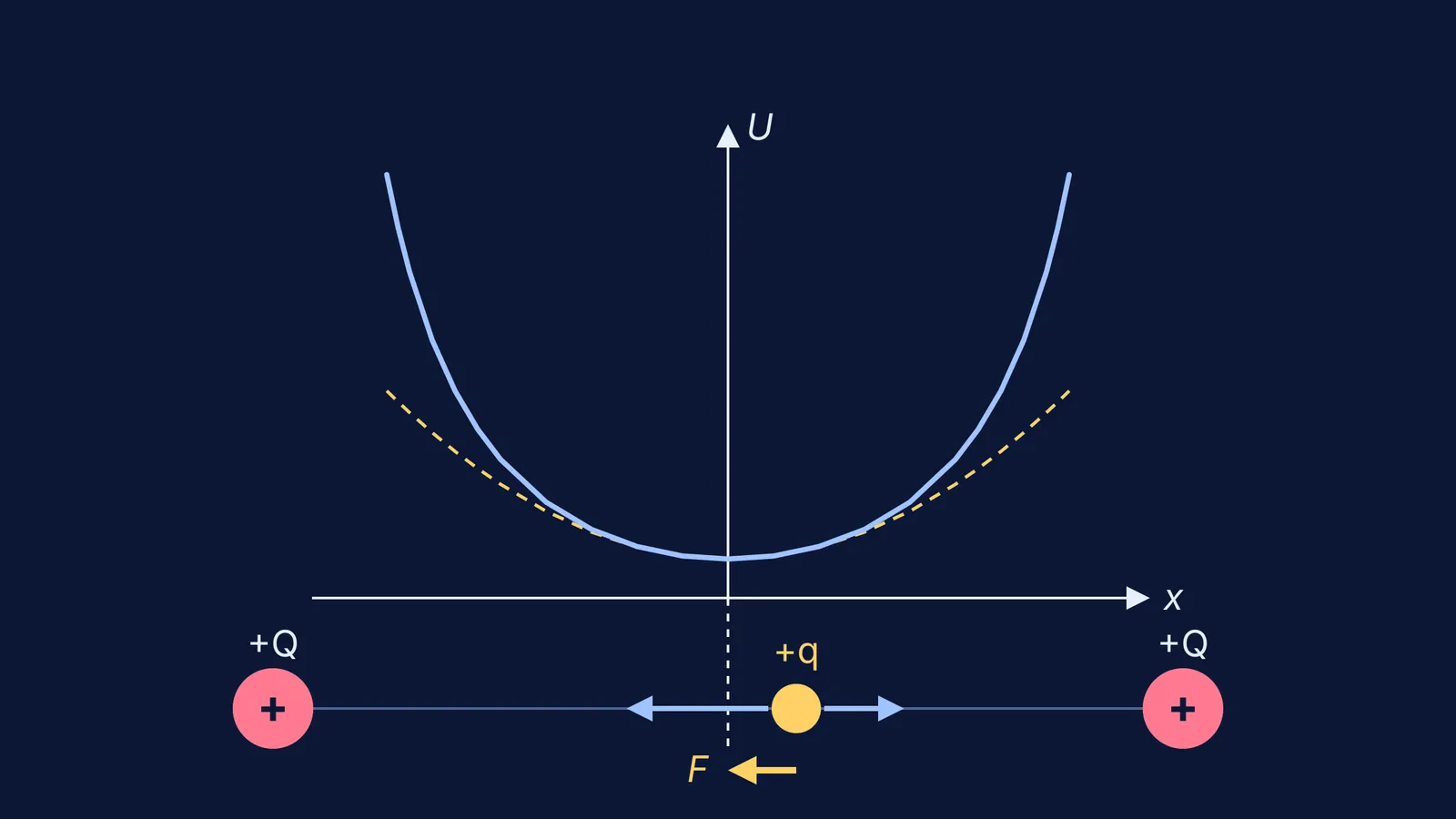
Fix charge +Q at x = −a and another +Q at x = +a. A charge +q of mass m sits at the midpoint, x = 0. There the two pushes cancel, so it is in equilibrium. Now move it to a small x > 0.
The left charge is now further away, at distance a + x, and pushes q to the right with force kQq/(a + x)².
The right charge is now closer, at distance a − x, and pushes q to the left with force kQq/(a − x)².
The net force (taking right as positive) is F = kQq[1/(a + x)² − 1/(a − x)²] = −4kQq·ax/(a² − x²)².
The closer charge always wins, so the net force points back towards the middle. For x much smaller than a, the bracket (a² − x²)² is almost a⁴. That leaves F ≈ −(4kQq/a³)x.
That is exactly the condition for simple harmonic motion: OpenStax defines SHM as motion in which the net force is proportional to the displacement and acts in the opposite direction.
What is the time period of small oscillations?
Compare F ≈ −(4kQq/a³)x with a spring's F = −k_s x. The charge behaves like a mass on a spring of stiffness k_s = 4kQq/a³. For a mass on a spring, OpenStax gives T = 2π√(m/k_s), and the period does not depend on the amplitude. So:
ω = √(4kQq/(ma³))
T = 2π√(ma³/(4kQq)) = π√(ma³/(kQq))
In terms of ε₀: T = π√(4πε₀ma³/(Qq))
If the question gives the distance between the fixed charges as d, then a = d/2 and T = π√(md³/(8kQq)). Mixing up a and d is an easy way to lose these marks.
Worked example
Take Q = q = 1 μC, a = 10 cm and m = 1 g. Then kQq = (8.99 × 10⁹)(10⁻⁶)(10⁻⁶) ≈ 8.99 × 10⁻³ N·m².
Stiffness: k_s = 4 × 8.99 × 10⁻³ / (0.1)³ ≈ 36.0 N/m.
Angular frequency: ω = √(36.0/0.001) ≈ 190 rad/s.
Period: T = 2π/ω ≈ 0.033 s, which is about 30 oscillations every second.
How small is "small"? At x = a/10 the exact force is (a²)²/(a² − x²)² = 1/0.99² times the linear one. That is only about 2% stronger, so the SHM answer holds well. At x = a/2 the factor is 1/0.75², about 1.78, and the motion is no longer close to SHM.
Our guide to finding the period of small oscillations from a potential energy curve shows the general method. The algebra also mirrors the block between two springs on either side.
What happens if the charge moves sideways?
Now move q a small distance y perpendicular to the line. Each +Q still repels it, and both repulsions have a component pointing away from the axis. The net sideways force is about +(2kQq/a³)y. It points away from the midpoint, so the equilibrium is unstable in that direction.
This is not a quirk of the problem. Earnshaw's theorem, first proved by the British mathematician Samuel Earnshaw in 1842, says a collection of point charges cannot be held in stable stationary equilibrium by electrostatic forces alone. Whatever direction is stable, some other direction will not be.
Flip the sign of the middle charge and the two directions swap. Use this quick reference:
Like charge, displaced along the line: stable, SHM with T = π√(ma³/(kQq)).
Like charge, displaced sideways: unstable.
Unlike charge, displaced along the line: unstable, because it is pulled towards the nearer charge.
Unlike charge, displaced sideways: stable for small y, SHM with T = 2π√(ma³/(2k|Qq|)), which is √2 times the along-the-line period.
How do you check your answer in an exam?
Run these four checks before you move on:
Sign: the net force must point back to equilibrium. If it does not, the answer is "unstable", not a period.
Distance: did the question give a (centre to each charge) or d (charge to charge)?
Units: the stiffness must come out in N/m.
Trend: a larger gap should give a longer period, since T grows as a^(3/2).
If you get the force right but stall on the expansion, the Fermi Problem Library has worked problems with a step-by-step solver that explains the reasoning rather than printing an answer. If you are not sure why the closer charge wins, try predicting Coulomb's law results with a simulation, or open the lesson on Coulomb's law in the Fermi Concept Library.


