

On this page
You can read F = kq₁q₂/r² a hundred times and still get stuck when a JEE question asks what happens if you halve the distance and triple one charge. A simulation lets you test the law yourself. The trick is to write your prediction down before you move the slider, so the simulation has a chance to prove you wrong.
What does Coulomb's law say about force, distance and charge?
The size of the force between two point charges is F = k|q₁q₂|/r², where r is the distance between them, as set out in OpenStax University Physics, Volume 2. The constant is k = 1/4πε₀ = 8.99 × 10⁹ N·m²/C², according to the same OpenStax chapter on Coulomb's law. Charges with the same sign repel; charges with opposite signs attract.
Two things follow. The force depends on the product of the charges, so changing either charge changes the force by the same factor. The force depends on 1/r², so distance matters more than many students expect.
How do you test the inverse-square law in a simulation?
You need a simulation that shows two charges and reads out the force on each. PhET's free Coulomb's Law simulation lets you change the sign and size of each charge and the distance between them. The Fermi Simulation Lab has interactive simulations for ideas that are easier to see than to read.
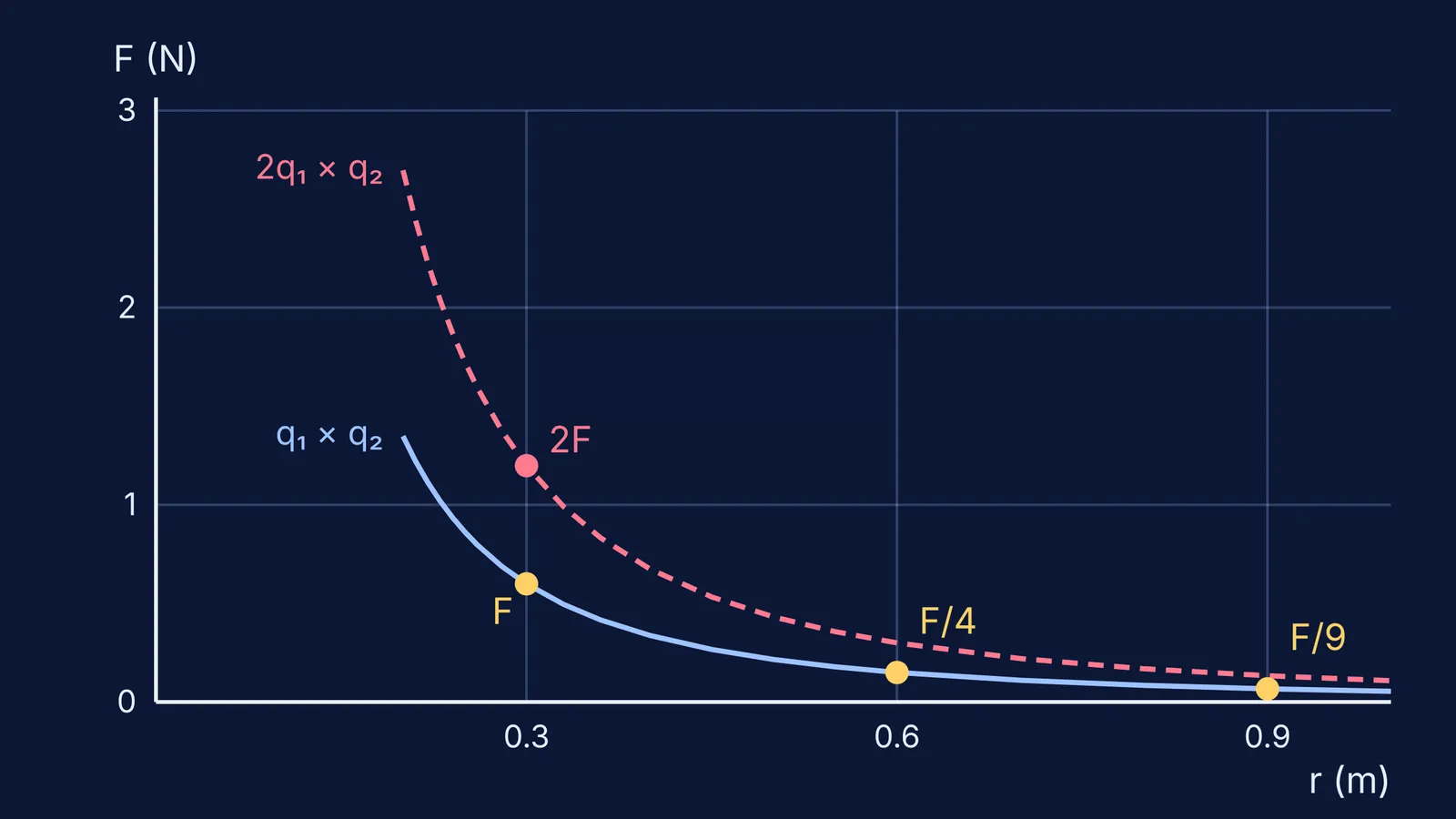
Start with q₁ = +2 μC and q₂ = +3 μC, with r = 0.30 m between them. Work out the force first, using k = 8.99 × 10⁹ N·m²/C² from OpenStax: F = 8.99 × 10⁹ × (2 × 10⁻⁶)(3 × 10⁻⁶) / 0.30² ≈ 0.60 N, and it pushes the charges apart. If your simulation uses different units or sizes, the ratios below still hold.
Now run five tests. For each one, write your prediction in your notebook, then move the slider and record what you see.
Double the distance to 0.60 m. Prediction: a quarter of the force, about 0.15 N. A common wrong guess is half, 0.30 N.
Triple the distance to 0.90 m. Prediction: a ninth of the force, about 0.067 N.
Go back to 0.30 m and double q₁ to 4 μC. Prediction: twice the force, about 1.20 N. Double both charges and you get four times the force.
Set q₁ back to 2 μC and flip q₂ to −3 μC. Prediction: still 0.60 N, but the arrows reverse and the charges now attract.
Look at the force on each charge while q₁ and q₂ are different sizes. Prediction: both are 0.60 N and point in opposite directions.
Test 5 surprises students who expect the bigger charge to push harder. OpenStax states that Newton's third law applies as usual: the force on q₁ is equal in magnitude and opposite in direction to the force it exerts on q₂. The forces come in a pair, so each charge feels the same push, however different their sizes.
How can you check your readings really follow 1/r²?
Multiply each force reading by r². If the law holds, F × r² stays the same at every distance:
0.60 N × 0.09 m² = 0.054 N·m²
0.15 N × 0.36 m² = 0.054 N·m²
0.067 N × 0.81 m² = 0.054 N·m²
That constant is kq₁q₂. Divide 0.054 N·m² by q₁q₂ = 6 × 10⁻¹² C² and you get about 9 × 10⁹ N·m²/C², the value of k listed by OpenStax. You have measured Coulomb's constant from your own data. If F × r² drifts as r changes, check how the simulation measures r: Coulomb's law uses the distance between the two charges, centre to centre, not the gap between their edges.
Some simulations count charge in multiples of the elementary charge, e. The NIST CODATA constants page for the elementary charge lists e = 1.602176634 × 10⁻¹⁹ C as an exact value.
Which Coulomb's law mistakes does this experiment catch?
Halving the force when the distance doubles, instead of quartering it.
Thinking the bigger charge feels, or exerts, a bigger force.
Letting a minus sign change the size of the force. Use magnitudes for the size and the signs only for direction.
Combining changes in the wrong order. Halving the distance multiplies the force by 4, and tripling one charge multiplies it by 3, so together the force becomes 12 times larger.
Once the ratios feel natural, try harder problems. Our guide to placing a third charge so it stays in equilibrium uses the same 1/r² reasoning. For the history, read how Charles-Augustin de Coulomb measured the force with a torsion balance. For why prediction-first simulation work helps, see what PhET research says interactive simulations are good for.
When you move from the simulation to exam questions, the Fermi Problem Library has worked problems with a step-by-step solver that explains the reasoning rather than printing an answer.
Open a simulation tonight, write down five predictions, and see how many survive.


