On this page
A jellyfish, sea anemone or Hydra cannot chase its food. Instead, its tentacles carry stinging cells, each holding a capsule called a nematocyst that fires a tiny harpoon into prey. The firing is so quick that it took a special camera to see it, and the published numbers are worth working through yourself.
How fast does a nematocyst fire?
In 2006, Timm Nüchter, Thomas Holstein and colleagues filmed nematocyst discharge and published the result in Current Biology. A Journal of Experimental Biology summary of the study explains that they used camera exposures as short as 200 nanoseconds, and reports what they measured:
The barbed stylet was fully discharged in about 700 ns, or 0.0000007 s.
It travelled about 13 µm (micrometres) on average.
Its average speed was about 14 m/s, and its final speed about 25 m/s.
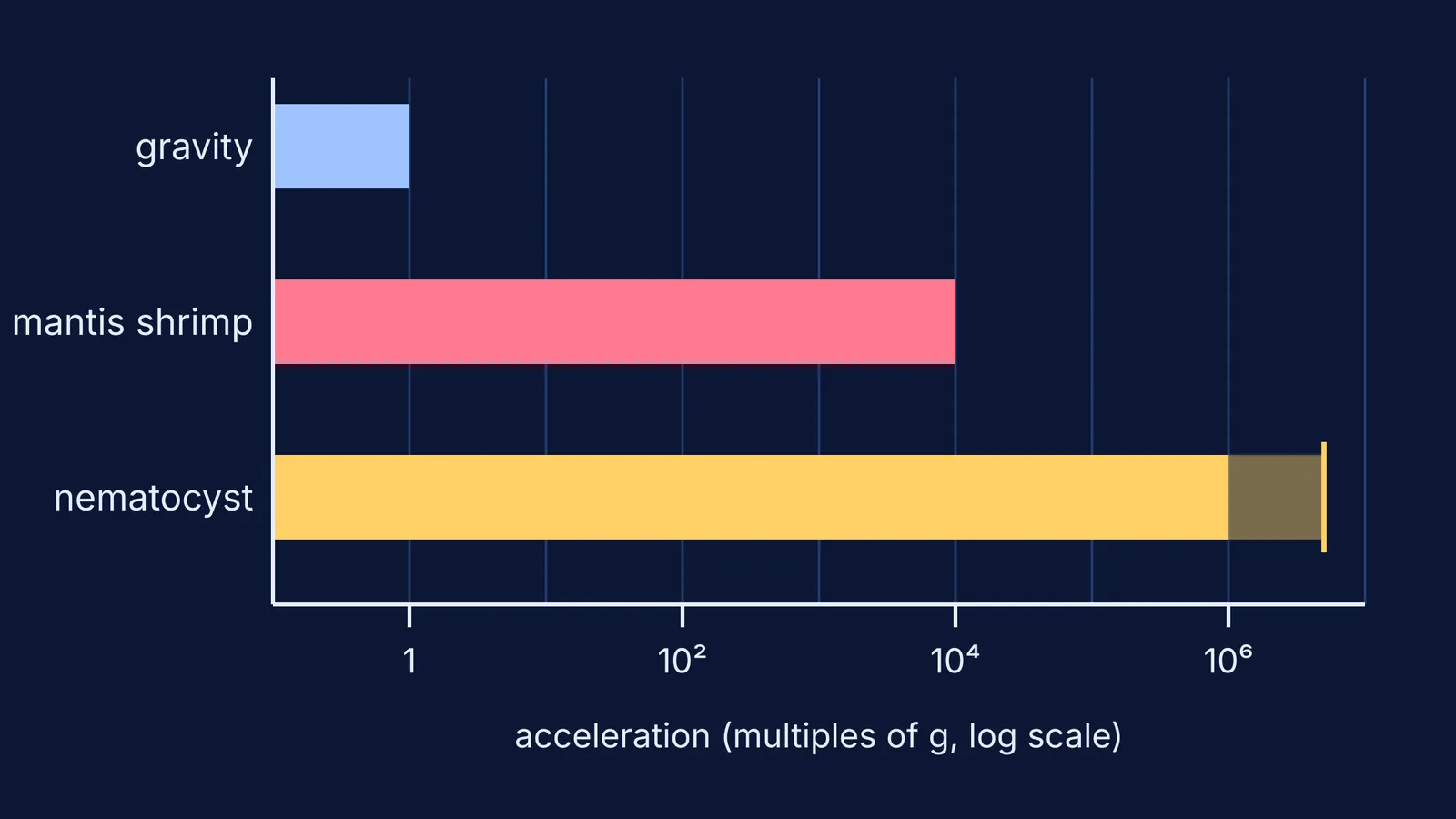
Its acceleration was 1 to 5 million times the acceleration due to gravity (g).
The same JEB summary compares this with the mantis shrimp, whose strike is famous for speed and reaches more than 10,000 g. The nematocyst's acceleration is roughly 500 times greater.
Notice what is not extreme here. A final speed of 25 m/s is about as fast as a car on a highway. What is extraordinary is how little time the stylet takes to get there.
What pressure is inside a nematocyst capsule?
Researchers studying Hydra describe the driving force for discharge as "an extreme osmotic pressure of 150 bar" (Garg and colleagues, iScience, 2023). Osmotic pressure builds when a closed compartment holds far more dissolved material than its surroundings, so water pushes to get in.
An earlier study from overlapping research groups found that discharge involves volume changes of the highly pressurised capsule of up to 50% (Beckmann and colleagues, BMC Biology, 2015). The same study identified Cnidoin, a fast-recoiling, silk-like elastic protein built into the capsule walls and tubules, which the authors propose stores and releases kinetic energy during discharge: the wall acts like a stretched spring as well as a pressure vessel.
Can you check these numbers yourself?
Yes, with Class 11 kinematics. Use the measured values from the JEB summary and the pressure from Garg and colleagues, and convert everything to SI units first.
Average speed from distance and time: v = d/t = (13 × 10⁻⁶ m) / (7 × 10⁻⁷ s) ≈ 19 m/s. The reported average is about 14 m/s; the published figures are rounded averages, so expect agreement only in order of magnitude.
Acceleration needed to reach 25 m/s within 700 ns: a = Δv/Δt = 25 / (7 × 10⁻⁷) ≈ 3.6 × 10⁷ m/s². Divide by g = 9.8 m/s² and you get about 3.6 million g, inside the reported range of 1 to 5 million g.
Reverse check: at 5 million g, a ≈ 4.9 × 10⁷ m/s², so reaching 25 m/s takes t = v/a ≈ 5.1 × 10⁻⁷ s, about 510 ns. That fits inside the 700 ns window.
Distance check: with steady acceleration of 3.6 × 10⁷ m/s², reaching 25 m/s takes s = v²/2a = 625 / (7.2 × 10⁷) ≈ 9 × 10⁻⁶ m, about 9 µm. The measured 13 µm is the same order.
Pressure in everyday terms: 150 bar = 150 × 10⁵ Pa = 1.5 × 10⁷ Pa. On one square millimetre (10⁻⁶ m²) that is a force of 15 N, about the weight of a 1.5 kg mass.
Two honest limits. Steps 2 and 4 assume steady acceleration, which a real discharge does not have, so the peak value can be higher than the average you calculate. And the figures are lab measurements of specific capsules, not constants for every cnidarian.
Why does this matter for NEET and board biology?
Cnidarians take their name from these stinging cells, and the phylum's features are easy to mix up. If you are revising it, read our explainers on whether mesoglea counts as a germ layer and why a jellyfish is mostly water, then test yourself with common animal kingdom mistakes in NEET Biology.
The bigger habit is checking any striking number in biology the way you just did:
Convert to SI before you divide or multiply.
Recompute one quantity from the others.
Ask whether a figure is an average or a peak.
If you want more practice turning a stated fact into a calculation, the Fermi Problem Library has worked problems with a step-by-step solver that explains the reasoning rather than printing an answer. For the ideas underneath, such as osmosis, pressure and acceleration, each has its own lesson in the Fermi Concept Library.
Next time you see a jellyfish, picture a few hundred nanoseconds and a 150-bar capsule, then try the arithmetic again from memory.