On this page
In the sea, a jellyfish looks like a solid animal. Stranded on a beach, it slumps and shrinks to a thin wet film. Both facts come from the same design choice: a jellyfish builds most of its body out of seawater.
What is the mesoglea in a jellyfish?
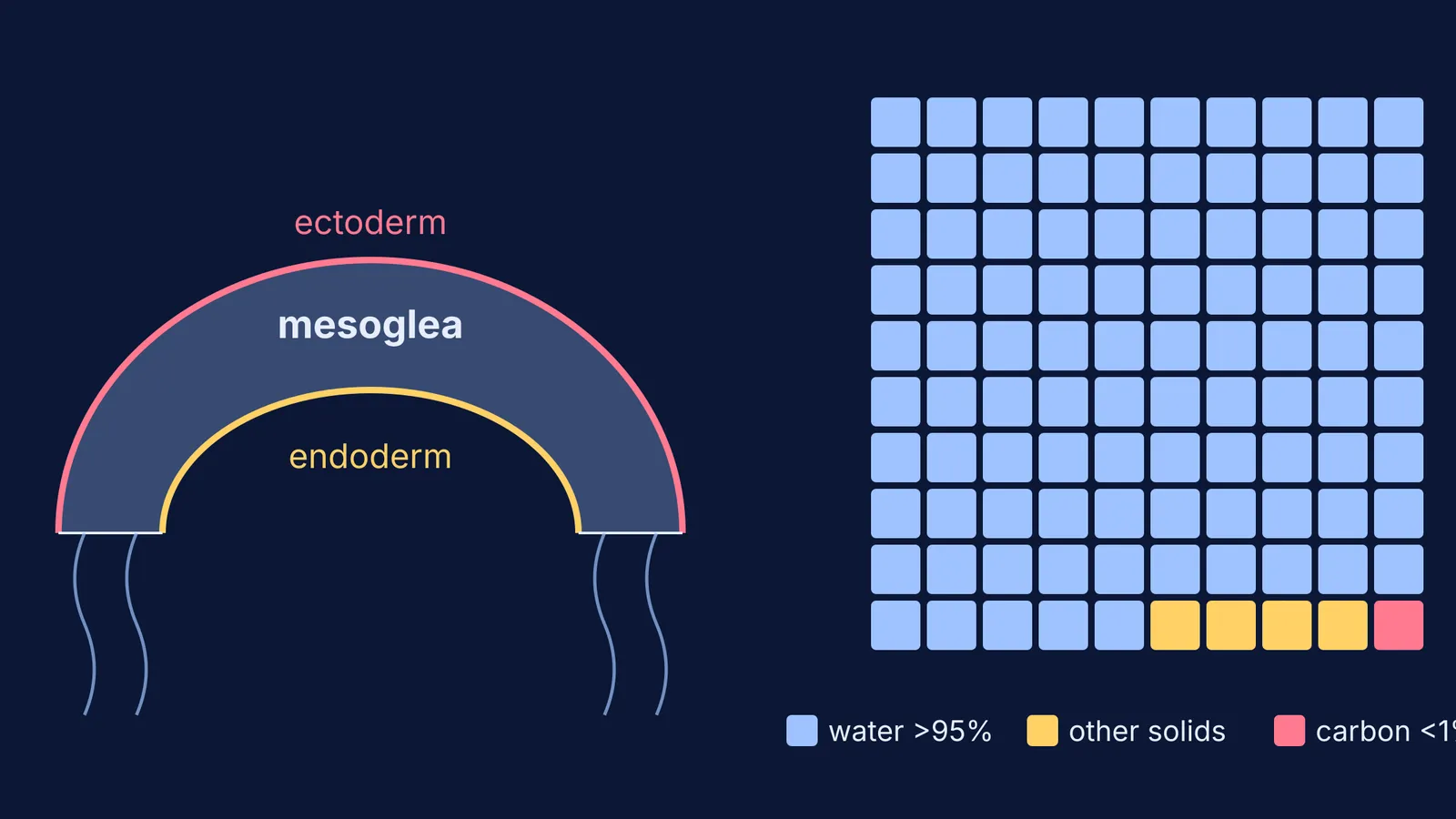
Jellyfish belong to Cnidaria, and the OpenStax Biology 2e chapter on Cnidaria describes them as diploblastic: they develop from two embryonic layers, ectoderm and endoderm. The outer layer (from ectoderm) covers the animal, and the inner layer (from endoderm) lines the digestive cavity.
A non-living, jelly-like mesoglea lies between these two layers, according to the same OpenStax chapter. Our guide to diploblastic and triploblastic animals compares the two body plans.
In a jellyfish, the mesoglea is not a thin glue line. It is most of the animal. A 2013 PLOS ONE paper by Kylie Pitt and colleagues says the bulk of the body is mesoglea, "a robust extracellular matrix that comprises water, collagen fibres and salts". The paper adds that the mesoglea gives structural support and is elastic, so it can work as a hydrostatic skeleton.
Why is a jellyfish body made of 95 percent water?
The same Pitt et al. paper puts the numbers plainly: jellyfish have "very high water (>95%) and low carbon (usually <1% of wet weight)" content. There are three reasons this pays off.
1. It is cheap to build. Living cells cost food and energy to make and run. The mesoglea contains few cells in scyphozoans (true jellyfish) and none in hydrozoans, so "its metabolic demand is small", the Pitt et al. paper notes. The authors also explain that because the body is mostly water and has so few cells, jellyfish can grow much faster than animals that must build new tissue to get bigger.
2. It makes the animal big for its budget. Pitt and colleagues found jellyfish were 3.2 times larger in diameter than other open-water animals with the same carbon content (PLOS ONE, 2013). A bigger bell sweeps more water for prey. A 2011 Science paper by José Luis Acuña and colleagues, titled "Faking giants", reports that jellyfish process prey at the same rates as fish.
3. It floats with little effort. A body that is mostly seawater is close to the density of seawater, so the jellyfish needs little effort to stay up. Some species also adjust the ions in their jelly: Newton and Potts (1993) found that *Obelia* medusae keep magnesium and sulphate ions out of their mesoglea. An earlier paper by Bidigare and Biggs (1980)90193-0) examined sulphate exclusion as a way of keeping gelatinous animals buoyant. Why near-equal density means near-zero apparent weight is Archimedes' principle, which our explainer on why objects weigh less in water works through.
Why do jellyfish shrink to almost nothing on the beach?
On sand, the water that made up the jelly drains and evaporates, and there is little else left to hold the shape. A hydrostatic skeleton works only while it is full of water.
Here is a worked example using the published figures. Take a 500 g jellyfish stranded on a beach.
Water is more than 95% of its mass (Pitt et al., 2013), so more than 475 g is water.
That leaves less than 25 g of dry matter: salts, collagen and the thin cell layers.
Carbon is usually under 1% of wet weight, so under 5 g of the whole animal is carbon.
Compare non-gelatinous animals. In those groups, carbon is 30-60% of dry mass, while in jellyfish it is typically under 15%, according to the dataset by Cathy Lucas and colleagues in Ecology (2011). So most of the little dry matter a jellyfish leaves is not carbon, and the salts from the mesoglea make up part of it. That is why a big jellyfish on the sand can end up as a faint film.
How do you explain this in an exam answer?
Use a three-step chain. A strong answer links structure to function instead of stopping at the definition.
Structure: two cell layers, ectoderm and endoderm, with mesoglea between them.
What it is made of: mostly water with collagen fibres and salts, and few or no cells.
Why it helps: cheap to grow, large body for little carbon, close to the density of seawater, but it collapses and dries when stranded.
Also keep jellyfish separate from comb jellies. Both are watery, but they are different phyla. Our Cnidaria vs Ctenophora comparison lists the differences.
If the germ layers keep blurring together, the Fermi Concept Library gives each biology concept its own lesson and shows its place in the map. If density and floating are hard to picture, the Fermi Simulation Lab has interactive simulations for ideas that are easier to see than to read.