

On this page
Every animal starts as a single cell. As that fertilised egg cell divides, the growing embryo eventually folds in on itself during a process called gastrulation to create distinct sheets of cells. These sheets are known as germ layers, and they serve as the biological blueprint for the organism. Over time, these layers grow and differentiate into every tissue and organ in the adult body.
In biology—and particularly when studying animal diversity for exams like NEET-UG—animals are classified by how many of these germ layers they form. The divide between having two layers (diploblastic) or three (triploblastic) marks one of the most important leaps in evolutionary history. It separates simpler organisms that rely on diffusion from complex animals capable of building true organ systems.
What is a diploblastic animal?
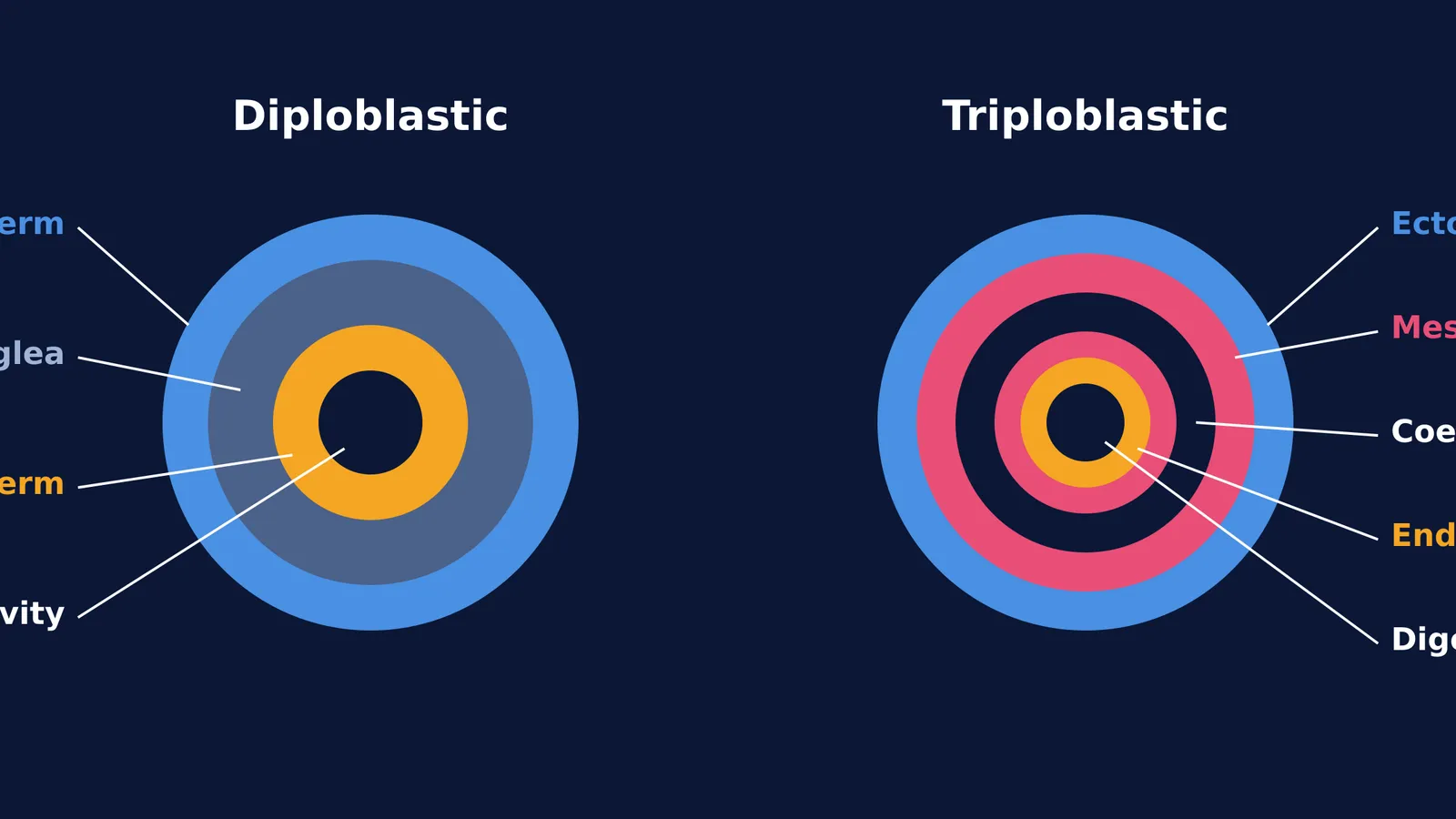
Diploblastic animals develop from exactly two embryonic germ layers:
Ectoderm: the outer layer. In diploblastic animals, this develops into the epidermis (the animal's outer covering) and a very basic nervous network.
Endoderm: the inner layer, which lines the gastrovascular cavity and handles digestion.
Instead of a cellular third layer, diploblastic animals have a jelly-like, mostly non-cellular matrix separating the inside and outside called the mesoglea. Because they lack a true cellular middle layer, these animals cannot form complex organs or a body cavity (coelom). They rely instead on simpler tissue-level organization. For example, without a circulatory system, they depend heavily on direct diffusion through the water to absorb oxygen and remove waste.
Which phyla are diploblastic?
The classic examples of diploblastic animals belong to two ancient phyla:
Cnidaria: This includes aquatic animals like *Hydra*, jellyfish, sea anemones, and corals.
Ctenophora: Commonly known as comb jellies, these marine predators are structurally similar but use tiny, ciliated combs to swim.
What is a triploblastic animal?
Triploblastic animals possess three germ layers. A 2003 review by Technau and Scholz outlines how the evolutionary addition of a cellular third layer—the mesoderm—gave rise to the complex organs we see in all bilaterian animals (2003 review).
Ectoderm: forms the outer skin, hair, and the complex central nervous system, including the brain.
Mesoderm: the new middle layer, which develops into muscles, bones, cartilage, the circulatory system, and kidneys.
Endoderm: forms the lining of the digestive gut and the respiratory tract, as well as associated organs like the liver.
The mesoderm provides the solid, living tissue needed to build true, functional organs. It allows for complex muscle systems that enable active, directed movement. Most importantly, the mesoderm splits to form a coelom—a fluid-filled internal body cavity that safely houses and cushions these new organs.
Once you understand how the mesoderm sets up internal systems, you can explore how different animal lineages handle those systems. For example, you can look at why waste differs across ammonotelic, ureotelic and uricotelic animals, or how the mesoderm eventually builds the formed elements of blood in complex animals.
Which phyla are triploblastic?
Every animal phylum from Platyhelminthes (flatworms) all the way up the evolutionary tree to Chordata (which includes fish, birds, and humans) is triploblastic.
Even though flatworms are triploblastic, they are acoelomate, meaning their mesoderm is solid and lacks a true cavity. As you move further up the taxonomic ladder, the mesoderm creates a distinct coelom. Other common triploblastic phyla include annelids (earthworms), arthropods (insects, crabs, and spiders), molluscs (snails and octopuses), and echinoderms (starfish and sea urchins).
Keeping the classifications straight
When you are learning animal classification for an exam, memorising which phylum has which features can feel like reading a dictionary. To succeed, you need to connect the anatomical feature (like germ layers) to the evolutionary advantage it provides (like the ability to build organs). If you are struggling to keep these phyla straight, the Fermi Concept Library places all these evolutionary milestones into a clear visual map, showing exactly where each phylum fits and why it evolved that way.
To check your understanding of these examples, try applying them to real questions in the Fermi Problem Library. The AI tutor will help you work through assertion-reasoning problems step by step, rather than just printing the answer for you.


