

On this page
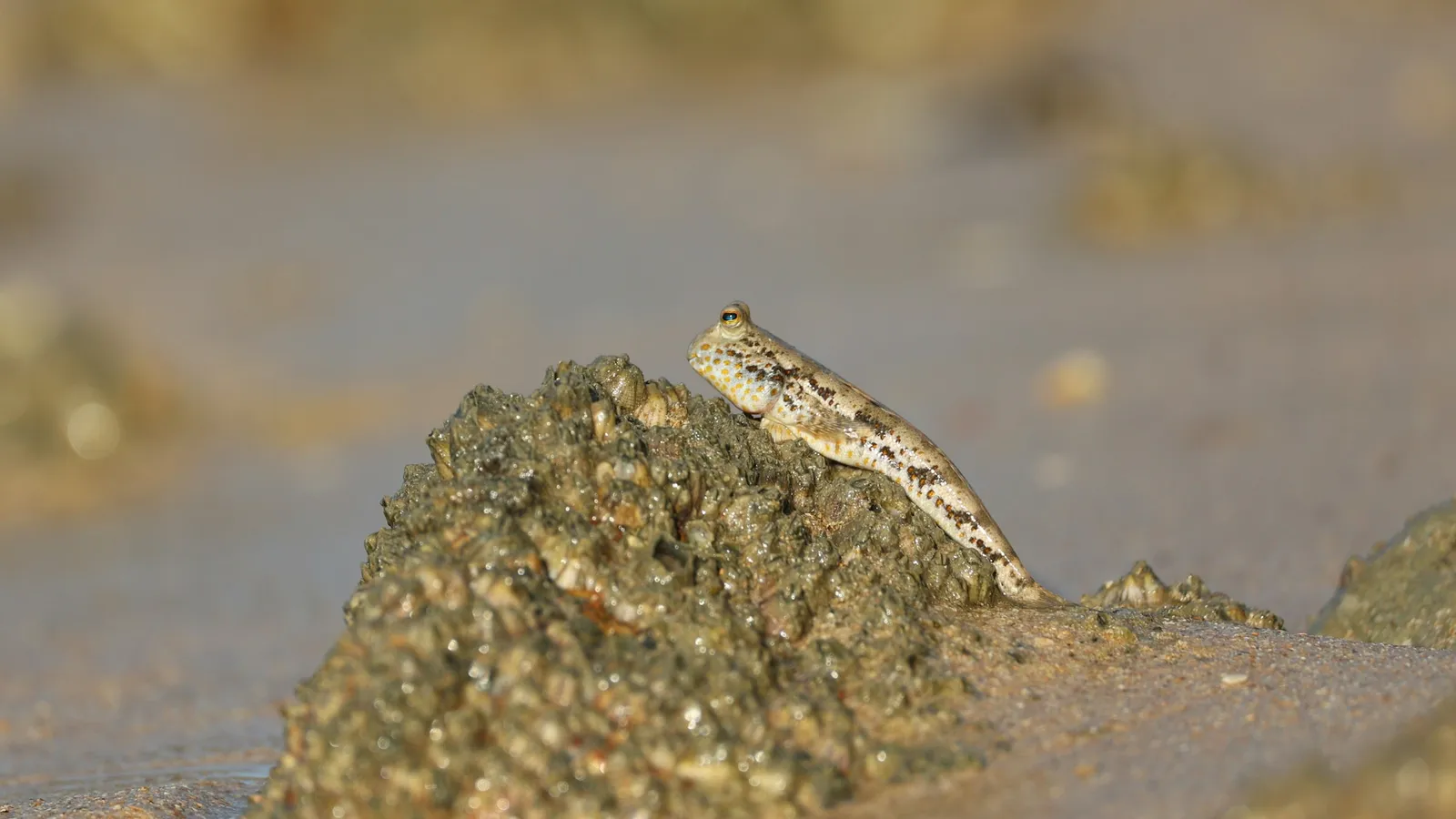
Stand by a village pond in May and you may see the water go still and green, many fish gasping at the surface, and a few that seem unbothered: magur, the climbing perch (koi) and, on the coastal mud, mudskippers. They carry a second set of breathing equipment that works in air.
Why would a fish want to breathe air?
Because air holds far more oxygen than water. An FAO aquaculture manual on the chemical features of water gives the solubility of oxygen in fresh water as 7.539 mg per litre at 30 °C, and notes that a fish has to pump a larger amount of a much heavier medium through its gills to get enough oxygen.
Here is the worked example, using the ideal gas law and the 21% oxygen in air (figure from the Aqu@teach respiration physiology module):
Partial pressure of oxygen in air at sea level: 0.21 × 101,325 Pa = 21,278 Pa.
Moles per cubic metre at 30 °C (303 K): 21,278 ÷ (8.314 × 303.15) = 8.44 mol.
Mass: 8.44 × 32 g = 270 g per cubic metre, which is 270 mg per litre.
Compare with water at the same temperature: 270 ÷ 7.54 ≈ 36.
So a litre of air at 30 °C carries about 36 times as much oxygen as a litre of fully saturated water.Our post on Henry's law and dissolved air explains why gases dissolve this way.
What extra breathing organs do magur, climbing perch and mudskippers have?
Magur (Clarias batrachus)
A 2021 histology study in Animals by Adamek-Urbańska and colleagues describes the dendritic organ of clariid catfish as a tree- or shrub-like structure with an elastic cartilage core. It forms near the second and fourth gill arches; the smaller part sits in the gill cavity and the larger part in the suprabranchial cavity above the gills. The paper calls these catfish facultative air-breathers. The walking catfish genome paper (Li and colleagues, BMC Genomics, 2018) adds that the species lives in low-oxygen swamps and wetlands, burrows into mudflats in summer, and can pull itself across land with its pectoral fins to reach new water.
Climbing perch (Anabas testudineus)
The climbing perch has accessory breathing organs in the upper part of its gill chambers, and it is an obligate air-breather: a 2017 Journal of Experimental Biology paper by Chen and colleagues notes they gave their tanks no aeration because the climbing perch is an obligate air-breather. A 2006 study by Tay and colleagues records that the climbing perch lives in rivers, canals, swamps and stagnant water and can face air exposure in the dry season.
Mudskippers (Periophthalmus and relatives)
Mudskippers lean on their skin. A 2022 study in Applied Microscopy by Dorostghoal and colleagues cites earlier measurements (Tamura and colleagues, 1976) that Periophthalmus cantonensis took 48% of its oxygen through the skin in water and 76% in air. Comparing two other mudskippers, the same study found that capillaries sit closer to the skin surface in the highly land-living Periophthalmus waltoni than in Boleophthalmus dussumeri, which suggests its skin is better suited to gas exchange.
Why do these fish survive in muddy ponds where others die?
A warm, weedy pond swings between plenty of oxygen and almost none. The Noble Research Institute explains that dissolved oxygen is highest in the afternoon and lowest just before dawn, because at night plants and animals all use oxygen, and warm water cannot hold as much as cold water. The FAO manual describes a sharp fall toward morning, often to near complete depletion.
Gills alone have nothing to fall back on at that hour. Magur and koi can gulp air, and mudskippers can breathe through damp skin. A 2023 study in Proceedings of the Royal Society B by Aaskov and colleagues notes that air-breathing has evolved independently more than 80 times in fish, on a spectrum from obligate air-breathers that drown without air to facultative ones that use air only when the water's oxygen falls too low. For why water-breathers must work so hard in the first place, see why aquatic animals breathe faster.
How do you write this up for NEET-UG and board exams?
Use this four-line frame for any "accessory respiratory organ" question:
Problem: warm, stagnant water holds little oxygen, lowest before dawn.
Organ: name it and place it (dendritic organ in the suprabranchial cavity; accessory organs in the upper gill chamber; vascular skin).
Example: magur, climbing perch, mudskipper.
Type: facultative (magur) or obligate (climbing perch) air-breather.
For practice, redo the 36-times calculation at 25 °C, where the FAO table gives 8.244 mg per litre for water.
If the link to fish circulation is still hazy, our post on why fish have a two-chambered heart fills it in. To see respiration, diffusion and gas laws side by side, the Fermi Concept Library gives every concept in biology and chemistry its own lesson and its place in the map.


