

On this page
Watch a fish in an aquarium and its mouth and gill covers hardly ever stop. NCERT's Class 10 chapter Life Processes explains why in one sentence. Here we put numbers on that sentence and turn it into a board answer.
How much oxygen is in water compared with air?
Dry air is 20.95% oxygen by volume, according to NASA's Earth fact sheet.
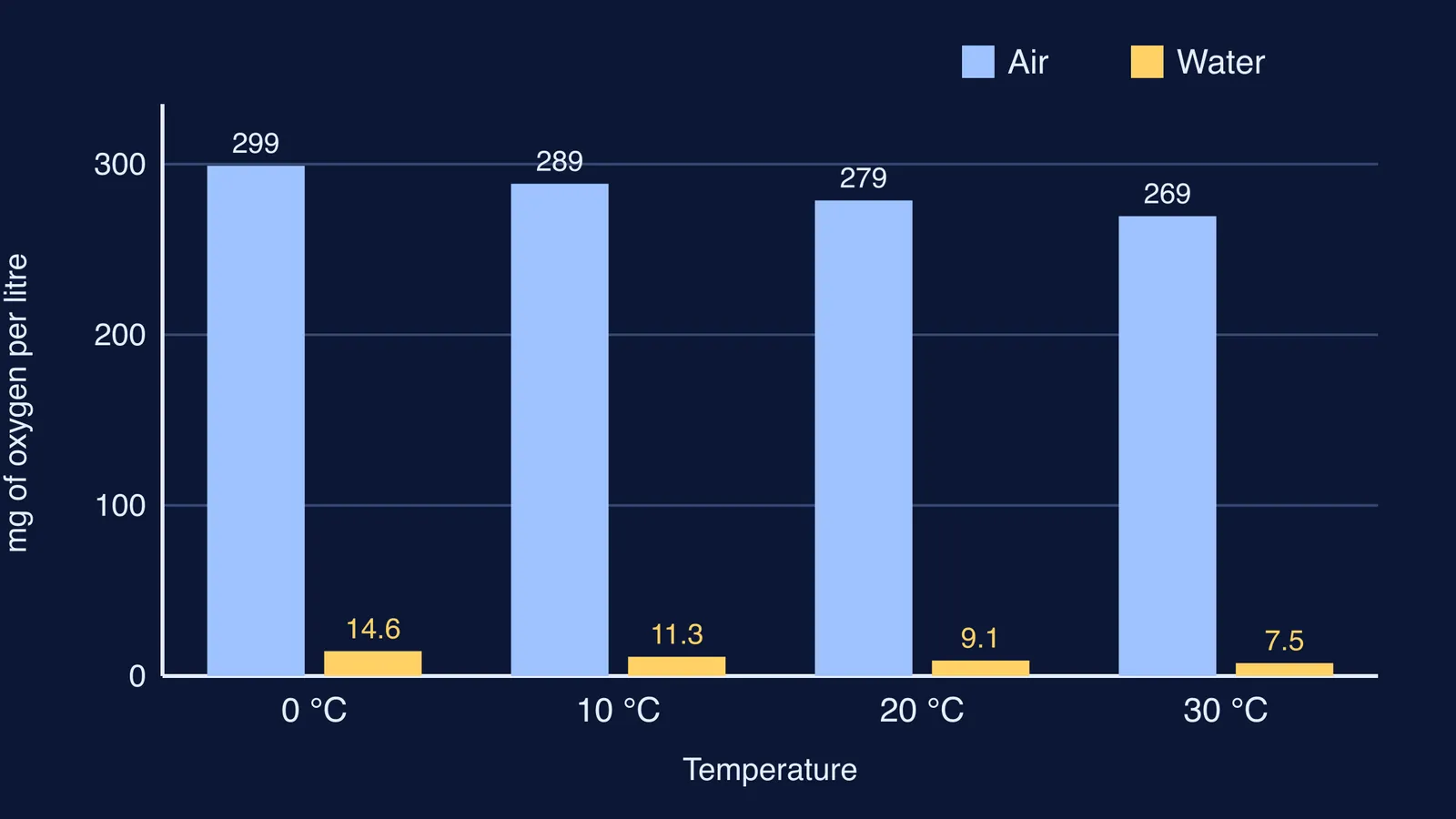
Fresh water saturated with air holds only 9.08 mg of oxygen per litre at 20 °C and 8.24 mg per litre at 25 °C, according to the solubility table in an FAO guide to the chemical features of water.
How many times more oxygen does a litre of air hold?
Worked example for one litre at 25 °C, using the NASA and FAO figures above.
One litre of air contains 0.2095 L of oxygen (20.95% of 1 L).
At 25 °C and normal atmospheric pressure, one mole of any gas takes up about 24.5 L, so that is 0.2095 ÷ 24.5 = 0.00855 mol of oxygen.
The molar mass of oxygen gas is 32 g/mol, so the mass is 0.00855 × 32 = 0.274 g, or about 274 mg.
A litre of air-saturated fresh water at 25 °C holds 8.24 mg (the FAO table above).
Ratio: 274 ÷ 8.24 ≈ 33.
Run the same steps at 20 °C and you get about 31; at 30 °C, where the FAO table gives 7.54 mg per litre, you get about 36. So at room temperature, a litre of air carries roughly 30 times as much oxygen as a litre of water. The gap widens as water warms because cold water holds more dissolved oxygen than warm water, as the USGS Water Science School explains. Natural water can hold far less than the saturated figure: the USGS defines water with less than 2 mg/L of oxygen as hypoxic.
Why do aquatic animals breathe faster than land animals?
NCERT gives the reason directly: "Since the amount of dissolved oxygen is fairly low compared to the amount of oxygen in the air, the rate of breathing in aquatic organisms is much faster than that seen in terrestrial organisms" (NCERT Class 10 Science, Chapter 5). The same page explains that fishes take in water through their mouths and force it past the gills, where the dissolved oxygen is taken up by blood.
The logic is simple. An animal needs a certain amount of oxygen every minute, and each mouthful of water brings only a small share of what the same volume of air would. So it must move far more water across its gills, with faster breathing movements. The FAO guide adds a second cost: the fish "has to pump through its gills relatively a larger amount of the medium, which is much heavier too" (FAO).
How do you write this as a board answer?
The question often comes in one of two forms: "Why is the rate of breathing in aquatic organisms much faster than in terrestrial organisms?" or NCERT's "What advantage over an aquatic organism does a terrestrial organism have with regard to obtaining oxygen for respiration?" For two or three marks, write three linked points:
Aquatic organisms use the oxygen dissolved in water, while terrestrial organisms use the oxygen in the atmosphere.
The amount of dissolved oxygen in water is very low compared with the amount of oxygen in air (roughly 30 times less per litre at room temperature, from the FAO solubility table and the worked example above).
So, to get enough oxygen, aquatic organisms must pass a much larger volume of water over their gills, and their rate of breathing is much faster.
For the advantage version, end with: "Terrestrial organisms get oxygen-rich air, so they do not need to breathe as fast to obtain the oxygen they need."
Check your answer for these common slips:
Writing "water has less oxygen" without the word dissolved. Every water molecule contains oxygen atoms; the marks are for dissolved oxygen gas.
Leaving out the "so" that links low oxygen to faster breathing.
Giving a different reason, such as fish being smaller or more active.
Stating the ratio as exact. Say "roughly", because it changes with temperature.
If the mole step in the worked example is the part that trips you up, the Fermi Problem Library has worked problems with a step-by-step solver that explains the reasoning rather than printing an answer.
How can you see it for yourself?
Try NCERT's Activity 5.6. At an aquarium, count how many times one fish opens and closes its mouth in a minute, then count how many times you breathe in and out in a minute. Write both numbers next to your three-point answer.
The same low-oxygen fact turns up again in ecology questions. Read why fish die in ponds during hot summers and how BOD values separate clean water from polluted water. For the land-animal side of breathing, see why we cannot hold our breath for long. And if you want to see where gas exchange sits next to diffusion, solubility and respiration, the Fermi Concept Library gives every concept in biology and chemistry its own lesson and its place in the map.


