

On this page
In the human nervous system, speed is fundamentally a matter of survival. The difference in conduction velocity between a myelinated and an unmyelinated axon is the difference between instantly dropping a burning hot pan and feeling a slow, dull ache hours after an injury. To understand how our bodies send these rapid signals, you have to look at the physical structure of the nerve fibres.
What is the difference between saltatory and continuous conduction?
The core difference between the two types of nerve fibres lies in how the electrical signal, known as the action potential, travels along the axon membrane.
Unmyelinated nerve fibres rely on continuous conduction. In these fibres, the axon membrane is entirely exposed to the extracellular fluid. To propagate a signal, voltage-gated sodium channels must open and close sequentially, step by step, down the entire length of the nerve. Every time a segment of the membrane depolarises, it triggers the adjacent segment to do the same. Because this ion exchange physically takes time at every micrometre of the journey, continuous conduction is relatively slow and metabolically expensive.
Myelinated nerve fibres, by contrast, use a much more efficient method called saltatory conduction. The axon is wrapped in a thick myelin sheath—created by Schwann cells in the peripheral nervous system or oligodendrocytes in the brain and spinal cord. This sheath acts as a powerful biological insulator. It is interrupted at regular intervals by tiny, uninsulated gaps known as the nodes of Ranvier, which are densely packed with sodium channels.
Instead of flowing continuously, the electrical signal "jumps" from one node to the next. Because the time-consuming process of opening ion channels and exchanging ions only happens at these specific nodes, the action potential moves down the axon much faster.
Visualising this jumping mechanism from a static textbook diagram can be difficult. The Fermi Simulation Lab provides interactive simulations for the ideas that are easier to see than to read, allowing you to watch the action potential leap between nodes and compare its speed directly against a continuous wave.
How fast are myelinated vs unmyelinated nerves?
The presence of myelin drastically changes the maximum speed a nerve can achieve. According to textbook benchmarks, unmyelinated axons typically conduct signals at speeds of just 0.5 to 10 m/s (NCBI Bookshelf). These slow fibres, often called C-fibres, are perfectly adequate for functions where split-second timing is not required, such as regulating digestion or transmitting chronic, aching pain.
In contrast, myelinated axons can reach conduction velocities of up to 150 m/s (NCBI Bookshelf). This means the fastest myelinated nerves are roughly 15 times faster than the absolute fastest unmyelinated nerves.
Myelin acts exactly like the protective rubber coating on a copper wire, which you might recognise when comparing conductors and insulators in physics. By increasing the membrane's electrical resistance, myelin stops the electrical current from leaking out into the surrounding tissue. Furthermore, it decreases the membrane capacitance, meaning less charge is required to change the voltage across the membrane. This forces the local current to flow passively and rapidly down the inside of the axon to the next node.
How do you predict nerve conduction speed from diameter?
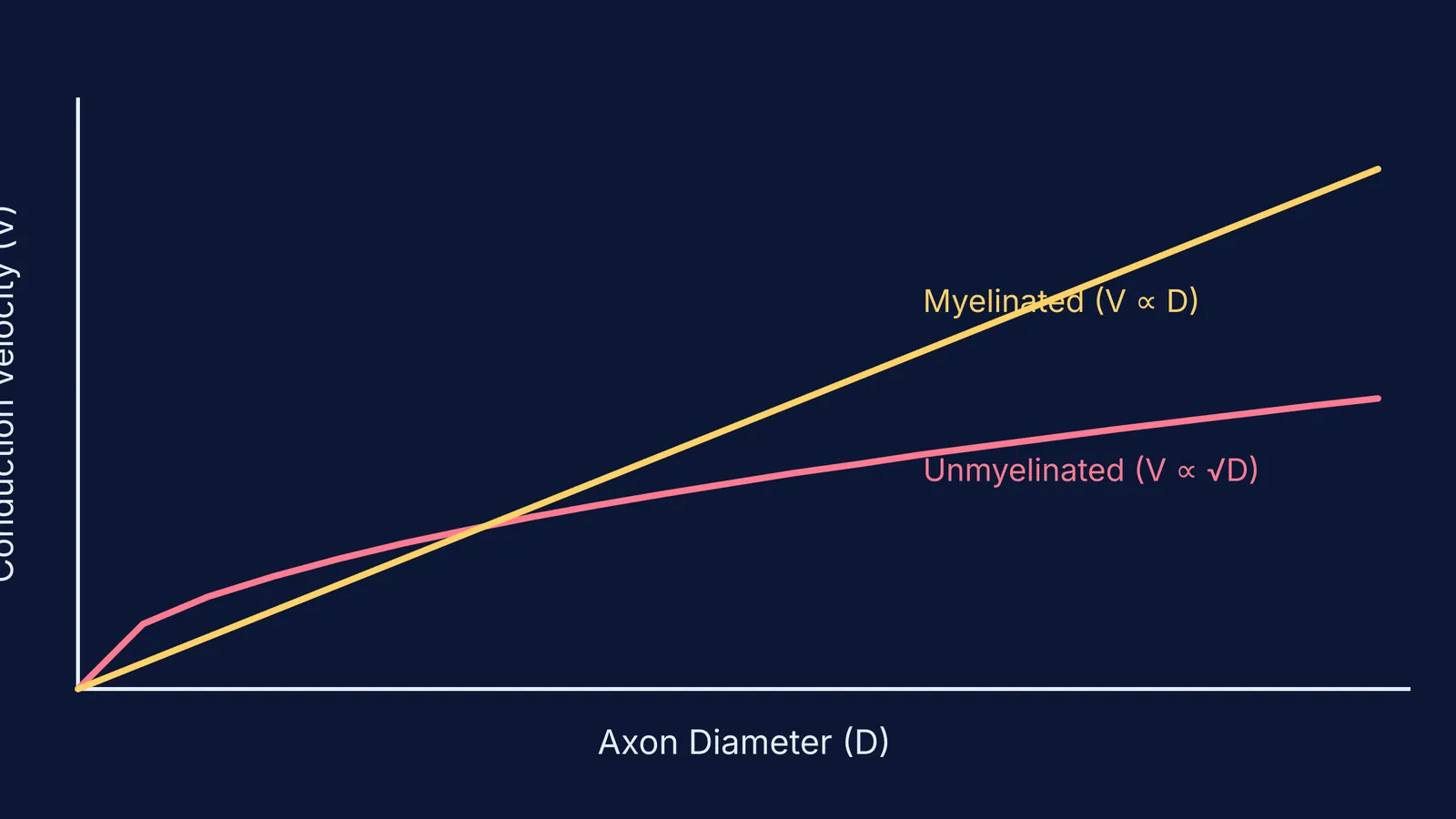
Beyond the simple presence of myelin, an axon's physical diameter (D) is the most critical factor in predicting its speed (V). In physics, a wider pipe allows water to flow with less resistance, and a wider axon allows electrical current to flow with less internal resistance. However, the mathematical rules for how diameter affects speed differ fundamentally between the two types of fibres (Akaishi et al., 2017):
Myelinated speed is proportional to diameter: For a myelinated axon, the relationship is linear (V ∝ D). If you double the axon's diameter, the conduction velocity roughly doubles.
Unmyelinated speed is proportional to the square root of diameter: For an unmyelinated axon, the relationship is a square-root curve (V ∝ √D). If you want to double its speed, you must quadruple its diameter.
This square-root rule explains why myelin is such a profound evolutionary advantage. Certain invertebrates, like the squid, rely on unmyelinated nerves for their escape reflexes. To achieve fast signal speeds, the squid evolved an exceptionally thick "giant axon".
If humans relied purely on unmyelinated nerves to conduct signals at 100 m/s, our spinal cords would need to be physically massive—potentially the width of a tree trunk—to accommodate the necessary axon diameters. By wrapping a much thinner axon in myelin, the human body achieves incredibly high speeds while saving vital anatomical space. Because the electrical activity is confined strictly to the gaps, the body also concentrates the energy density in the electric field at the nodes of Ranvier, saving the metabolic energy that would otherwise be spent pumping ions back and forth along the entire nerve.


