On this page
Two neurons can talk in two ways. In one, current flows straight from one cell into the next. In the other, the first cell releases a chemical that the second cell has to detect. Your NCERT chapter covers both in two short paragraphs, and small words in them matter: faster, rare, cleft. Here are the four differences side by side, with the sources behind each one.
What is the difference between electrical and chemical synapses?
NCERT defines a synapse as the junction formed by the membranes of a pre-synaptic and a post-synaptic neuron, "which may or may not be separated by a gap called synaptic cleft" (NCERT Class 11 Biology, Chapter 18). That "may or may not" is the whole difference in a few words.
At an electrical synapse, the two membranes are very close and current flows directly from one neuron into the other (NCERT, Chapter 18). The connection is usually a gap junction, and in mammals these junctions are mostly made of a protein called connexin36 (Curti and colleagues, Biology, 2022).
At a chemical synapse, a fluid-filled synaptic cleft separates the membranes. Vesicles in the axon terminal release neurotransmitters, which bind to receptors on the post-synaptic membrane and open ion channels (NCERT, Chapter 18).
Here is how the two compare:
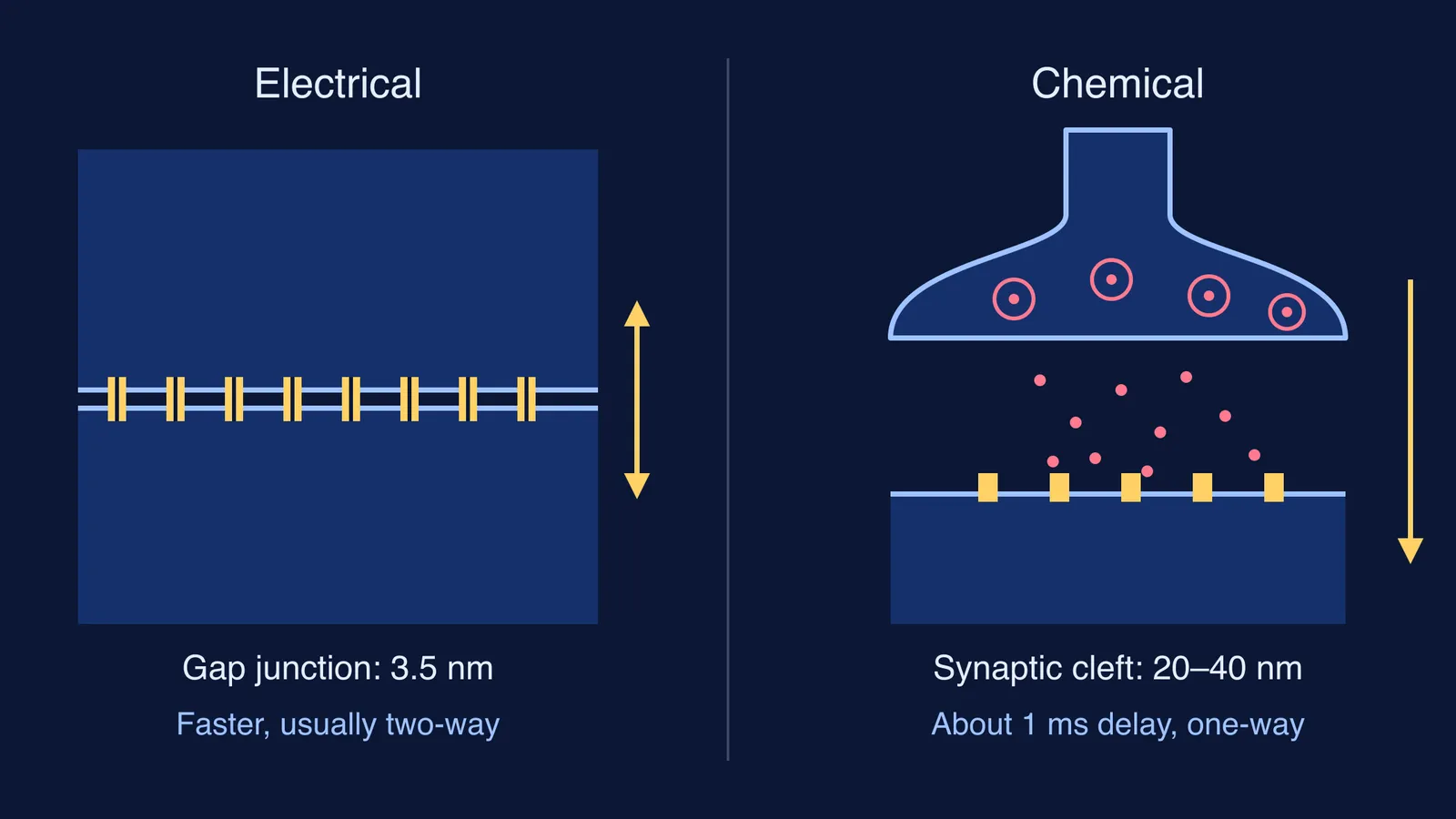
Gap width: gap junctions are about 3.5 nm across, while chemical synapses span 20–40 nm (Schirrmacher, International Journal of Molecular Sciences, 2025). The chemical cleft is roughly 6 to 11 times wider.
Speed: signalling at an electrical synapse is virtually instantaneous, while a chemical synapse has a delay of about one millisecond (OpenStax Biology 2e).
Direction: chemical signalling is one-way, from the pre-synaptic to the post-synaptic cell. Electrical transmission is typically two-way (Curti and colleagues, 2022), though OpenStax words it carefully: some electrical synapses are bidirectional.
How common: electrical synapses are fewer in number than chemical ones, but they are found in all nervous systems (OpenStax Biology 2e).
The diagram at the top of this page draws both gaps to the same scale, so you can see the size difference for yourself.
Which synapse is faster, and why?
The electrical synapse is faster. NCERT says transmission across an electrical synapse "is very similar to impulse conduction along a single axon" and "is always faster than that across a chemical synapse" (NCERT, Chapter 18).
The reason is the number of steps. Current crosses a gap junction directly. A chemical signal has to wait for vesicles to move, fuse and release transmitter, which then crosses the cleft and binds a receptor. A 2022 review of mammalian electrical synapses says the latency for spike transmission is usually below 1 ms (Curti and colleagues). OpenStax adds that this speed matters for synapses involved in key reflexes, and that electrical synapses help synchronise the activity of a group of neurons (OpenStax Biology 2e).
To see each chemical step in order, read our explainer on how a synapse transmits a nerve impulse.
Which synapse does NCERT say is more common?
The exact line is: "Electrical synapses are rare in our system" (NCERT Class 11 Biology, Chapter 18, page 234). So in your answer, chemical synapses are the common kind.
Researchers add some nuance. A 2022 review notes that both kinds of transmission coexist in most regions of the mammalian brain, and that the contribution of electrical synapses has historically been underestimated (Curti and colleagues). That fits with "fewer, but everywhere". For a school or NEET-UG answer, stick with NCERT's wording.
How do you write the answer in an exam?
For a "differentiate" question, write one line per point, electrical first and chemical second, using the figures above (Schirrmacher, 2025; OpenStax Biology 2e):
Structure: membranes very close, joined by gap junctions (about 3.5 nm), versus a fluid-filled synaptic cleft (20–40 nm).
Mechanism: current flows directly, versus neurotransmitters released from vesicles that bind receptors.
Speed and direction: faster and usually two-way, versus slower (about 1 ms delay) and one-way.
Occurrence: rare in our system, versus the common type.
Now test yourself. A statement says: "At a chemical synapse, current flows directly from the pre-synaptic to the post-synaptic neuron." It is false, because direct current flow describes the electrical synapse. The chemical synapse passes its signal through neurotransmitters, and the new potential they produce can be excitatory or inhibitory (NCERT, Chapter 18). Inhibition has its own history, told in our piece on John Eccles and the synapse that tells a neuron to stop.
If the chemical steps still feel muddled, the Fermi Concept Library gives each biology concept its own lesson and shows its place in the map. To practise questions that mix these ideas, try the Fermi Problem Library, whose step-by-step solver explains the reasoning rather than printing an answer.