On this page
A nerve impulse is electrical, but most synapses are chemical and cannot pass electricity across. The sending cell turns the signal into chemicals for a moment, and the receiving cell turns them back into electricity. The process makes more sense if you step through it like a simulation, one frame at a time.
What happens at a synapse, step by step?
Here is the sequence at a chemical synapse, following the open textbook OpenStax Anatomy and Physiology.
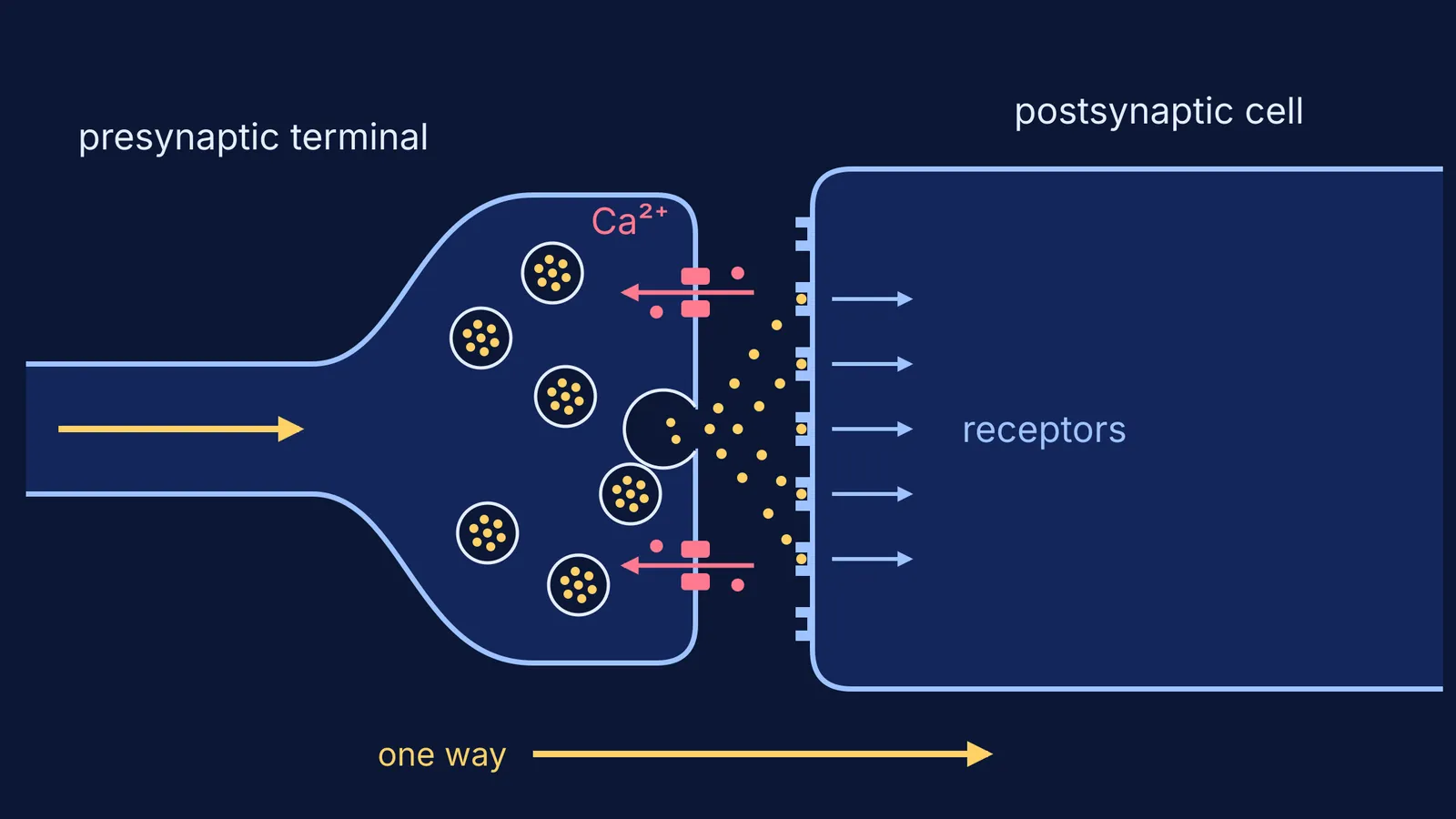
The impulse arrives. An action potential reaches the axon terminal, the swollen end of the sending (presynaptic) neuron.
Calcium gets in. The voltage change opens voltage-gated Ca2+ channels in the terminal membrane, and calcium ions flow into the terminal.
Vesicles fuse. Calcium helps vesicles full of neurotransmitter merge with the membrane, releasing their contents into the synaptic cleft by exocytosis.
Transmitter binds. The neurotransmitter diffuses the short distance across the cleft and binds to receptors on the receiving (postsynaptic) membrane.
The next cell responds. Some receptors are ligand-gated ion channels. Once they open, the postsynaptic membrane depolarises (an excitatory signal) or hyperpolarises (an inhibitory one).
The signal is cleared. Acetylcholine is broken down by the enzyme acetylcholinesterase; other transmitters, including amino acids, are taken back up by neurons or glial cells (reuptake).
Step 6 matters more than students expect. A synapse that could not clear its transmitter would stay switched on and could not send the next message clearly.
How fast does a synapse transmit a signal?
Fast. Thomas Südhof's review in Neuron says that calcium entering a terminal during an action potential triggers neurotransmitter release in less than a millisecond (Südhof, 2013). The same review explains how: RIM proteins help dock and prime vesicles at the release site and recruit calcium channels to the same spot, so calcium can flow straight from the channels to the sensor protein synaptotagmin. When calcium binds synaptotagmin, it triggers the machinery that fuses the vesicle with the membrane.
Measurements put real numbers on this. Working at rat cerebellar synapses at physiological temperature, Sabatini and Regehr found that postsynaptic responses began just 150 microseconds after the presynaptic action potential started, and that vesicle fusion lagged calcium entry by only 60 microseconds (Sabatini and Regehr, Nature, 1996). OpenStax Biology gives a rounder textbook figure for chemical synapses: a delay of about one millisecond between the impulse reaching the terminal and the postsynaptic channels opening.
Why do signals at a synapse go only one way?
Chemical synaptic signalling is unidirectional, as OpenStax Biology puts it. The reason is in the layout. The vesicles of transmitter, and the calcium channels that trigger their release, sit on the presynaptic side. The receptors that can read the transmitter sit on the postsynaptic side. If the receiving cell fires, it has no vesicles at that junction to release, and the sending terminal has no receptors there to detect anything. The parts face one way, so the signal can only travel one way.
Electrical synapses are the useful contrast. The same OpenStax chapter notes that signalling in electrical synapses is virtually instantaneous and some of them are bidirectional, because the two cells are joined by gap junctions that let current pass directly from one cell to the next. Chemical synapses give up a little speed and in return get a one-way signal that can excite or inhibit the next cell.
How can you run a synapse simulation in your head?
A good way to check you understand a mechanism is to break it on purpose and predict what happens. Cover the answers, say your prediction out loud, then check.
Calcium channels blocked. Prediction: the impulse still reaches the terminal, but with no calcium entry the vesicles do not fuse and nothing is released. The signal stops at step 2.
Acetylcholinesterase blocked. Prediction: acetylcholine is not broken down, so it lingers in the cleft and keeps acting on receptors for longer. Step 6 fails.
The receiving neuron fires first. Prediction: nothing crosses back, because there are no vesicles on that side to release and no receptors on the sending side to bind. This is the one-way rule.
Swap in an electrical synapse. Prediction: current passes directly between the cells, there is almost no delay, and at some electrical synapses the signal can travel in either direction.
If you are revising for a biology exam, a three-line answer to 'why is synaptic transmission unidirectional?' can follow the same logic: neurotransmitter is stored in vesicles only in the presynaptic terminal; receptors are present only on the postsynaptic membrane; so transmitter can only be released from one side and detected on the other.
Watching the steps move often helps more than one more read of the diagram. The Fermi Simulation Lab has interactive simulations for ideas that are easier to see than to read, and if a single term like exocytosis or depolarisation is holding you up, the Fermi Concept Library gives each concept its own lesson.
Next time you see the textbook diagram, read it left to right in this order: impulse, calcium, vesicles, binding, response, clearing.