On this page
Most students read an NCERT chapter like a story, start to finish, then reread it before the test. A major review of study techniques rates rereading as low utility (Dunlosky and colleagues, Psychological Science in the Public Interest). SQ3R is a short routine that replaces it, and below we run it on one real chapter, minute by minute.
What is the SQ3R method?
SQ3R stands for survey, question, read, recite and review, a textbook study system that Francis P. Robinson set out in his 1946 book Effective Study (ERIC record of a history of textbook study systems). That history says it is held to be “the most widely advocated textbook study system”.
Survey: skim the chapter's skeleton before reading it.
Question: turn each heading into a question.
Read: read one section at a time, hunting for the answer.
Recite: close the book and write the answer from memory.
Review: test yourself on the whole chapter, today and again later.
Does SQ3R actually work?
The strongest evidence is for its last two steps rather than the package as a whole. A 2013 review of 10 learning techniques rated practice testing and distributed practice as high utility, and rereading and highlighting as low utility, advising “practice testing instead of rereading” (Dunlosky and colleagues, Psychological Science in the Public Interest). Recite is practice testing on yourself. Review spread over days is distributed practice.
In a 2006 experiment, students who recalled a prose passage remembered more of it 2 days and 1 week later than students who reread it, though rereading won on a test given after 5 minutes (Roediger and Karpicke, Psychological Science). A 2011 study on science texts found that retrieval practice produced more learning than drawing concept maps (Karpicke and Blunt, Science). So if you are short of time, shorten the survey. Never cut recite.
How do you use SQ3R on an NCERT chapter?
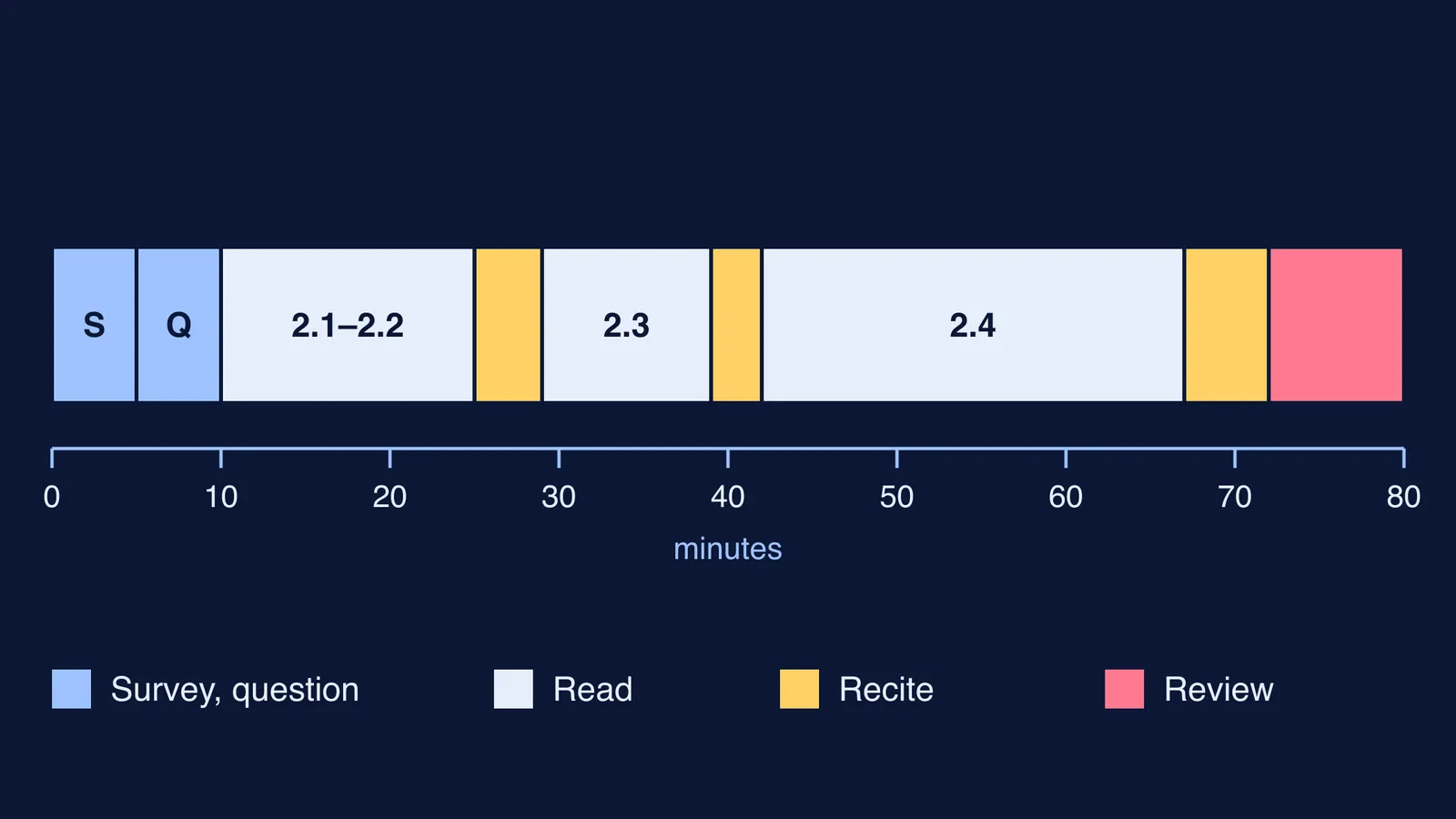
Take NCERT Class 11 Physics, Chapter 2: Motion in a Straight Line. In the 2026-27 reprint, the text runs from section 2.1 to 2.4 over pages 13 to 26, with 7 worked examples, a Summary, Points to Ponder and 18 exercises. Allow about 80 minutes for the first sitting.
Survey (5 minutes). Read the section headings, bold terms and figure captions, then the Summary and Points to Ponder.
Question (5 minutes). Write one per heading: “How is instantaneous velocity different from average velocity?”, “What does the area under a v-t graph give?”, “When can I use v = v0 + at, and when can't I?”
Read 2.1 and 2.2 (15 minutes), then recite (4 minutes). Book shut, write the definition of instantaneous velocity and explain why the last column of Table 2.1 settles near one number.
Read 2.3 (10 minutes), then recite (3 minutes). From memory, sketch the x-t graphs for positive, negative and zero acceleration.
Read 2.4 and Examples 2.2 to 2.7 (25 minutes), then recite (5 minutes). Write the three kinematic equations and the one condition they need: constant acceleration.
Review (8 minutes). Answer all your questions on a blank page, check them against the Summary, and circle what you missed.
The next day, spend 10 minutes answering the questions cold, then try a few exercises. Repeat a week later. If an idea such as velocity as the limit of Δx/Δt still doesn't land after two reads, the Fermi Concept Library covers every concept in physics, chemistry, biology, mathematics and computing, each with its own lesson.
What goes on a printable SQ3R worksheet?
Copy this onto one A4 sheet per chapter, leaving space under each line:
Chapter, pages and date of the first sitting
Three things the Summary says matter most
My questions, one per heading
Answers from memory for each chunk, written before checking
What I got wrong or left out, in a different colour
Next-day and one-week review dates, each with a tick box
Exercises tried, and which ones went wrong
The “got wrong” line matters most. It becomes your list for the next review, so you stop rereading what you already know.
When does SQ3R not fit?
SQ3R is built for chapters with headings, so it suits a first reading of NCERT theory. Once you move on to problem practice for board exams or JEE Main, the exercises become your recite step. If you keep picking the right formula but reaching the wrong answer, the Fermi Problem Library has a step-by-step solver that explains the reasoning rather than printing an answer.
Pick one chapter this week, print the worksheet and time your first sitting.