On this page
Chapter 1 of the new Class 8 Social Science book asks when something in nature becomes a resource, and how we can keep using it without using it up.
The chapter opens *Exploring Society: India and Beyond*, Part I (code hees1; First Edition July 2025, reprinted March 2026), per the NCERT prelims. CBSE publishes no separate 2026-27 curriculum for Classes 6 to 8, which follow the NCERT book; the chapter is assessed by the school.
When does nature become a resource?
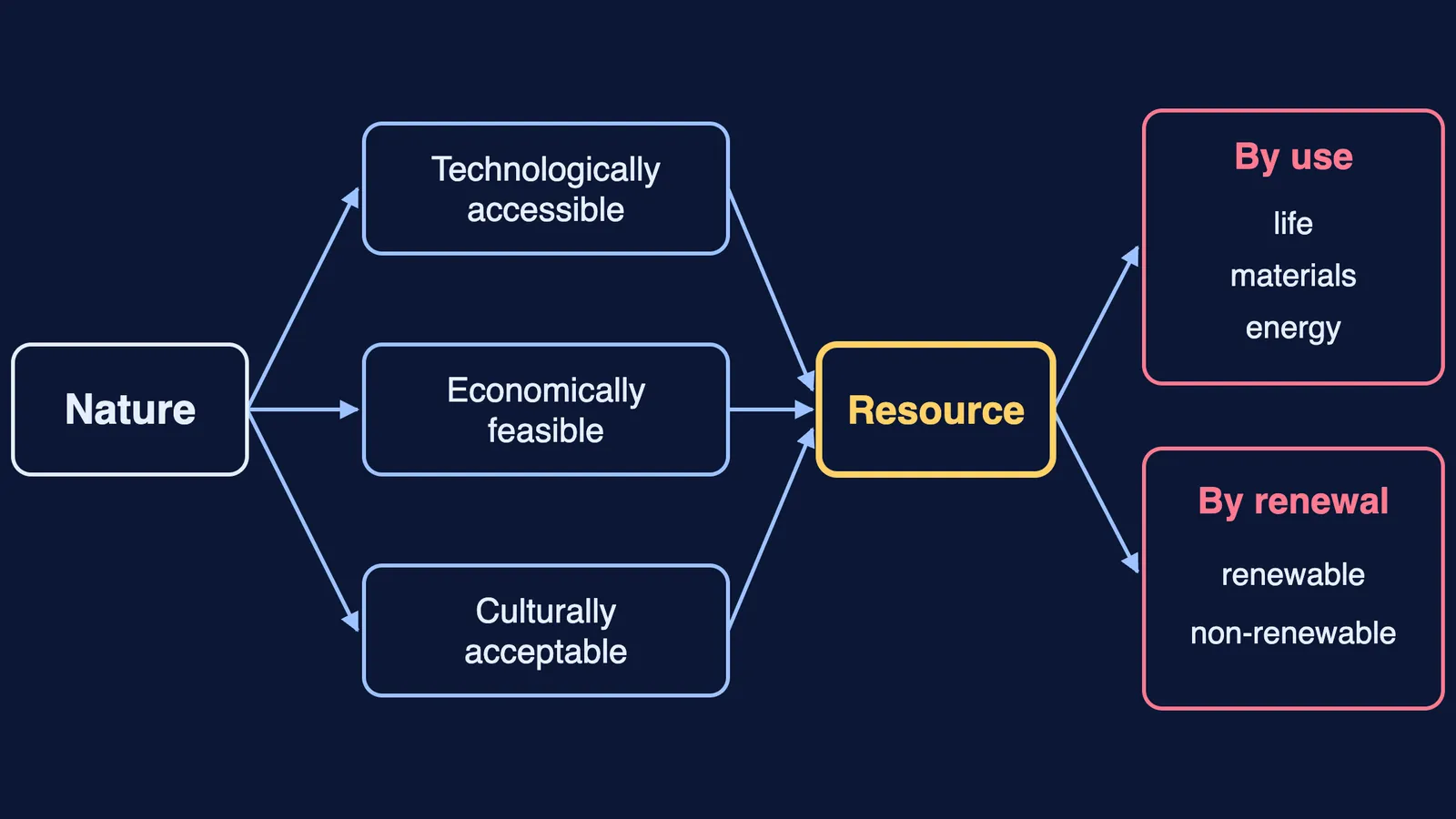
The chapter defines natural resources as things found in nature that people find valuable (NCERT Chapter 1). A tree becomes a resource when we use it, say for furniture.
The book then sets three conditions. To count as a resource, something must be reachable with the technology we have, worth extracting at a sensible cost, and acceptable to the culture around it. Oil too deep under the ocean fails the first test; trees in a sacred grove fail the third.
What are the categories of natural resources?
Resources are sorted two ways (NCERT Chapter 1).
By use: essential for life (air, water, food), for materials (wood, marble, gold) and for energy (coal, sunlight, wind).
By renewal: renewable and non-renewable.
Renewable resources such as sunlight, wind, flowing water and timber stay renewable only if nature can restore and regenerate them. Cut timber faster than the forest regrows and it runs out. Non-renewable resources such as coal, petroleum, iron and gold form over very long periods and cannot be replaced as fast as we use them. The chapter notes an estimate that India's coal reserves may last another 50 years (NCERT Chapter 1).
The book also separates ecosystem functions (a forest filters water) from ecosystem services (the clean water people get). It adds that one mature tree gives off about 275 litres of oxygen daily, against a person's need of about 350, (NCERT Chapter 1); the book notes both figures vary. By our arithmetic, a family of four needs about 1,400 litres, roughly five trees' output (1,400 ÷ 275 ≈ 5.09).
Why does the distribution of resources matter?
Resources are spread unevenly, and the chapter links this to where people settle, trade, relations between countries and even wars. Nearby industries bring jobs, but have sometimes displaced local people.
Rivers cross borders too: the book's example is Kaveri water, shared by Karnataka, Tamil Nadu, Kerala and Puducherry through careful negotiation (NCERT Chapter 1).
The chapter also introduces the "paradox of plenty" (the "natural resource curse"): being resource-rich does not automatically make a country rich. The book says India has generally avoided it by building industries that add value, and points ahead to Chapter 7, Factors of Production.
What do the Punjab and Sikkim caselets teach?
Two caselets show stewardship, the chapter's word for responsible use (NCERT Chapter 1).
Punjab: thirsty high-yielding crops and free power led to over-pumping, and farm chemicals reached the groundwater. Almost 80% of Punjab's area is now classed as "over-exploited", and in a large part of the state groundwater has become inaccessible down to depths of about 30 metres.
Sikkim: a farm family switches to compost and natural repellents; yields dip, then recover after about five years. In 2016 Sikkim became fully organic, and the book reports farm incomes rising 20% on average.
The chapter also covers cement pollution, Vṛikṣhāyurveda (a traditional plant science) and solar energy.
Worked example: is this well still renewable?
A fictional town, with our own numbers. Rain refills the town's aquifer by 60 lakh litres a year. Farms and homes pump out 75 lakh litres a year. About 120 lakh litres are stored underground.
Yearly gap: 75 − 60 = 15 lakh litres more taken out than put back.
Time left at these rates: 120 ÷ 15 = 8 years before the store is empty.
The town harvests rooftop rainwater (+10 lakh litres of recharge) and cuts wasteful use by 8 lakh litres, both strategies from the chapter. Recharge becomes 70, pumping becomes 67.
New balance: 70 − 67 = +3 lakh litres a year. The store stops shrinking, so the groundwater can renew itself.
The same water was renewable or running out depending on the balance between use and recharge, which is the Punjab lesson.
How can you practise this chapter?
These questions are our own; the mark labels are our suggestion.
Give one example each of something failing the technology, cost and culture tests. (3 marks)
Sort each item both of the book's ways (life, materials or energy; renewable or non-renewable): wind, copper, timber, petroleum, river water. (3 marks)
Explain the paradox of plenty and say what helps a country avoid it. (3 marks)
A town takes 50 units of groundwater a year and rain adds 40. Suggest two steps from the chapter to close the gap. (5 marks)
For extra practice from the old NCERT book, see our Resources Class 8 guide and land, soil, water and wildlife notes. For the Class 9 book, see Life on Earth.
Not sure where to begin your revision? Fermi's AI tutor works out what you already know and builds a plan for the session.