

On this page
Questions from the Class 8 chapter Resources test three skills: defining a resource, sorting things into the right type, and explaining conservation. This guide follows the NCERT chapter and adds a four-question sorting test.
What is a resource in Class 8 geography?
NCERT's definition is short: "Anything that can be used to satisfy a need is a resource" (NCERT, Resources and Development, Chapter 1). Two ideas make something a resource: utility (it can be used) and value (it is worth something).
Value is not always money. Metals may have economic value and a beautiful landscape may not, but both meet human needs. Time and technology can also turn a substance into a resource: fast-flowing water became one once people could make hydroelectricity from it.
A common one-mark trap from the exercises: quantity does not make something a resource. Utility and value do.
What are the types of resources?
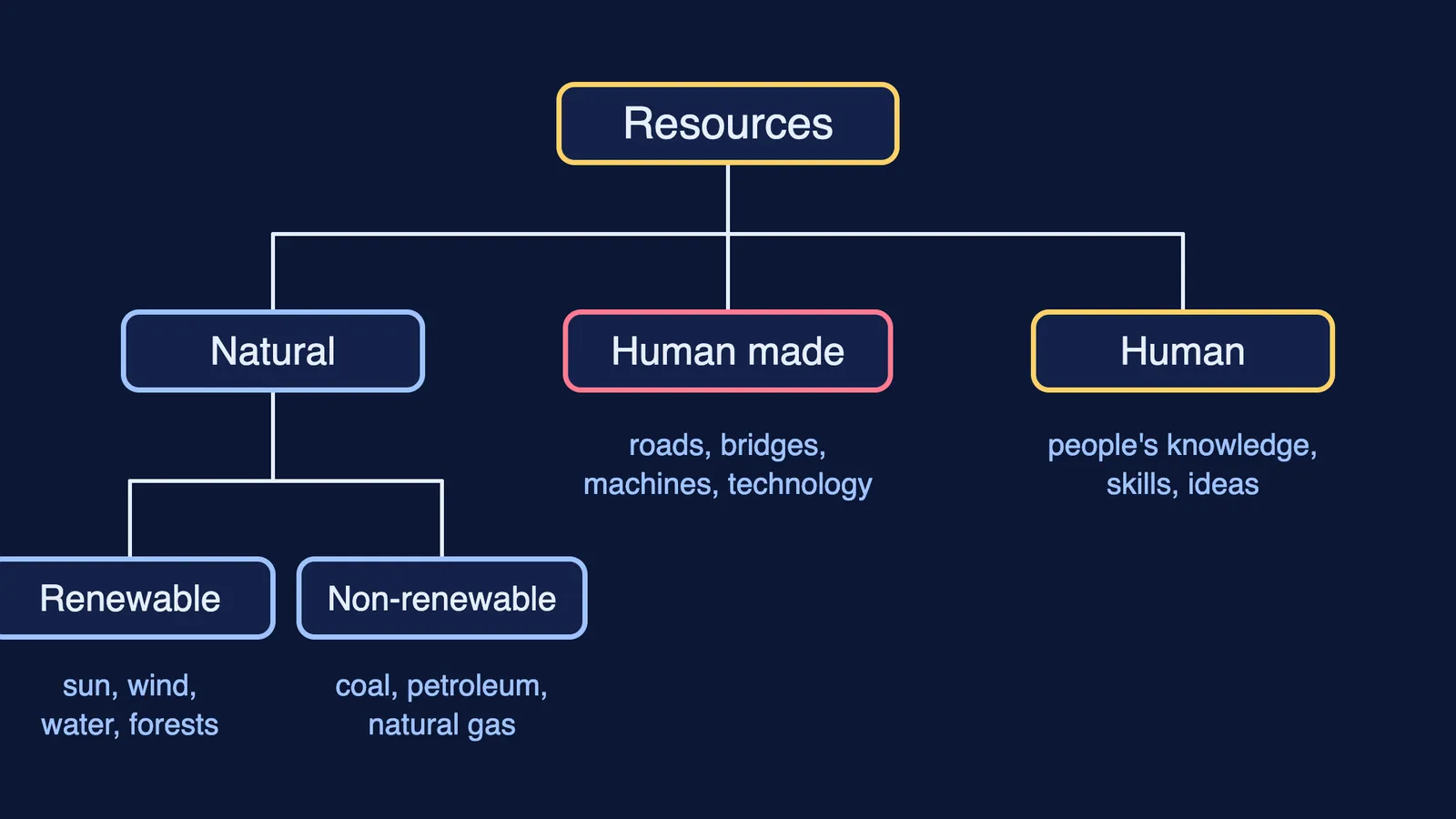
NCERT classifies resources into three groups: natural, human made and human (NCERT Chapter 1).
Natural resources are drawn from nature and used without much modification, such as air, river water, soil and minerals.
Renewable resources are natural resources that get renewed or replenished quickly, such as solar energy, wind, water, soil and forests.
Non-renewable resources have a limited stock. Once used up, they may take thousands of years to replenish. Coal, petroleum and natural gas are examples.
Human made resources are things people make by changing natural substances, such as buildings, bridges, roads, machinery and vehicles. NCERT counts technology here too.
Human resources are people, with their knowledge, skills and the technology they know how to use. Education and health make people a more valuable resource.
Two details students miss: renewable does not mean unlimited, since careless use can shrink the stock of water, soil and forests; and natural resources are spread unequally because terrain, climate and altitude differ across the earth.
How do you classify a resource into its type?
Ask questions 1 to 3 in order and stop at the first yes; a yes to question 3 leads on to question 4.
Is it a person's skill, knowledge or ability? Then it is a human resource.
Did people change it from its natural form to make it? Then it is human made.
Is it taken from nature and used much as it is? Then it is natural.
Does it replenish quickly, or will its stock run out? Quick means renewable. A limited stock means non-renewable.
Here is the test worked on six items:
Water in a village pond: natural, renewable, though its stock can fall if it is overused.
Coal in a mine: natural, non-renewable.
Sunlight on a rooftop: natural, renewable, and not affected by human use.
A steel bridge: human made, because people changed iron ore into steel to build it.
A medicine that treats cancer: human made (a question straight from the textbook exercises).
A farmer's knowledge of soil: human resource.
Our guides to environment and its components in Class 7 and resources and development in Class 10 cover the chapters before and after this one.
What is sustainable development and how do we conserve resources?
NCERT defines resource conservation as using resources carefully and giving them time to get renewed. It defines sustainable development as balancing the need to use resources with conserving them for the future (NCERT Chapter 1).
The idea has an international history too. In 1987 the United Nations Brundtland Commission defined sustainability as "meeting the needs of the present without compromising the ability of future generations to meet their own needs" (United Nations Academic Impact).
The chapter lists six principles of sustainable development, which make a ready long answer:
Respect and care for all forms of life.
Improve the quality of human life.
Conserve the earth's vitality and diversity.
Minimise the depletion of natural resources.
Change personal attitude and practices towards the environment.
Enable communities to care for their own environment.
For a question on how you can conserve resources, NCERT names reducing consumption, recycling and reusing. Add a home example for each: switching off fans you are not using, recycling old newspaper, carrying a cloth bag.
How should you revise this chapter?
Make one page with the five definitions, the six principles and the four-question test, then quiz yourself on objects at home. The forest and wildlife resources guide for Class 10 shows where the conservation ideas go next.
How solar panels or hydroelectric plants actually work is physics. The Fermi Concept Library has a lesson for every concept in physics, chemistry, biology, mathematics and computing. If you are unsure where to begin, Fermi's AI tutor can work out what you already know and build a plan for the session.


