On this page
National Income Accounting teaches you to measure a whole economy in one number. This guide covers the full chapter, with an original solved example for each method and for real GDP.
What does CBSE keep in this chapter for 2026-27?
The CBSE Economics curriculum for 2026-27 gives Unit 1, National Income and Related Aggregates, 10 marks. Those 10 marks are shared with "What is Macroeconomics?", so no separate figure exists for this chapter alone. Its topics include:
final and intermediate goods, stocks and flows, depreciation
the two-sector circular flow and the value added, expenditure and income methods
GDP, NDP, GNP and NNP at market price and factor cost
real and nominal GDP, the GDP deflator, and GDP and welfare
Your textbook is Chapter 2 of NCERT's Introductory Macroeconomics, marked "Reprint 2026-27".
What is the circular flow of income?
In NCERT's simple model, households supply land, labour, capital and entrepreneurship to firms and earn rent, wages, interest and profit. They spend all of it on the firms' goods, so the money returns to firms as sales revenue, with no saving, government or foreign trade.
You can therefore measure the flow at three points: spending on final goods (expenditure method), value of goods produced (value added method) or factor payments (income method). NCERT's chapter shows all three give the same GDP.
Income and output are flows, measured over a period; capital is a stock, measured at a point of time. Only final goods count: adding intermediate goods counts the same value twice.
How do the three methods give the same GDP? A solved example
All figures are for one imaginary economy in ₹ crore.
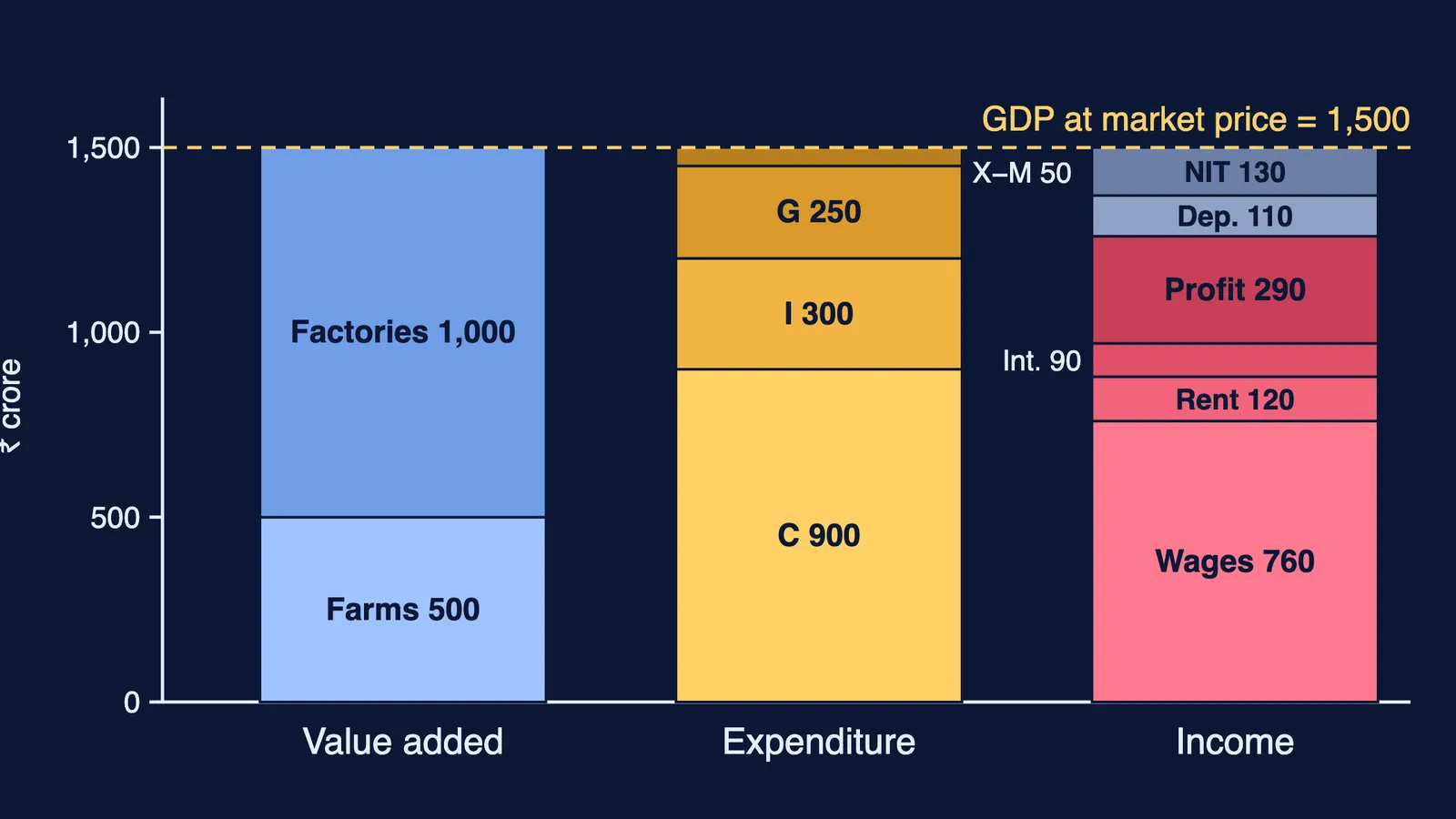
1. Value added method. Farms produce output of 700 using inputs of 200; factories produce 1,700 using inputs of 700. Value added is 500 + 1,000, so GDP at market price (GDPMP) = 1,500.
2. Expenditure method. Consumption C = 900, investment I = 300, government G = 250, exports X = 180, imports M = 130. GDPMP = C + I + G + X − M = 900 + 300 + 250 + 180 − 130 = 1,500.
3. Income method. Wages 760, rent 120, interest 90 and profit 290 add to 1,260. That is NDP at factor cost. Add depreciation of 110 and net indirect taxes (indirect taxes − subsidies) of 130: 1,260 + 110 + 130 = 1,500.
How do you move between GDP, GNP, NDP and NNP?
NCERT's Table 2.4 links the aggregates with three adjustments. Gross to net: subtract depreciation. Domestic to national: add net factor income from abroad (NFIA). Market price to factor cost: subtract net indirect taxes (NIT).
Take NFIA = −20 in our economy:
GNPMP = 1,500 − 20 = 1,480
NNPMP = 1,480 − 110 = 1,370
NNPFC, or national income = 1,370 − 130 = 1,240
Check: NDPFC + NFIA = 1,260 − 20 = 1,240. NCERT notes that since January 2015 India's headline measure is GDP at market prices.
For longer data tables, see our step-by-step guide to national income numericals.
Why is real GDP different from nominal GDP?
Nominal GDP values output at current prices; real GDP uses base-year prices, so it changes only when output changes. The GDP deflator is nominal ÷ real GDP, often × 100.
Say an economy makes 100 units of A at ₹20 and 50 units of B at ₹40: nominal GDP ₹4,000. Next year: 120 units at ₹25 and 60 at ₹45: nominal GDP ₹5,700. At base prices that is 120 × 20 + 60 × 40 = ₹4,800.
Nominal GDP grew 42.5%, but real GDP grew only 20%.
GDP deflator = 5,700 ÷ 4,800 × 100 = 118.75, so prices rose about 19%.
The 2026-27 marking scheme calls real GDP the better growth measure because it removes price change.
What questions come from this chapter, and how should you answer?
The 2026-27 sample paper tests this unit as a 1-mark assertion-reason item on durable goods, a 3-mark numerical finding GDPMP by the value added and expenditure methods (½ mark for each formula, substitution and answer), or, as its internal choice, a 2+1 question on factors and their rewards, and a case study asking for GDP's definition (1 mark) and real versus nominal GDP (2 marks).
Try these:
Assertion: a lathe bought by a workshop is a final good. Reason: it is not used up in production within the year. (1 mark)
GDPMP is 2,000, depreciation 150, NIT 180 and NFIA 40. Find national income. (3 marks; answer 1,710)
Nominal GDP is ₹6,600 crore and the GDP deflator is 120. Find real GDP. (3 marks; answer ₹5,500 crore)
With your own example, explain two reasons GDP may not measure welfare. (4 marks)
Write the formula, substitute, then give the answer with units. Next, carry these ideas into determination of income and employment and the government budget and its deficits.
Stuck on where to start? Fermi's AI tutor works out what you already know and builds a plan for the session.