On this page
This is the chapter where Class 12 macroeconomics stops measuring the economy and starts explaining it: why output settles where it does, and why that level can leave people out of work.
What does CBSE keep in this chapter for 2026-27?
The CBSE Economics curriculum for 2026-27 lists Determination of Income and Employment as Unit 3 of Introductory Macroeconomics, worth 12 marks, the most of any unit in Part A. It keeps:
aggregate demand and its components
average and marginal propensity to consume and to save
short-run equilibrium output, and the investment multiplier and its mechanism
full employment and involuntary unemployment
excess and deficient demand, corrected through government spending, taxes and money supply
Your textbook is Chapter 4 of NCERT's Introductory Macroeconomics, marked "Reprint 2026-27". It assumes fixed prices and a constant interest rate, and its model follows John Maynard Keynes.
What do AD, MPC and the multiplier mean?
In a two-sector economy, aggregate demand is planned (ex ante) consumption plus planned investment: AD = C + I. The NCERT chapter writes consumption as C = C̄ + cY, autonomous consumption plus induced consumption.
MPC (c) is the change in consumption per unit change in income, ΔC/ΔY.
MPS (s) is the change in saving per unit change in income, and MPC + MPS = 1.
APC and APS are consumption and saving per unit of income, C/Y and S/Y.
The investment multiplier is k = ΔY/ΔI = 1/(1 − MPC) = 1/MPS.
Since MPC lies between 0 and 1, k runs from 1 to infinity, the answer the 2026-27 marking scheme gives for Question 10.
How do you find equilibrium income? A worked numerical
Here is an original problem in the board format. All figures are in ₹ crore.
An economy has C = 60 + 0.75Y and autonomous investment I = 90. Full-employment income is 720. Find (a) equilibrium income, (b) saving, APC and APS at equilibrium, (c) the gap at full employment, and (d) the rise in autonomous spending that closes it.
Equilibrium needs Y = C + I, so Y = 60 + 0.75Y + 90. Then 0.25Y = 150, so Y = 600.
Consumption is 60 + 0.75 × 600 = 510, so saving is 90, equal to planned investment, as equilibrium requires. APC = 510/600 = 0.85 and APS = 90/600 = 0.15.
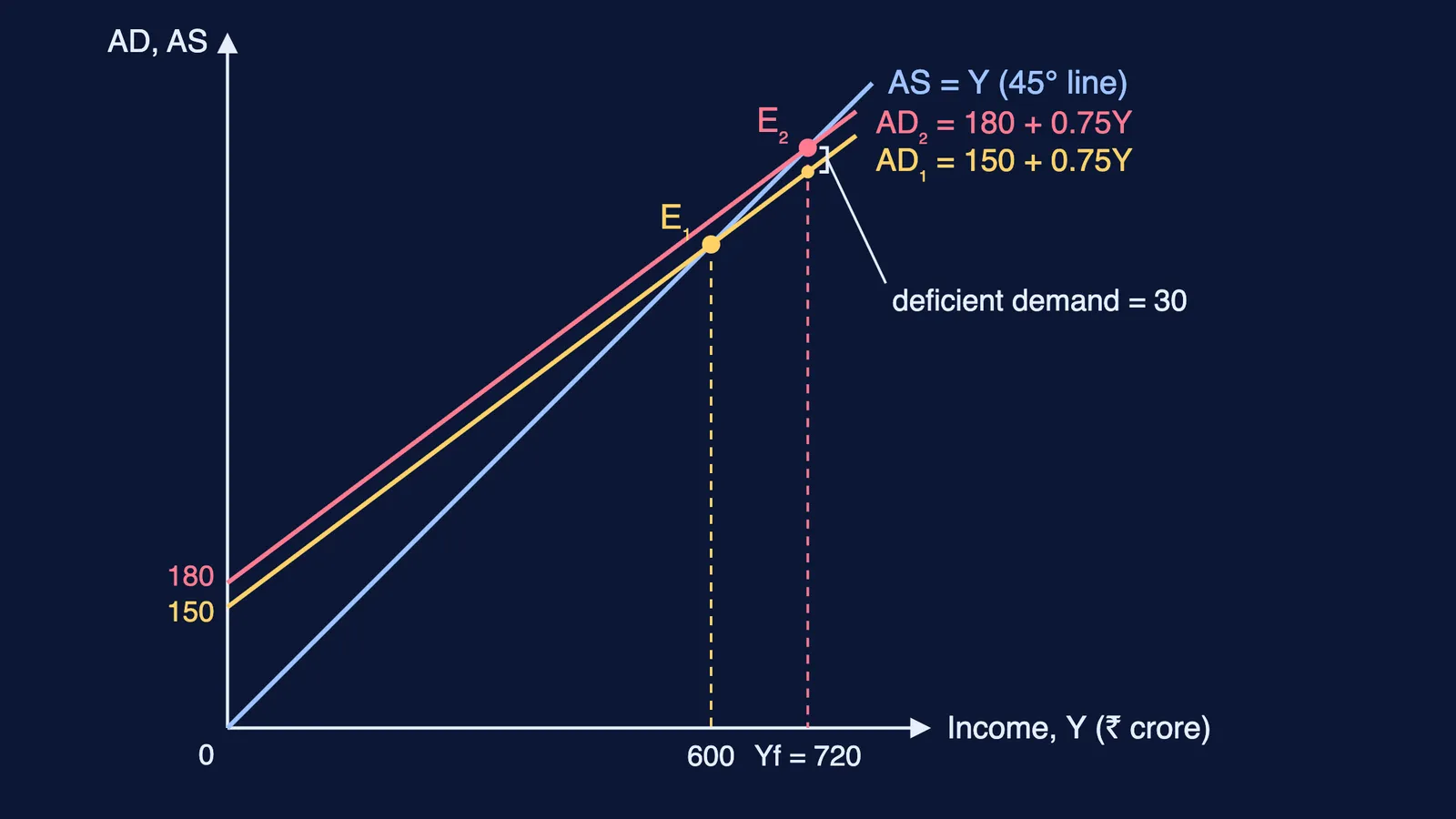
At Y = 720, aggregate demand is 150 + 0.75 × 720 = 690. Output of 720 meets demand of only 690: deficient demand of 30.
The multiplier is 1/(1 − 0.75) = 4. Income must rise by 120, so autonomous spending must rise by 120 ÷ 4 = 30.
The answer to (d) equals the gap in (c). That always holds when the gap is measured at full-employment income, so it is a quick check on your working.
Why does 30 become 120? Extra spending of 30 becomes income of 30. Households spend 0.75 of it (22.5), then 16.875, then 12.66, and so on; the series sums to 30 ÷ 0.25 = 120. The diagram at the top plots AD₁ = 150 + 0.75Y and AD₂ = 180 + 0.75Y against the 45° line.
For more practice in the same step-by-step layout, see our guide to national income numericals.
What are excess demand and deficient demand?
The NCERT chapter defines full-employment income as the level where all factors of production are fully employed. Equilibrium only means income will not change if left alone, so it can sit above or below that level.
Deficient demand: equilibrium output is below full employment because demand cannot employ every factor. NCERT says prices fall in the long run.
Excess demand: demand exceeds full-employment output. Output and employment cannot rise, so the general price level rises, as the marking scheme's answer to Question 15 states.
To close a deficient-demand gap, the government can raise its spending or cut taxes, and the RBI can expand money supply; for excess demand, they do the reverse. Our posts on the government budget and its deficits and on credit creation by commercial banks explain those levers.
How should you write these answers in the board exam?
The 2026-27 sample paper tests this chapter in one-mark questions on the slope of the consumption curve read from an AD shift diagram (Question 6) and the multiplier's range (Question 10), a numerical comparing equilibrium income with full-employment income (Question 15), and an internal choice in Question 17 between the components of the consumption function and true-or-false reasoning on APC at break-even income and ex-ante saving.
Write the equilibrium condition (Y = C + I) before substituting; the marking scheme gives it a mark.
Name the situation, then state its effect on output, employment and prices.
In diagrams, label both axes, the 45° line, the intercept and the equilibrium point.
Check numericals both ways: Y = C + I and S = I must give the same income.
If you are not sure where to start, Fermi's AI tutor works out what you already know and builds a plan for the session, then checks your understanding as it goes.