

On this page
According to CBSE statistics, 1,621,224 students appeared for the Class 12 exams in 2024. For those in the commerce and humanities streams, macroeconomics numericals are a reliable way to secure marks—provided you know what to include and what to leave out. Yet, many students lose points not on the arithmetic itself, but on conceptual rules, such as double counting intermediate goods or applying the wrong sign for net factor income from abroad.
What are the three methods of national income?
The Central Board of Secondary Education (CBSE) syllabus covers three distinct ways to measure national income. Regardless of the method you choose, they all eventually lead to the same aggregate: National Income, formally known as Net National Product at Factor Cost (NNP FC).
The Value Added Method (Product Method): This approach measures the contribution of each producing enterprise. You find the Gross Value Added at Market Price (GVA MP, which is equivalent to GDP MP) by taking the total value of output (sales plus change in stock) and subtracting intermediate consumption.
The Income Method: This method looks at who earns the money. You add up all factor incomes paid out within the domestic territory to find the Net Domestic Product at Factor Cost (NDP FC). The components are compensation of employees (wages and salaries), operating surplus (rent, interest, royalty, and profit), and the mixed income of the self-employed.
The Expenditure Method: This method measures where the money is spent. It sums private final consumption expenditure, government final consumption expenditure, gross domestic capital formation (investment), and net exports (exports minus imports) to arrive at GDP MP.
How do you calculate national income?
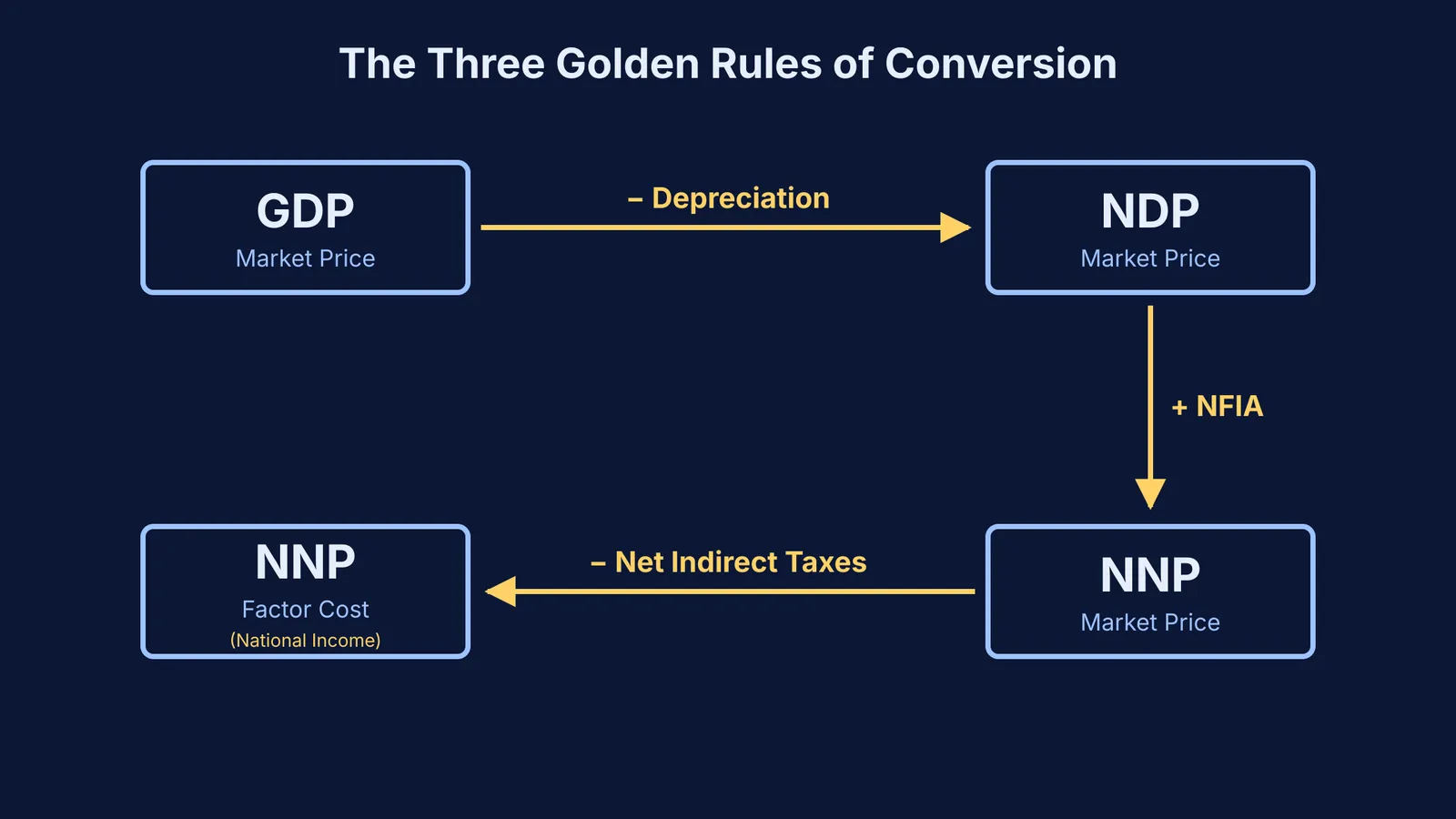
To get from any domestic aggregate to NNP FC, you must apply the three golden rules of conversion. Memorising these rules is essential for every macroeconomics paper:
Gross to Net: Subtract depreciation. Examiners frequently use the synonym "consumption of fixed capital" instead of the word depreciation.
Domestic to National: Add Net Factor Income from Abroad (NFIA).
Market Price to Factor Cost: Subtract Net Indirect Taxes (NIT), which is calculated as indirect taxes minus subsidies.
If you struggle to know where to begin with complex conversions, Fermi's AI tutor can work out what you already know and build a plan for the session, teaching you foundational problem-solving skills step by step.
Where do students lose marks in national income numericals?
Examiners consistently point out the same traps in student answer sheets. Knowing them beforehand helps you spot them in the exam hall.
Double counting: Students often include intermediate goods (like flour bought by a baker) instead of only the final product (the bread). Intermediate consumption must always be excluded.
Transfer payments: It is a common mistake to add pensions, scholarships or financial gifts. National income only counts factor income earned for productive work. Transfer payments are unearned and must be left out.
Net exports signs: If a question gives "Net Imports" as 50, the "Net Exports" value in your formula must be written as −50.
NFIA confusion: Students sometimes add factor income *to* abroad instead of subtracting it. NFIA is strictly defined as factor income *from* abroad minus factor income *to* abroad.
When wrong-method mistakes keep happening, the Fermi Problem Library has worked problems with a step-by-step solver that explains the reasoning rather than printing an answer.
How can you check your national income answers?
Before you move on to the next question, run your work through a quick mental checklist.
Identify the path: Write down which aggregate the question gives you initially and which one you need as the final answer. Map out the steps (e.g., GDP MP → NDP MP → NDP FC → NNP FC).
Check the definitions: If you see a term you do not recognise, pause and think about synonyms. For example, "retained earnings" is a part of profit.
Verify the units: A final answer of "500" is wrong if the paper asked for "₹ in Crores". Always append the correct monetary unit to your final underline.
Treatment of second-hand goods: Ensure you have excluded the sale price of any second-hand goods. However, if the problem lists a commission or brokerage fee earned on that sale, you must include it, as the service itself is a new productive activity.
Taking a structured approach to practice makes a measurable difference, much like when tackling quadratic word problems in Class 10 or calculating how adding to or scaling data changes the mean and variance. A study published in *Economic Inquiry* found that active learning exercises—rather than passively reading textbook examples—significantly increase cognitive gains and retention for students learning macroeconomic concepts. By mapping out your steps and watching for the common traps, you can turn national income numericals into your strongest section.


