

On this page
The government budget is Chapter 5 of NCERT's Class 12 Introductory Macroeconomics, and most classification and numerical questions on it come down to two skills: sorting an item into the right box, and doing three subtractions in the right order. Below, both are worked on India's real Budget 2026-27 numbers.
What is a government budget in Class 12 economics?
Article 112 of the Constitution requires the government to place before Parliament a statement of estimated receipts and expenditure for every financial year, which runs from 1 April to 31 March, according to the NCERT chapter Government Budget and the Economy. That Annual Financial Statement is the main budget document.
The same chapter splits the budget into two accounts. The revenue account holds items that relate only to the current year. The capital account holds items that change the government's assets and liabilities. NCERT also names three objectives: allocation (providing public goods such as defence and roads), redistribution (taxes and transfers that move incomes towards what society sees as fair) and stabilisation (raising or cooling demand).
For the bigger picture, our explainer on where each rupee of the Union Budget comes from and goes is a good warm-up.
How do you tell revenue items from capital items?
Use a two-question test built from NCERT's definitions.
For a receipt, ask: does it create a liability or reduce the government's assets? If yes, it is a capital receipt. If no, it is a revenue receipt.
For an expenditure, ask: does it create an asset or reduce a liability? If yes, it is capital expenditure. If no, it is revenue expenditure.
Common examples:
Income tax, corporation tax, GST: revenue receipts (tax).
Dividends from public sector companies, fees, interest received: revenue receipts (non-tax).
Borrowing: capital receipt, debt-creating, because it must be repaid.
Disinvestment (selling PSU shares) and recovery of loans: capital receipts, but non-debt-creating.
Salaries, pensions, subsidies, interest payments: revenue expenditure.
Building roads, buying machinery, giving loans to states: capital expenditure.
How are revenue, fiscal and primary deficit calculated?
All three formulas come from the NCERT chapter.
Revenue deficit = Revenue expenditure minus Revenue receipts.
Fiscal deficit = Total expenditure minus (Revenue receipts + Non-debt-creating capital receipts).
Primary deficit = Fiscal deficit minus Interest payments.
NCERT describes the fiscal deficit as the government's total borrowing requirement, so in the official budget table it equals the borrowings and other liabilities line. Primary deficit strips out interest on old debt. Strictly, NCERT subtracts net interest liabilities (interest paid minus interest received); the official Budget at a Glance 2026-27 subtracts interest payments.
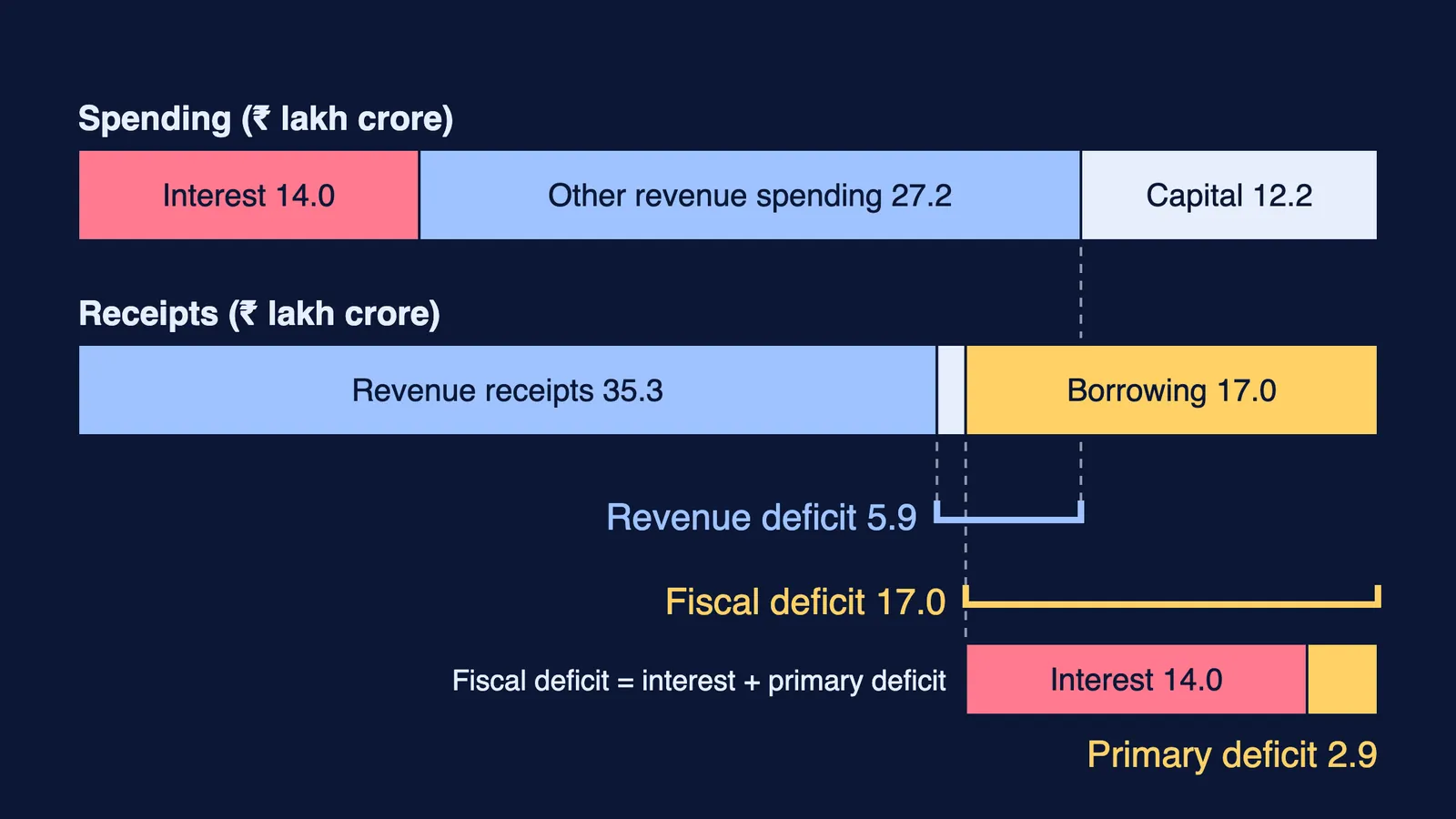
Worked example: India's Budget 2026-27
These Budget Estimates come from page 1 of Budget at a Glance 2026-27, published by the Ministry of Finance in February 2026. All figures are in rupees crore.
Revenue receipts: 35,33,150 (tax net of states' share 28,66,922 plus non-tax 6,66,228)
Recovery of loans: 38,397; other receipts: 80,000
Borrowings and other liabilities: 16,95,768
Revenue expenditure: 41,25,494, of which interest payments 14,03,972
Capital expenditure: 12,21,821
Total expenditure: 53,47,315
Revenue deficit = 41,25,494 minus 35,33,150 = 5,92,344.
Non-debt receipts = 35,33,150 + 38,397 + 80,000 = 36,51,547.
Fiscal deficit = 53,47,315 minus 36,51,547 = 16,95,768.
Primary deficit = 16,95,768 minus 14,03,972 = 2,91,796.
All three match the official table, which puts them at 1.5%, 4.3% and 0.7% of GDP, with 2026-27 GDP estimated at 393,00,393 crore in the same Budget at a Glance. If "per cent of GDP" feels abstract, see what GDP means, with India's numbers.
What the answers say: interest payments equal about 83% of the fiscal deficit, which is why the primary deficit is small; most of this year's borrowing is matched by interest on past debt. The revenue deficit is about 35% of the fiscal deficit. NCERT's warning applies here: a large revenue share means part of the borrowing pays for day-to-day spending rather than investment.
How should you practise this before the board exam?
A 20-minute drill you can repeat:
Write the three formulas from memory, then check them.
Classify ten items with the two-question test, including grants to states and disinvestment.
Redo the worked example with the 2025-26 Revised Estimates column of the same Budget at a Glance table. Your answers should be revenue deficit 5,26,764, fiscal deficit 15,58,492 and primary deficit 2,84,154 crore.
Write one line on what each deficit tells you about borrowing.
If you use an AI chatbot to check answers, verify it against the NCERT formulas line by line, as in our guide to checking an AI's national income answer with NCERT.
If economics shares your evenings with physics or maths revision, Fermi's AI tutor can work out what you already know and build a plan for the session, so each evening starts with a clear next step.
Start with step 3 tonight: one column, three subtractions.


