On this page
If you study economics in Class 12, Chapter 3 of NCERT's Introductory Macroeconomics, "Money and Banking", asks you to explain how one deposit lets banks create several times as much in deposits and loans, then prove it with numbers. Here are the functions of money in brief, then a credit creation numerical worked step by step, and its reversed versions.
What are the functions of money?
The NCERT chapter on money and banking opens with a definition worth learning word for word: money is the commonly accepted medium of exchange. It then lists what money does that barter cannot:
Medium of exchange. It removes the need for a double coincidence of wants, where a rice seller must find someone who has clothes and also wants rice.
Unit of account. Prices are written in rupees, so goods can be compared: if a pencil costs ₹2 and a pen ₹10, a pen is worth 5 pencils (the chapter's own example).
Store of value. Unlike stored rice, money does not rot and costs little to keep, so wealth can be carried into the future, as long as prices stay fairly stable.
If barter and bank loans feel hazy, revise money and credit from Class 10 first.
How do commercial banks create credit?
NCERT puts it in one line: "Banks can lend simply because they do not expect all the depositors to withdraw what they have deposited at the same time" (NCERT, Section 3.3). A bank keeps part of each deposit as reserves and lends the rest. The borrower spends the loan, the money lands in another bank account as a fresh deposit, and most of that can be lent again.
The brake is the reserve rule. NCERT defines the Cash Reserve Ratio (CRR) as the percentage of deposits a bank must keep as cash reserves, a legal requirement set by the RBI (NCERT).
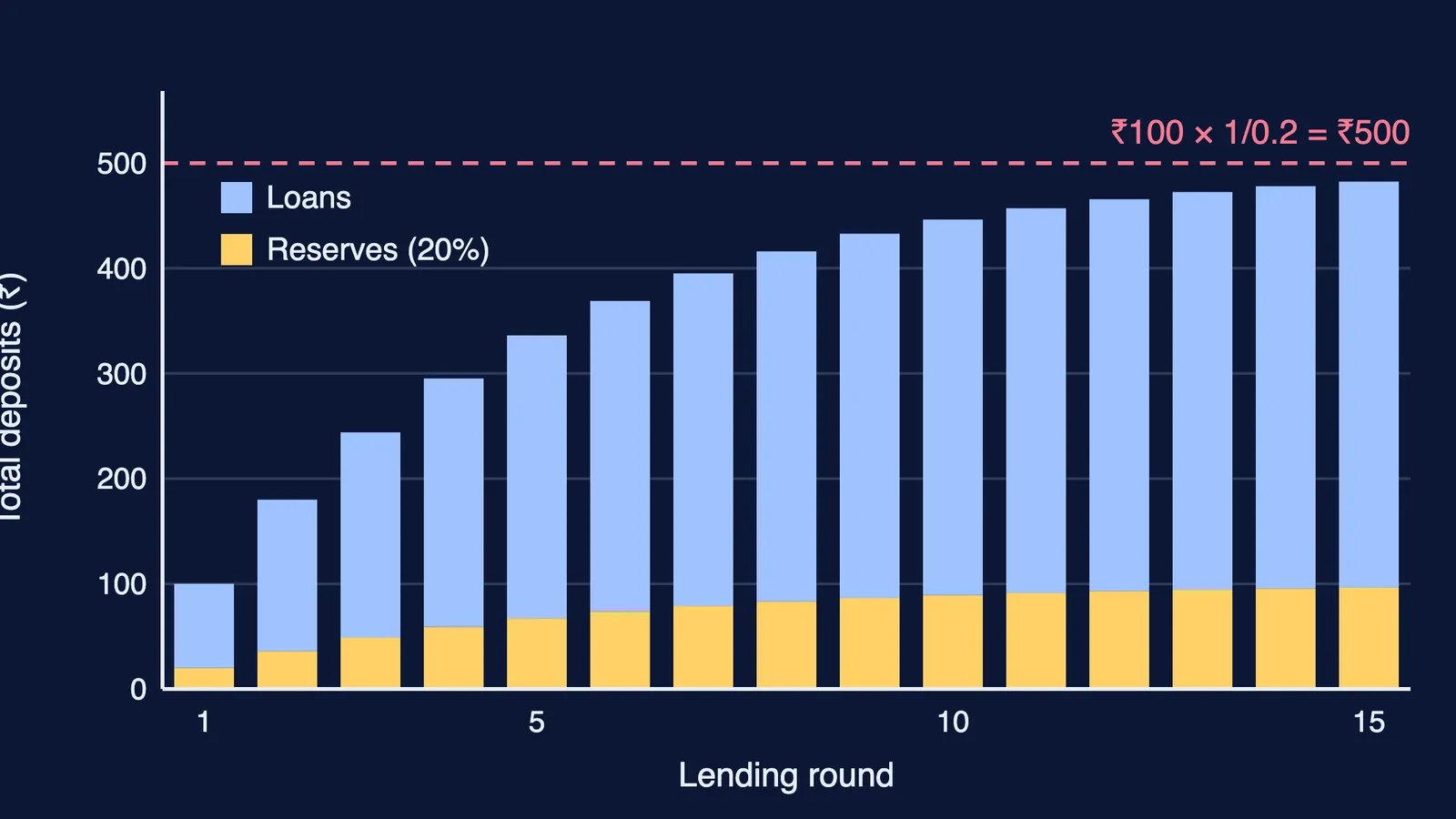
The money multiplier is 1 divided by the CRR, so a 20% CRR gives a multiplier of 5 (NCERT).
The textbook model assumes the public holds no cash, so every loan comes back as a deposit, and that banks lend everything above the required reserve. State these assumptions in a long answer.
How do you solve a credit creation numerical?
The steps are the ones in NCERT's Table 3.2, with different numbers.
Question: Riya deposits ₹10,000 in a bank. The CRR is 10%. Find total deposits and credit created, and show the first three rounds.
Money multiplier = 1 ÷ 0.10 = 10.
Total deposits = ₹10,000 × 10 = ₹1,00,000.
Credit created = ₹1,00,000 − ₹10,000 = ₹90,000.
Check: reserves = 10% of ₹1,00,000 = ₹10,000, the whole first deposit. Lending stops exactly when the original deposit is all held as reserves.
Each round, as new deposit, reserve kept and loan made:
Round 1: ₹10,000, ₹1,000, ₹9,000
Round 2: ₹9,000, ₹900, ₹8,100
Round 3: ₹8,100, ₹810, ₹7,290
Totals after all rounds: ₹1,00,000, ₹10,000, ₹90,000
The deposits form a geometric series: 10,000 + 9,000 + 8,100 + ... = 10,000 ÷ (1 − 0.9) = 1,00,000. That is where 1/CRR comes from. NCERT's table shows the same process as running totals (₹100, ₹180 and so on, ending at ₹500); both layouts give the same answer. If the series step is shaky, the Fermi Concept Library has a lesson for every concept in mathematics.
How can the question be reversed?
Each version uses the same formula, money multiplier = 1/CRR (NCERT).
Given the multiplier, find the CRR. A multiplier of 4 means CRR = 1 ÷ 4 = 25%.
Given credit created, find the first deposit. CRR 20%, credit created ₹4,000. Total deposits are 5D, so credit is 5D − D = 4D = ₹4,000, and D = ₹1,000.
The CRR changes. In NCERT's example, raising the CRR from 20% to 25% means ₹100 of reserves supports only ₹400 of deposits, so loans fall from ₹400 to ₹300 and money supply shrinks.
What is the CRR in India now?
When we checked on 12 November 2026, the Reserve Bank of India's website listed the CRR at 3.00% and the Statutory Liquidity Ratio at 18.00%. The formula would give 1 ÷ 0.03, about 33, but that is a textbook ceiling: people keep some cash, banks also hold SLR assets, and not every rupee finds a borrower. In exams, use the CRR the question gives you.
Money supply also connects to prices, which you can see by building a samosa price index to understand inflation.
Which mistakes should you avoid?
Putting 10 instead of 0.10 into 1/CRR.
Giving total deposits when the question asks for credit created.
Leaving out the assumptions in a long answer.
Mixing up CRR (cash kept with the RBI) and SLR (liquid assets the bank holds itself).
Forgetting that a higher CRR means less credit, not more.
Try the three reversed versions without looking, then check each step. If one mistake keeps returning, bring the problem to Fermi's AI tutor, which works out what you already know and builds a plan for the session.