On this page
Our definitions are in our own words, checked against the Reprint 2026-27 NCERT chapter and the CBSE Class XII Physics curriculum 2026-27. Neither has a section on the cyclotron machine or the toroid, so they are left out. For answer-writing, read our Moving Charges and Magnetism board exam guide.
What makes a magnetic field and what does it push on?
Oersted's experiment: in 1820 Hans Christian Oersted saw a current in a straight wire deflect a nearby compass needle, the observation that showed electricity and magnetism are related, as the NCERT chapter describes.
Magnetic field (B): a vector field produced by currents and moving charges; fields from several sources add as vectors (the principle of superposition).
Lorentz force: the total force on a charge q moving with velocity v through electric and magnetic fields, F = q(E + v × B).
Magnetic force on a moving charge: q(v × B), perpendicular to both v and B; zero if the charge is at rest or moves along the field.
Tesla (T) and gauss (G): the SI unit of B, and a smaller unit, 1 G = 10⁻⁴ T. Example: NCERT gives Earth's field as about 3.6 × 10⁻⁵ T.
Force on a current-carrying conductor: F = I l × B, where l points along the current. Don't confuse: B here is the outside field, not the wire's own field.
How does a charged particle move in a magnetic field?
No work by the magnetic force: the force is always sideways to the motion, so speed and kinetic energy stay constant.
Circular motion: when v is perpendicular to B, the magnetic force acts as the centripetal force and the radius is r = mv/qB. Example: NCERT's electron at 3 × 10⁷ m/s in a 6 × 10⁻⁴ T field circles with a radius of about 28 cm.
Cyclotron frequency: the number of turns per second in that circle, qB/2πm; a faster particle moves on a bigger circle, so the time per turn stays the same.
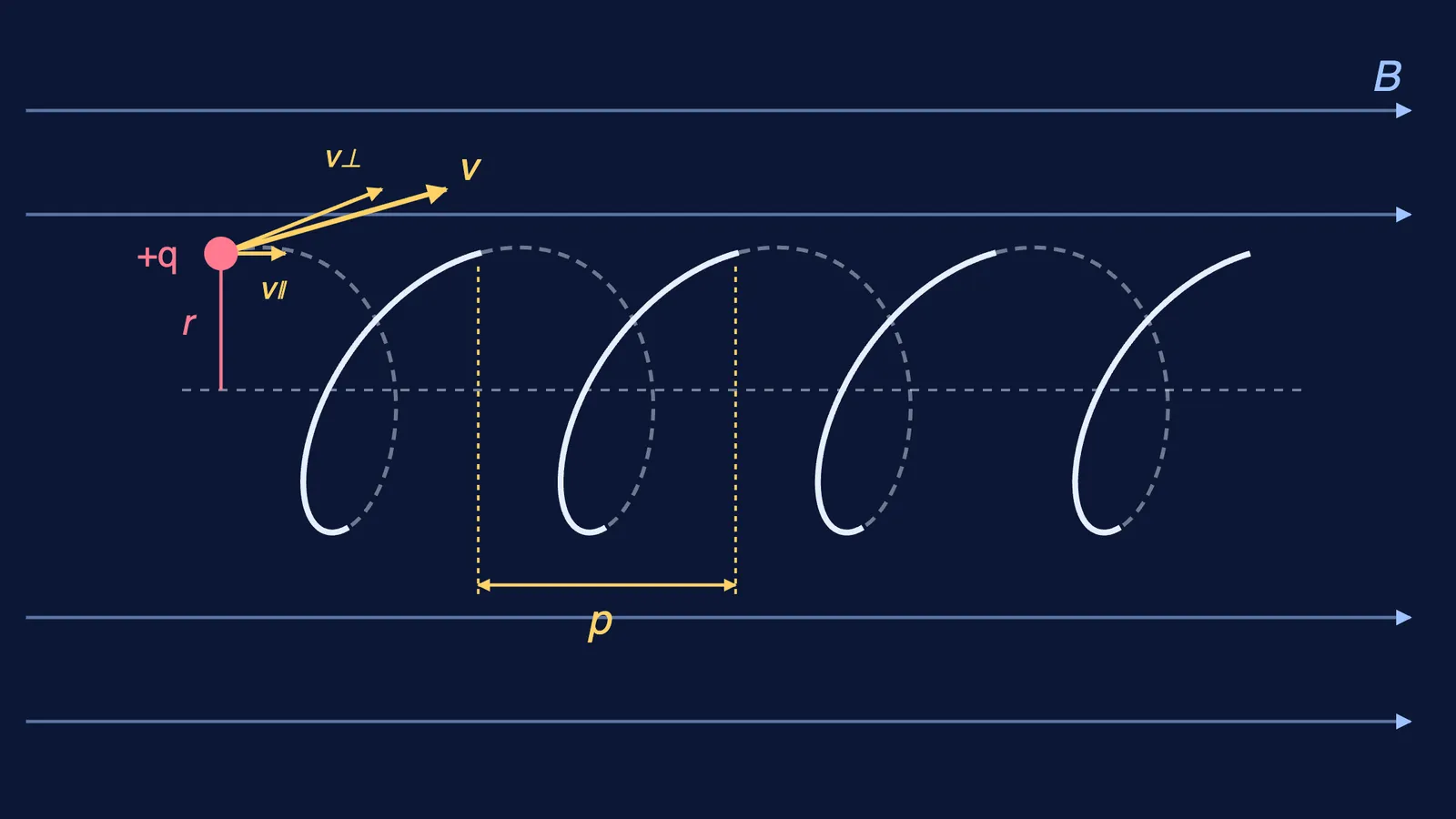
Helical motion: if v has a part along B, that part is unchanged while the perpendicular part goes round in a circle, giving a helix (see the diagram).
Pitch (p): how far the particle advances along B during one full revolution, p = v∥T. Don't confuse with the radius of the helix, which comes from v⊥ only.
Which laws give the field of a current?
Biot-Savart law: the field dB from a current element I dl is proportional to I dl sin θ/r² and perpendicular to the plane of dl and r. Don't confuse with Coulomb's law: its source is a vector (I dl), not a scalar charge.
Permeability of free space (μ0): the constant in the law, taken as 4π × 10⁻⁷ T m A⁻¹ in the NCERT chapter.
Field of a circular loop: on the axis it is μ0IR²/2(x² + R²)^(3/2), falling to μ0I/2R at the centre. Example: NCERT's 100-turn coil of radius 10 cm with 1 A gives about 6.28 × 10⁻⁴ T at the centre.
Right-hand thumb rules: for a straight wire, thumb along the current and fingers curl with the field; for a loop, fingers curl with the current and the thumb gives the field. Don't confuse the two: fingers and thumb swap jobs.
Ampere's circuital law: adding up B · dl all the way round a closed path gives μ0 times the net current crossing any surface with that path as its edge.
Amperian loop and enclosed current (Ie): a closed path chosen so B is tangential and constant, normal, or zero on each part; Ie is the current threading it.
Field of a long straight wire: B = μ0I/2πr, with field lines as closed circles round the wire. Don't confuse with electric field lines, which start and end on charges.
Solenoid: a long, tightly wound helix of wire; inside, the field is uniform, B = μ0nI (n turns per unit length), and outside nearly zero. The syllabus words it as "Straight solenoid (only qualitative treatment)".
What do forces, torques and the galvanometer terms mean?
Force between parallel currents: μ0IaIb/2πd per unit length. Parallel currents attract and antiparallel ones repel, the reverse of the rule for like charges.
The ampere: the steady current that, in two long thin parallel wires 1 m apart in vacuum, gives a force of 2 × 10⁻⁷ N per metre of length, per NCERT's definition.
Torque on a current loop: in a uniform field, no net force but a torque τ = m × B. It is zero with m parallel to B (stable) or antiparallel (unstable).
Magnetic dipole moment (m): m = NIA, in A m², along the area vector given by the right-hand thumb rule.
Current loop as a magnetic dipole: far away, a loop's field has the same form as an electric dipole's, with p replaced by m and 1/ε0 by μ0. Magnetic monopoles are not known to exist.
Moving coil galvanometer: a many-turn coil in a radial field round a soft iron core; the spring's counter-torque kφ (k is the torsional constant) balances NIAB, so deflection φ is proportional to I.
Current sensitivity: deflection per unit current, φ/I = NAB/k.
Shunt (ammeter conversion): a small resistance in parallel takes most of the current, since the galvanometer reaches full scale at currents of the order of µA.
Voltmeter conversion: a large resistance in series, so the meter draws very little current. For the circuits these meters sit in, see our Current Electricity Class 12 board guide.
For helical paths and a coil turning in a field, the Fermi Simulation Lab has interactive simulations for the ideas that are easier to see than to read.
How to learn these terms
Learn in pairs: Biot-Savart and Ampere's law, shunt and series resistance, field lines of B and E.
Draw the helix and label v∥, v⊥, r and p; say which sets the radius and which the pitch.
Practise both right-hand thumb rules on a wire and a loop.
Put the five field results (element, loop centre, loop axis, straight wire, solenoid) on one card with sketches.
Carry m = NIA into the next chapter with our Magnetism and Matter Class 12 guide.