On this page
Motion in a Straight Line is Chapter 2 of the NCERT Class 11 Physics textbook, Part I (Reprint 2026-27), and the CBSE 2026-27 Physics syllabus places it in Unit II, Kinematics. Terms follow NCERT's usage, with SI units. For the chapter's graphs, equations and solved examples, read our Motion in a Straight Line Class 11 chapter guide.
Relative velocity is in the contents, but the reprint has no section on it and the syllabus omits it from Chapters 2 and 3, so we skip it.
What do kinematics, frame of reference and point object mean?
Motion: an object's position changing as time passes.
Kinematics: describing motion without asking what causes it. Don't confuse with: the laws of motion, which deal with forces.
Rectilinear motion: motion along one straight line.
Point object: an object treated as a single point because it is tiny compared with the distance it covers. Example: a train between two cities, but not a spinning cricket ball.
Frame of reference: the origin, the chosen positive direction and the clock you measure from. Example: a school gate as x = 0, east as positive.
Position: where the object is, given by its coordinate x from the origin, in metres (m); positive on the chosen positive side, negative on the other.
Displacement: the change in position, final minus initial, in m; it can be positive, negative or zero.
Path length: the total distance actually travelled, in m, never negative. Don't confuse with: displacement. Walk 300 m to a shop and back: path length 600 m, displacement zero.
How are average and instantaneous velocity different?
Source: section 2.2 and the summary of the NCERT chapter.
Uniform motion: motion at constant velocity; its x-t graph is a straight sloping line.
Non-uniform motion: motion with changing velocity.
Average velocity: displacement divided by the time taken, in metres per second (m s⁻¹). In the shop example it is zero.
Average speed: total path length divided by the time taken, in m s⁻¹. A 600 s shop trip gives 1 m s⁻¹. Don't confuse with: average velocity; average speed is always greater than or equal to its size.
Instantaneous velocity (velocity): the value average velocity approaches as the time interval shrinks towards zero, written dx/dt. Example: if x = 3t² m, then v = 6t, so v = 12 m s⁻¹ at t = 2 s.
Instantaneous speed (speed): the size of the velocity at an instant, without its sign. +5 and −5 m s⁻¹ both mean 5 m s⁻¹.
Differentiation: the calculus step that turns position into velocity and velocity into acceleration.
Integration: the reverse step, adding up tiny pieces such as v dt to get displacement from velocity.
What is acceleration, and when is an object in free fall?
Source: section 2.3 and Example 2.4 of the NCERT chapter.
Average acceleration: change in velocity divided by the time taken, in metres per second squared (m s⁻²). Example: rest to 12 m s⁻¹ in 4 s is 3 m s⁻².
Instantaneous acceleration: the rate of change of velocity at one instant, dv/dt, the slope of the v-t graph there.
Uniformly accelerated motion: motion with constant acceleration in both size and direction.
Retardation (deceleration): acceleration pointing opposite to the velocity, so the object slows down. Don't confuse with: negative acceleration. Its sign depends on your chosen axis; a ball falling with a = −g is speeding up.
Acceleration due to gravity (g): the downward acceleration near Earth's surface, taken as 9.8 m s⁻² near the surface.
Free fall: motion under gravity alone, with air resistance neglected. Example: a stone dropped from rest is moving at 9.8 × 2 = 19.6 m s⁻¹ after 2 s.
How do you read x-t and v-t graphs?
Source: section 2.3 and the summary of the NCERT chapter.
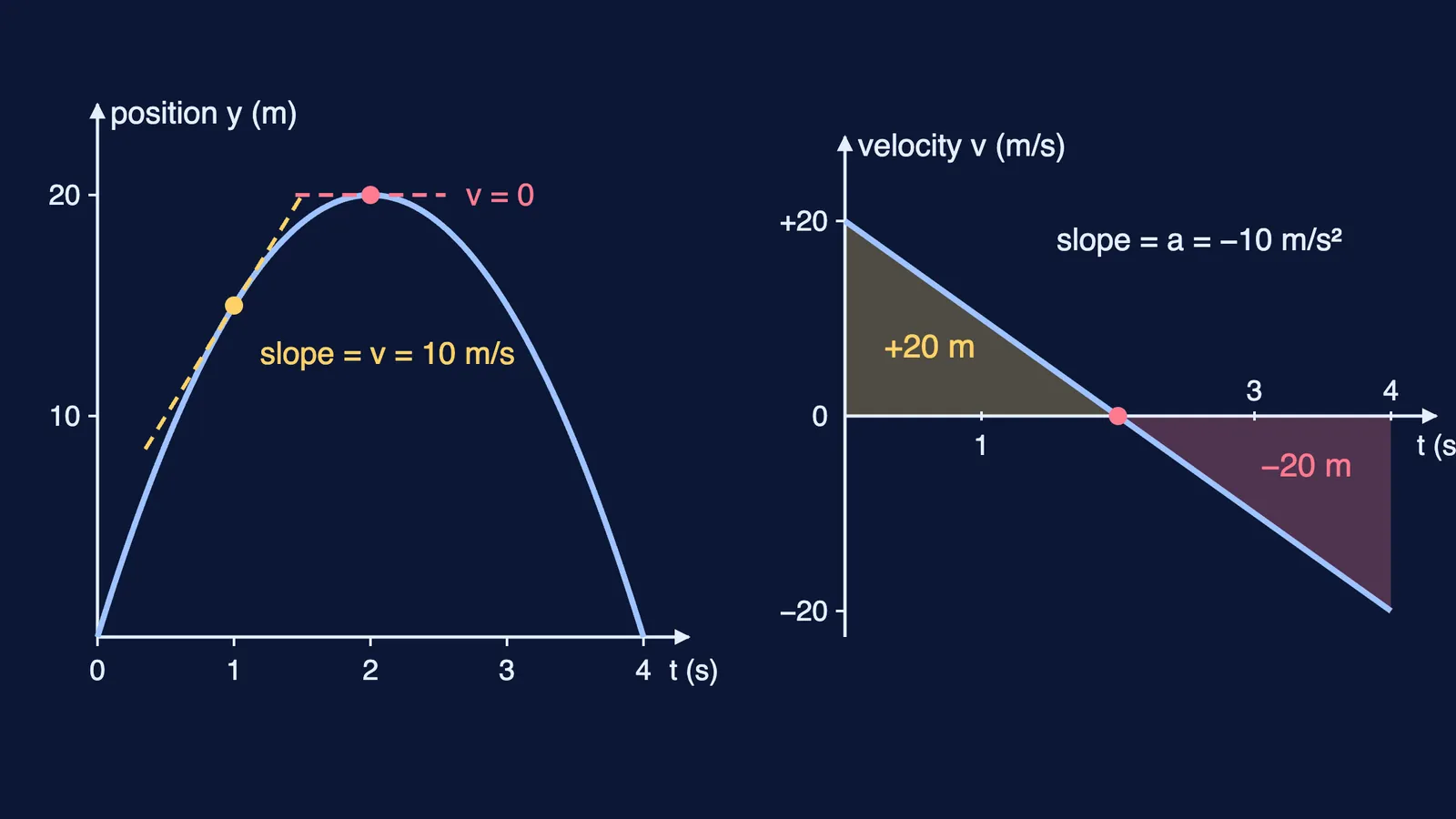
Position-time (x-t) graph: position plotted against time. The slope of the tangent at a point gives the velocity at that instant; with uniform acceleration the curve is a parabola.
Velocity-time (v-t) graph: velocity plotted against time. Its slope gives acceleration; with uniform acceleration it is a straight line.
Area under the v-t curve: the displacement in that interval; area below the time axis counts as negative. Example: 10 m s⁻¹ for 5 s gives 50 m.
What are the kinematic equations used for?
Source: section 2.4 and Examples 2.5 to 2.7 of the NCERT chapter.
Kinematic equations: three relations for constant acceleration linking initial velocity v0, final velocity v, acceleration a, time t and displacement x: v = v0 + at, x = v0t + ½at², and v² = v0² + 2ax. Replace x by (x − x0) if the start is not at the origin. Example: from 10 m s⁻¹ with a = 2 m s⁻² for 5 s, v = 20 m s⁻¹ and x = 75 m.
Stopping distance: how far a vehicle travels after the brakes are applied, v0²/2a for a retardation a. Doubling speed quadruples it: at 5 m s⁻², 40 m from 20 m s⁻¹ but 160 m from 40 m s⁻¹.
Reaction time: the time a person takes to notice, decide and act. A ruler that falls 0.20 m before you catch it means about 0.20 s, from d = ½gt².
Galileo's law of odd numbers: for a body falling from rest, distances covered in equal successive time intervals are in the ratio 1 : 3 : 5 : 7. With 1 s intervals: 4.9, 14.7, 24.5 and 34.3 m.
How to learn these terms
Learn them in pairs: displacement and path length, average velocity and average speed, retardation and negative acceleration.
Before any sign, write your origin and positive direction, as NCERT's Points to Ponder advise.
Sketch x-t and v-t graphs for one vertical throw and label slope, area and the top point.
For each kinematic equation, name the one quantity it leaves out: t, v or x.
If a word still feels vague, open its lesson in the Fermi Concept Library, where each physics concept has its own lesson.
Next, take these ideas into vectors and projectiles with our Motion in a Plane Class 11 guide, or see how they are tested in Kinematics for JEE Main.