On this page
These are the formulas of Chapter 2 of the NCERT Class 11 Physics textbook (Reprint 2026-27), grouped by topic. Relative velocity is left out: the CBSE Class XI Physics syllabus for 2026-27 does not list it, and the reprint's chapter has no section on it.
Symbols: x is position (m), t is time (s), v is velocity (m s⁻¹), a is acceleration (m s⁻²). Fix an origin and a positive direction first; displacement, velocity and acceleration then carry signs.
What are the formulas for velocity and speed?
Average velocity: v̄ = Δx/Δt = (x₂ − x₁)/(t₂ − t₁), in m s⁻¹.
Average speed = total path length (m) ÷ total time taken (s), in m s⁻¹.
Average speed ≥ |average velocity|; equal only if the object never turns back.
Instantaneous velocity: v = lim(Δt→0) Δx/Δt = dx/dt, in m s⁻¹, the slope of the tangent to the x-t graph.
Instantaneous speed = |v|, in m s⁻¹.
Worked example: x = 12t − 3t² (x in m, t in s), so v = 12 − 6t m s⁻¹, zero at t = 2 s. x(0) = 0, x(2) = 12 m, x(3) = 9 m. Over 0 to 3 s, v̄ = 9/3 = 3 m s⁻¹, but the path is 12 + 3 = 15 m, so average speed = 5 m s⁻¹.
Watch for: using displacement for average speed. Find where v = 0 and add each side's distance.
How is acceleration defined in Class 11?
Average acceleration: ā = Δv/Δt = (v₂ − v₁)/(t₂ − t₁), in m s⁻².
Instantaneous acceleration: a = lim(Δt→0) Δv/Δt = dv/dt = d²x/dt², in m s⁻², the slope of the tangent to the v-t graph.
Chain-rule form: a = v dv/dx, in m s⁻², useful when v or a depends on x.
Speeding up: a and v share a sign; slowing down: opposite signs.
Worked example: x = t³ − 6t² + 9t (x in m, t in s) gives v = 3t² − 12t + 9 m s⁻¹ and a = 6t − 12 m s⁻². At t = 1 s, v = 0 but a = −6 m s⁻². At t = 4 s, v = 9 m s⁻¹, so ā from 1 s to 4 s is 9/3 = 3 m s⁻².
Watch for: assuming v = 0 means a = 0, or that negative a means slowing down. The sign of a depends only on your chosen axis.
What do the slopes and areas of motion graphs give?
Slope of the x-t graph at an instant = v, in m s⁻¹.
Slope of the v-t graph at an instant = a, in m s⁻².
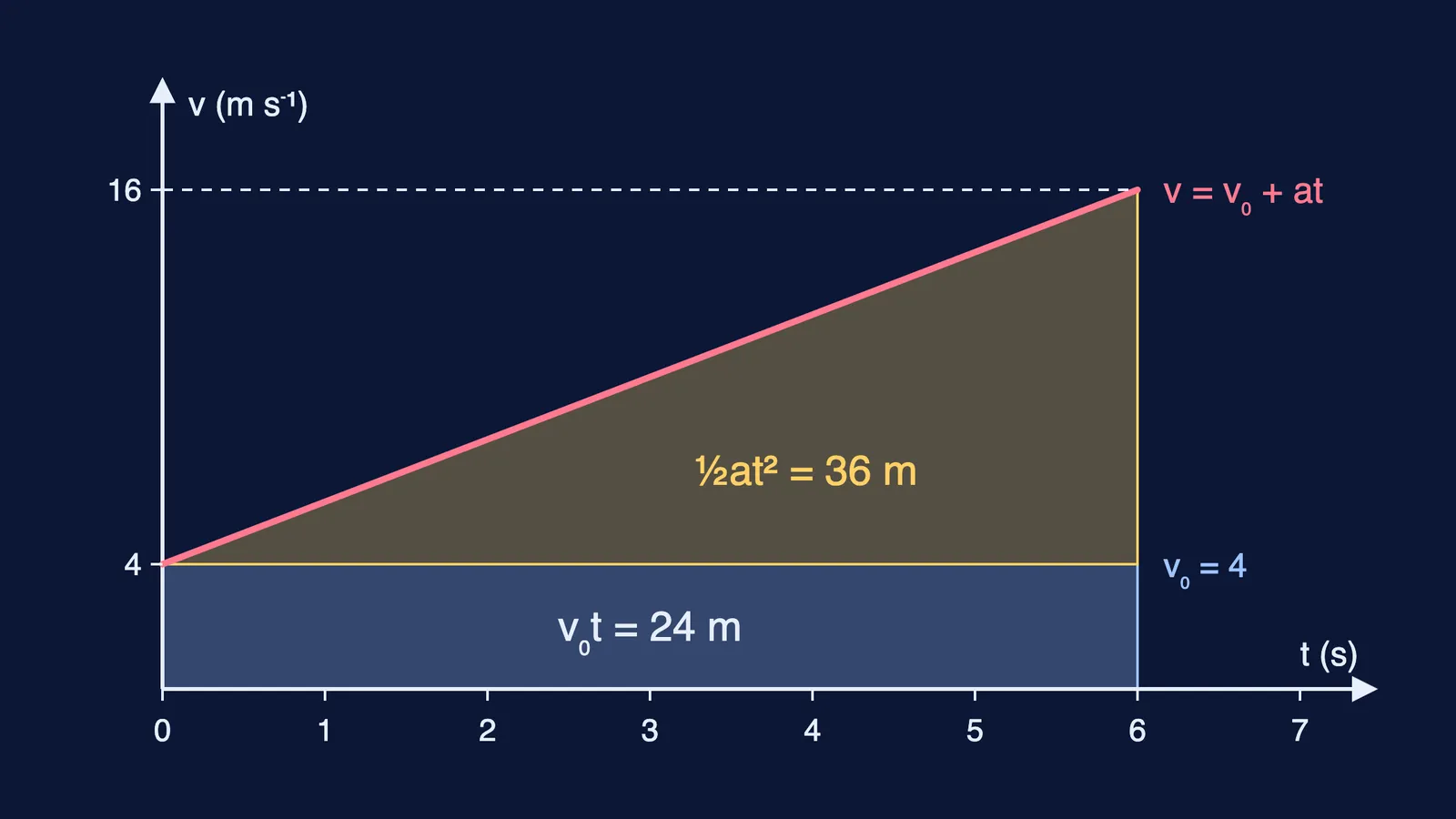
Area under the v-t graph between t₁ and t₂ = displacement x₂ − x₁ = ∫v dt, in m.
Area under the a-t graph between t₁ and t₂ = change in velocity v₂ − v₁ = ∫a dt, in m s⁻¹.
Uniform motion: straight sloping x-t, flat v-t. Uniform acceleration: parabolic x-t, straight sloping v-t.
Worked example: a scooter reaches 8 m s⁻¹ from rest in 4 s, holds it for 6 s, then stops in 2 s. The slopes are 2, 0 and −4 m s⁻²; the area is 16 + 48 + 8 = 72 m.
Watch for: area below the time axis is negative displacement; for distance, add the sizes of the areas.
Which equations of motion apply to uniformly accelerated motion?
Condition: a constant in magnitude and direction. v₀ is the velocity (m s⁻¹) and x₀ the position (m) at t = 0.
v = v₀ + at, in m s⁻¹.
x − x₀ = v₀t + ½at², in m.
v² = v₀² + 2a(x − x₀), in m² s⁻².
x − x₀ = ½(v₀ + v)t, in m.
Average velocity = (v₀ + v)/2, in m s⁻¹ (constant acceleration only).
Stopping distance: dₛ = −v₀²/(2a), in m, with a < 0 while braking; doubling v₀ quadruples dₛ.
Proofs are in our step-by-step derivations for this chapter.
Worked example: a car at 72 km h⁻¹ = 20 m s⁻¹ brakes at a = −5.0 m s⁻². It stops in 20/5.0 = 4.0 s over dₛ = −20²/(2 × −5.0) = 40 m. A 0.75 s reaction time adds 20 × 0.75 = 15 m, so 55 m in all.
Watch for: skipping the km h⁻¹ ÷ 3.6 step, or using these when a varies (integrate a = dv/dt instead).
What are the free-fall formulas?
Upward is positive, so a = −g, g = 9.8 m s⁻², constant for heights small compared with the Earth's radius, air resistance neglected.
Released from rest at y = 0: v = −gt (m s⁻¹), y = −½gt² (m), v² = −2gy (m² s⁻²).
Thrown up with speed u (m s⁻¹): maximum height H = u²/(2g), in m; time to the top = u/g, in s; time back to the launch point = 2u/g, in s.
Galileo's odd numbers: from rest, distances fallen in equal successive intervals are as 1 : 3 : 5 : 7 (dimensionless).
Reaction time from a dropped ruler: tᵣ = √(2d/g), in s, where d is the distance (m) the ruler falls before you catch it.
Worked example: a ball thrown up at 14.7 m s⁻¹ from a 19.6 m roof rises 14.7²/(2 × 9.8) = 11.0 m in 1.5 s. Setting 0 = 19.6 + 14.7t − 4.9t² gives t = 4.0 s to the ground, where v = 14.7 − 9.8 × 4.0 = −24.5 m s⁻¹.
Watch for: writing +g with upward positive.
How to revise this formula sheet
Write the sign convention before substituting numbers.
Tag each equation with the quantity it leaves out (t in v² = v₀² + 2a(x − x₀), a in x − x₀ = ½(v₀ + v)t) and choose by what the question omits.
Redraw a v-t graph from memory; read its slope and area (v₀t plus ½at²).
Practise with these case study questions on motion in a straight line; the chapter guide to graphs and equations covers the theory.
If graphs feel abstract, the Fermi Simulation Lab has interactive simulations for ideas that are easier to see than to read.