On this page
The current NCERT text, Motion in a Straight Line, NCERT Class 11 Physics Part I (Reprint 2026-27) derives the kinematic equations in Section 2.4, again by calculus in Example 2.2, and applies them in Examples 2.5 and 2.6. The CBSE Class XI-XII Physics curriculum for 2026-27 lists "relations for uniformly accelerated motion (graphical and calculus treatment)" for this chapter, so learn both routes.
Symbols used below: v₀ is the velocity at t = 0, v the velocity at time t, a the constant acceleration, and x the displacement in time t (position at t = 0 is zero unless we write x₀). For the chapter's graphs and definitions, start with our guide to Motion in a Straight Line for Class 11.
First equation of motion: v = v₀ + at
Setup: a body moves along a straight line with constant acceleration a; its velocity is v₀ at t = 0.
Acceleration is the rate of change of velocity with time.
With constant a, average acceleration over 0 to t equals a: a = (v − v₀)/(t − 0).
Multiply both sides by t: at = v − v₀.
Move v₀ across.
Result: v = v₀ + at. The v–t graph is a straight line with slope a and intercept v₀.
Where students slip: using this when the acceleration varies; it needs constant a.
Second equation of motion: x = v₀t + ½at² (graphical method)
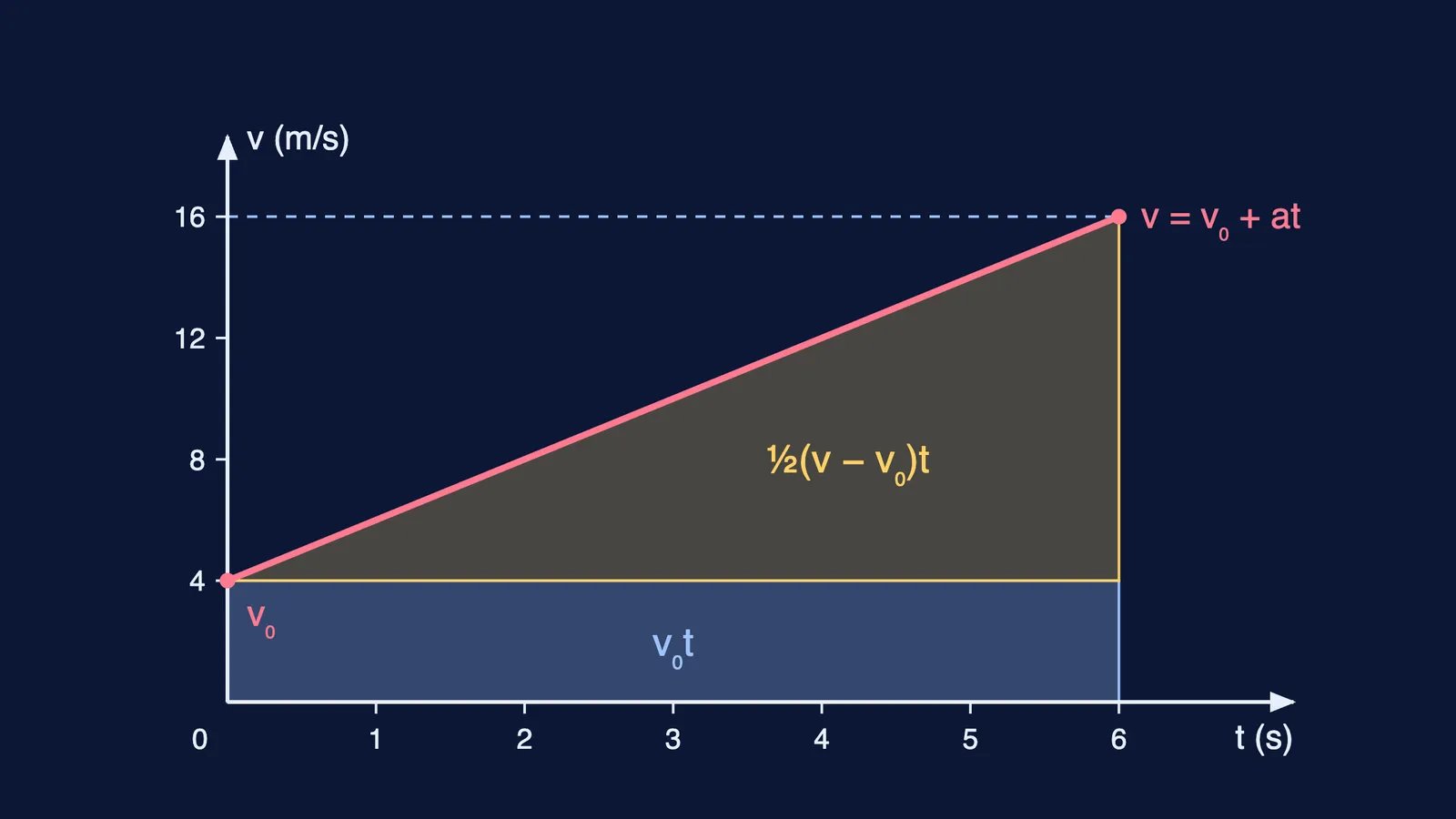
Setup: the v–t graph at the top of this post, a straight line from v₀ at time 0 to v at time t.
The area under a v–t graph between two instants equals the displacement in that interval.
Split that area into a rectangle (height v₀, width t) and a triangle on top (base t, height v − v₀).
Rectangle area = v₀t; triangle area = ½(v − v₀)t.
Add them: x = v₀t + ½(v − v₀)t.
From the first equation, v − v₀ = at. Substitute it.
Result: x = v₀t + ½at², or x = x₀ + v₀t + ½at² if the body starts at x₀.
Where students slip: treating area as distance when velocity changes sign; area below the time axis is negative displacement.
Third equation of motion: v² = v₀² + 2ax
Setup: the same motion; the aim is a relation without t.
Add the two areas another way: x = v₀t + ½vt − ½v₀t = ½(v + v₀)t, which is average velocity times time.
Rearrange the first equation: t = (v − v₀)/a.
Substitute: x = (v + v₀)(v − v₀)/(2a).
Use (v + v₀)(v − v₀) = v² − v₀², so 2ax = v² − v₀².
Result: v² = v₀² + 2ax, or v² = v₀² + 2a(x − x₀) from a start at x₀.
Where students slip: taking (v + v₀)/2 as the average velocity for any motion. It is true only when the acceleration is constant.
How do you derive the equations of motion by calculus?
Setup: Example 2.2 in the chapter; a is constant, a = dv/dt and v = dx/dt.
Write dv = a dt. Integrate velocity from v₀ to v and time from 0 to t: v − v₀ = at.
Write dx = v dt = (v₀ + at) dt. Integrate position from x₀ to x and time from 0 to t: x − x₀ = v₀t + ½at².
By the chain rule, a = dv/dt = (dv/dx)(dx/dt) = v dv/dx, so v dv = a dx.
Integrate velocity from v₀ to v and position from x₀ to x: ½(v² − v₀²) = a(x − x₀).
Result: the same three equations. NCERT notes that this calculus route also works when the acceleration is not constant.
Where students slip: mismatched limits. Each pair of lower limits must describe the same instant (v₀ and x₀ both at t = 0).
Galileo's law of odd numbers: distances in the ratio 1 : 3 : 5 : 7
Setup: Example 2.5; a body falls from rest with air resistance neglected. Take downward as positive, let g be the acceleration due to gravity, and split the fall into equal time intervals τ.
With v₀ = 0, the distance fallen in time t is ½gt².
After n intervals, the total distance is ½g(nτ)² = n² × ½gτ².
The distance covered in the nth interval alone is ½gτ²[n² − (n − 1)²].
Expand: n² − (n − 1)² = 2n − 1.
Result: the distance in the nth interval is (2n − 1) × ½gτ², so successive intervals give 1 : 3 : 5 : 7 and so on.
Where students slip: comparing total distances (1 : 4 : 9) instead of the distance covered within each interval. NCERT takes upward as positive (y = −½gt²); the ratio is unchanged.
Stopping distance: dₛ = −v₀²/(2a)
Setup: NCERT Example 2.6; a vehicle moving at v₀ brakes with constant acceleration a until it stops. Call the stopping distance dₛ.
Use the third equation with final velocity v = 0 and x = dₛ.
0 = v₀² + 2a dₛ, so dₛ = −v₀²/(2a).
Braking acceleration points against the motion, so a is negative and dₛ comes out positive.
Result: dₛ = −v₀²/(2a). Because dₛ depends on v₀², doubling the initial speed makes the stopping distance four times longer for the same braking.
Where students slip: dropping the minus sign, or entering a deceleration as a positive number.
How should you practise these derivations?
Write your symbol list and positive direction before step 1, as NCERT's points to ponder advise for every sign.
Do the three equations twice, once by area and once by integration, since the syllabus names both treatments.
Check each result: every term in x = v₀t + ½at² must be a length, and setting a = 0 must give uniform motion, x = v₀t.
Then apply them in our Motion in a Straight Line case study questions and the kinematics JEE Main practice questions with solutions.
If the area under a v–t graph still feels abstract, the Fermi Simulation Lab has interactive simulations for ideas that are easier to see than to read.