On this page
This sheet follows Chapter 3 of the rationalised NCERT Class 11 Physics Part I textbook (reprint 2026-27). The CBSE Class XI Physics syllabus for 2026-27 also lists scalar and vector products here. Relative velocity in two dimensions is in neither the rationalised chapter nor the syllabus.
Bold letters are vectors, plain letters magnitudes, units SI. For the reasoning, see Motion in a plane Class 11 derivations; for the chapter plan, the Motion in a plane Class 11 guide.
Vector formulas: components, addition and unit vectors
Unit vector: n̂ = A/A (no unit, magnitude 1); î, ĵ, k̂ point along x, y, z.
Components, with θ measured from the +x axis: Aₓ = A cos θ, A_y = A sin θ (same unit as A, e.g. m for displacement).
Magnitude and direction: A = √(Aₓ² + A_y²) (unit of A), tan θ = A_y/Aₓ; pick the quadrant from the signs of Aₓ and A_y.
Addition: R = A + B gives Rₓ = Aₓ + Bₓ, R_y = A_y + B_y (same unit as A and B). Subtraction: A − B = A + (−B).
Resultant of two vectors at angle θ, tails joined: R = √(A² + B² + 2AB cos θ), at angle α from A with tan α = B sin θ/(A + B cos θ) (R in the unit of A and B).
Worked example: displacements of 3.0 m and 5.0 m at 60° give R = √(9 + 25 + 15) = 7.0 m, at α = 38.2° from the 3.0 m one.
Watch for: writing −2AB cos θ. That is the cosine rule, with the angle opposite the side.
What are the scalar and vector product formulas?
NCERT defines them in Chapter 5, section 5.1.1 and Chapter 6, section 6.5; θ is the smaller angle between the vectors.
Scalar product: A·B = AB cos θ = AₓBₓ + A_yB_y + A_zB_z; unit is the product of the two units (N × m = J for force and displacement). A·B = 0 for perpendicular vectors.
Vector product: |A × B| = AB sin θ (product of the two units), perpendicular to their plane by the right-hand rule.
In components (same unit): A × B = (A_yB_z − A_zB_y)î + (A_zBₓ − AₓB_z)ĵ + (AₓB_y − A_yBₓ)k̂.
Order: A × B = −B × A, but A·B = B·A.
Worked example: F = (2.0î + 3.0ĵ) N moves a body through d = (4.0î − 1.0ĵ) m. F·d = 8.0 − 3.0 = 5.0 J. With F = 3.61 N and d = 4.12 m, cos θ = 0.336, so θ = 70.3°.
Watch for: dropping the sign of a negative component.
Position, velocity and acceleration in a plane
Position r = xî + yĵ; displacement Δr = r′ − r = Δxî + Δyĵ (m).
Velocity: average v̄ = Δr/Δt, instantaneous v = dr/dt, with vₓ = dx/dt, v_y = dy/dt (m s⁻¹); v is tangent to the path.
Acceleration: ā = Δv/Δt, a = dv/dt, with aₓ = dvₓ/dt, a_y = dv_y/dt (m s⁻²).
Constant acceleration only, with r₀, v₀ at t = 0: v = v₀ + at (m s⁻¹), r = r₀ + v₀t + ½at² (m).
Component form: x = x₀ + v₀ₓt + ½aₓt², y = y₀ + v₀_yt + ½a_yt² (m); vₓ = v₀ₓ + aₓt, v_y = v₀_y + a_yt (m s⁻¹).
Worked example: starting at the origin with v₀ = 5.0î m s⁻¹ and a = 2.0ĵ m s⁻², after 3.0 s r = 15î + 9.0ĵ m and v = 5.0î + 6.0ĵ m s⁻¹: 7.81 m s⁻¹ at 50.2° to the x-axis.
Watch for: mixing axes; each keeps its own initial velocity and acceleration.
What are the projectile motion formulas?
Conditions (NCERT section 3.9): launch from the origin at speed v₀ (m s⁻¹) and angle θ₀ above the horizontal, no air resistance, +y up, so aₓ = 0 and a_y = −g, with g = 9.8 m s⁻².
Position: x = (v₀ cos θ₀)t, y = (v₀ sin θ₀)t − ½gt² (m).
Velocity: vₓ = v₀ cos θ₀, v_y = v₀ sin θ₀ − gt (m s⁻¹).
Path: y = (tan θ₀)x − gx²/[2(v₀ cos θ₀)²], a parabola (m).
Time to the top: tₘ = v₀ sin θ₀/g (s). Maximum height: hₘ = (v₀ sin θ₀)²/2g (m).
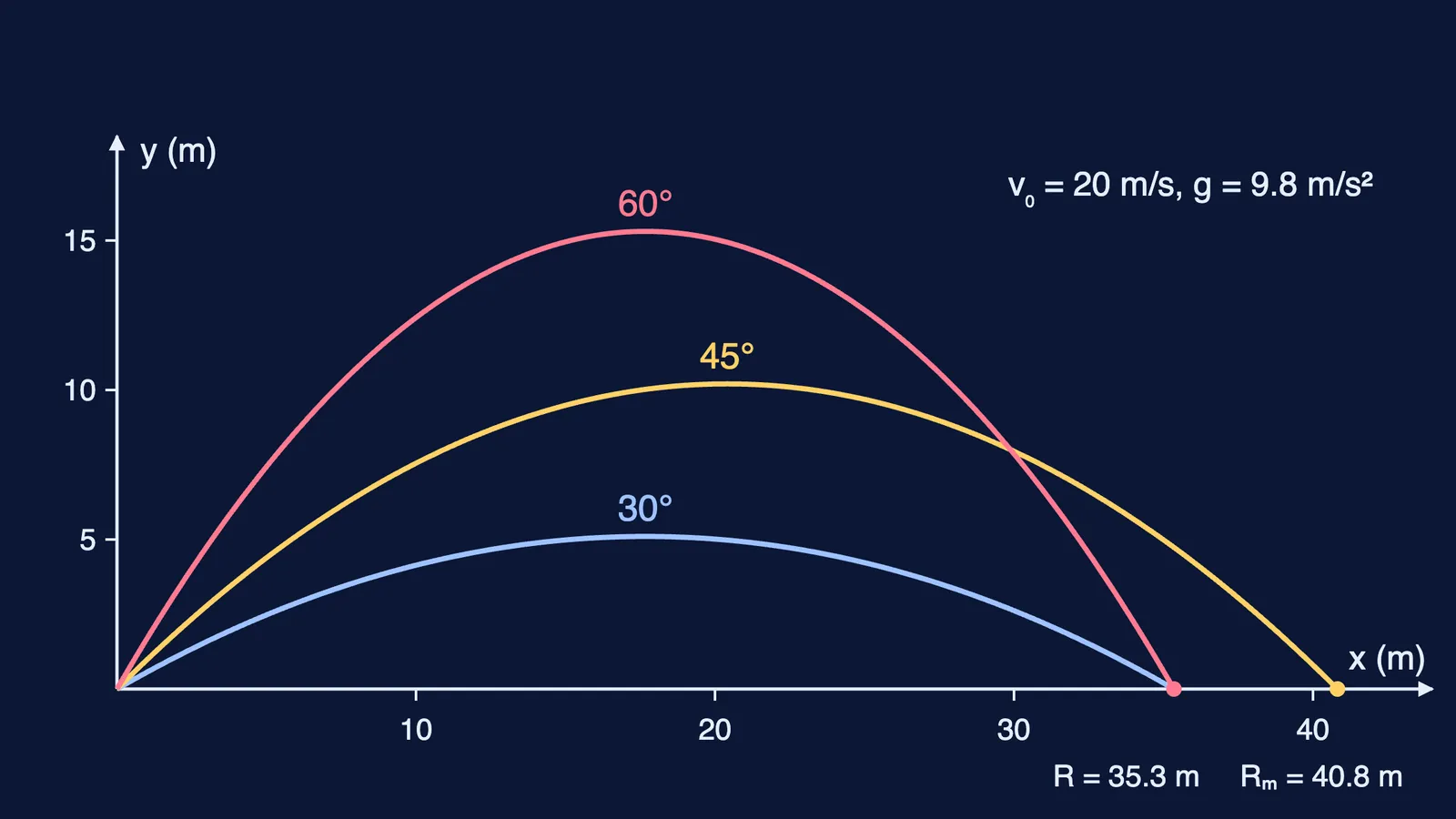
Landing at launch level only: time of flight T_f = 2v₀ sin θ₀/g (s) and range R = v₀² sin 2θ₀/g (m).
Largest range for a given v₀: Rₘ = v₀²/g (m), at θ₀ = 45°.
Worked example: a ball leaves the ground at 20 m s⁻¹ and 30°. Then tₘ = 1.02 s, hₘ = 5.10 m, T_f = 2.04 s and R = 35.3 m. At 60° the range is also 35.3 m, since sin 120° = sin 60°.
Watch for: using T_f and R when landing below the launch point, as off a cliff; solve y(t) for the real landing height instead.
To see how θ₀ changes the path, try the Fermi Simulation Lab, interactive simulations for ideas easier to see than read.
Uniform circular motion formulas
Condition: constant speed on a circle of radius R (m).
Angular speed: ω = Δθ/Δt (rad s⁻¹).
Linear speed: v = ωR (m s⁻¹).
Frequency ν (Hz) and period T (s): ω = 2πν = 2π/T (rad s⁻¹), v = 2πνR (m s⁻¹).
Centripetal acceleration, pointing to the centre: a_c = v²/R = ω²R = 4π²ν²R (m s⁻²).
Worked example: a fan blade tip 0.60 m from the axis at 300 revolutions per minute has ν = 5.0 Hz, so ω = 31.4 rad s⁻¹, v = 18.8 m s⁻¹ and a_c = 592 m s⁻².
Watch for: putting rpm straight into ω = 2πν. Divide by 60 first.
How to revise this formula sheet
Derive tₘ, hₘ, T_f and R from the x and y equations instead of memorising four results.
Check units on every answer: a_c must come out in m s⁻², a dot product of N and m in J.
Test the range formula at 30° and 60° with any speed; the ranges should match.
Practise with Motion in a plane case study questions, naming each formula's condition before using it.