On this page
In a case-based question, one wrong component can spoil every part that follows. Below are three original cases on motion in a plane, easiest first, each with four parts of rising difficulty and worked answers. They stay inside the CBSE Physics syllabus for 2026-27 and follow NCERT Class 11 Physics Chapter 3 (Reprint 2026-27). Class 11 papers are set by schools, so treat these as practice in the case-based style, not as a prediction of your paper. Take g = 9.8 m/s² and ignore air resistance throughout.
Formulas are in our Class 11 guide to motion in a plane; the format itself is explained in how case-based questions work.
Case 1: How far has the delivery drone really gone?
A pharmacy in Gurugram tests a delivery drone over open ground. Take x as east and y as north. From the shop, the drone flies 700 m due east to a junction, then turns and flies 400 m in a straight line at 60° north of east, landing on a hospital roof. The whole trip, both legs, takes 50 s. The operator's screen shows two numbers: the distance flown and the straight-line distance from the shop to the roof.
(i) Which of these is a scalar? (a) displacement (b) velocity (c) distance flown (d) acceleration
(ii) Find the x- and y-components of the second leg.
(iii) Find the magnitude and direction of the drone's total displacement.
(iv) Find the average speed and the magnitude of the average velocity. Why are they different?
Answers.
(i) (c). Distance (path length) has magnitude only; the other three need a direction.
(ii) x = 400 cos 60° = 200 m; y = 400 sin 60° = 346 m.
(iii) Add components: Rx = 700 + 200 = 900 m, Ry = 0 + 346 = 346 m. R = √(900² + 346²) = 964 m, at tan⁻¹(346/900) = 21.1° north of east.
(iv) Average speed = 1,100 m / 50 s = 22.0 m/s. Average velocity = 964 m / 50 s = 19.3 m/s, along the displacement. Path length exceeds displacement because the drone changed direction, so average speed is larger.
Case 2: At what angle should the gardener aim the hose?
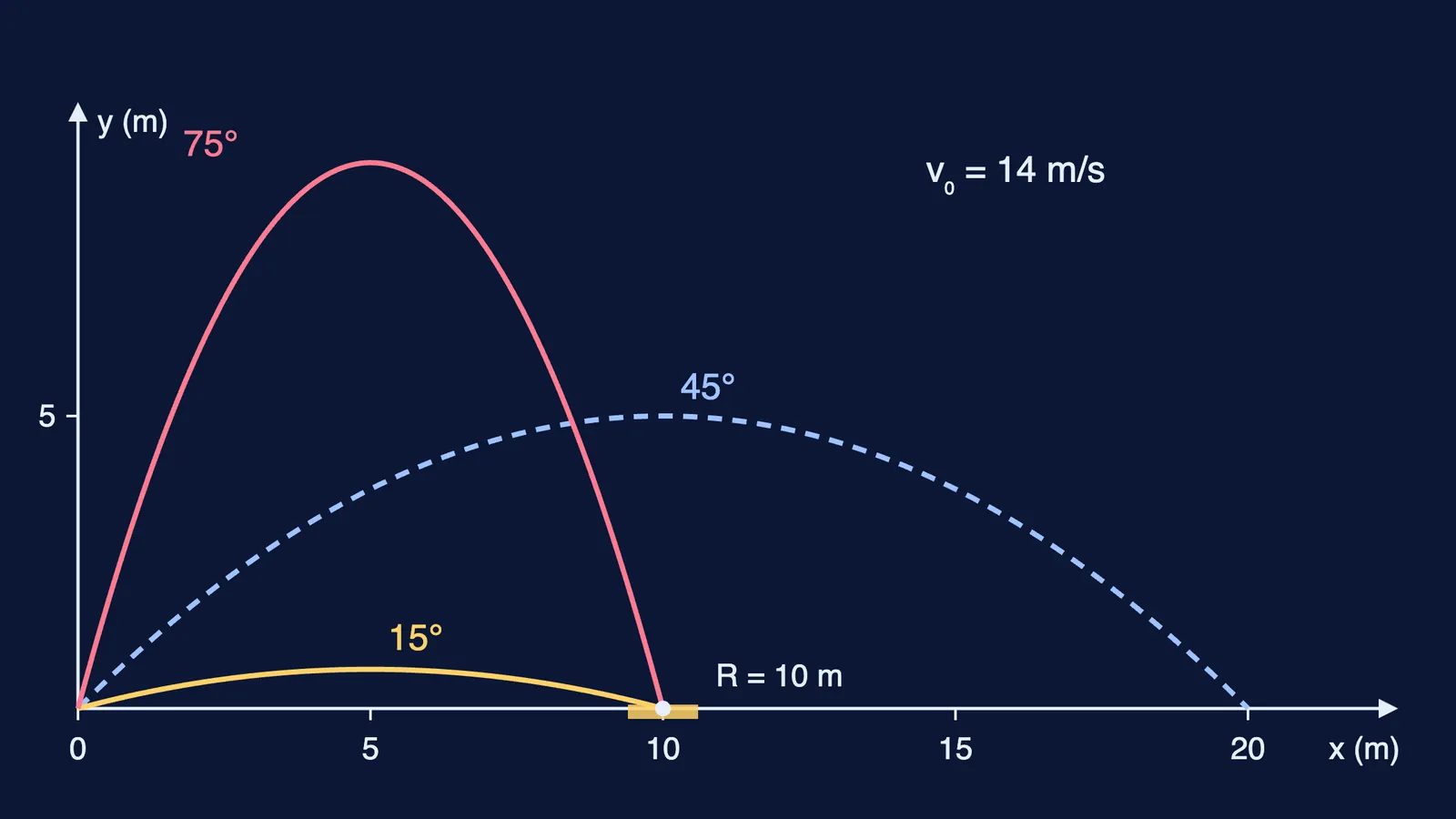
At a plant nursery in Pune, a gardener's hose nozzle sends water out at 14 m/s from ground level. Treat each drop as a projectile launched from the origin. He first tries an angle of 30° above the horizontal, then 60°, and notices the water lands at the same spot both times but rises much higher at 60°. Later he needs to water a flower bed exactly 10 m away on level ground, and wonders if more than one angle will work.
(i) At the highest point of its path, a water drop's velocity is: (a) zero (b) horizontal (c) vertical (d) along the nozzle
(ii) What is the farthest the jet can reach on level ground, and at what angle?
(iii) Find the range at 30° and the maximum heights at 30° and 60°. Why do both angles give the same range?
(iv) Find both angles that land water on the bed 10 m away, and the time of flight for each.
Answers.
(i) (b). At the top vy = 0, but vx = vo cos θo never changes.
(ii) Rm = vo²/g = 14²/9.8 = 20.0 m, at 45°.
(iii) R = vo² sin 2θo/g = 196 × sin 60°/9.8 = 17.3 m. hm = (vo sin θo)²/2g gives (7.0)²/19.6 = 2.5 m at 30° and (12.1)²/19.6 = 7.5 m at 60°. The range depends on sin 2θo, and sin 60° = sin 120°, so angles equally above and below 45° give equal ranges.
(iv) sin 2θo = Rg/vo² = 98/196 = 0.5, so 2θo = 30° or 150°: θo = 15° or 75°. Tf = 2vo sin θo/g gives 0.74 s at 15° and 2.76 s at 75°.
Case 3: Where do keys dropped from a giant wheel land?
At a Dasara fair in Mysuru, a giant wheel of radius 15 m turns at a steady rate, making one full revolution every 60 s. Its centre is 17 m above the ground, so the top seat is 32 m up. Ananya, at the very top, lets her keys slip out of her hand. At that instant the seat, and so the keys, are moving horizontally with the wheel's speed. Her brother waits below and wants to know where to search.
(i) At the top of the wheel, Ananya's acceleration points: (a) along her velocity (b) vertically up (c) vertically down, towards the centre (d) it is zero, since her speed is constant
(ii) Find the wheel's angular speed and Ananya's linear speed.
(iii) Find her centripetal acceleration and compare it with g. Is it a constant vector?
(iv) How long do the keys take to land, how far ahead of the point directly below the release point, and at what speed?
Answers.
(i) (c). In uniform circular motion the acceleration points towards the centre, which is straight down from the top seat.
(ii) ω = 2π/T = 2π/60 = 0.105 rad/s; v = Rω = 15 × 0.105 = 1.57 m/s.
(iii) ac = v²/R = 1.57²/15 = 0.164 m/s², about 1.7% of g. Its magnitude is constant but its direction keeps turning towards the centre, so it is not a constant vector.
(iv) Vertically, 32 = ½ × 9.8 × t², so t = 2.56 s. Horizontally, x = 1.57 × 2.56 = 4.0 m ahead. Then vy = 9.8 × 2.56 = 25.0 m/s, so speed = √(1.57² + 25.0²) = 25.1 m/s.
How do you attack case-study questions on motion in a plane?
Fix your axes and positive directions before writing any equation.
Resolve every vector into components; add components, not magnitudes.
For a projectile, the horizontal velocity never changes; only vy is affected by g.
For range questions, think in sin 2θo: two angles adding to 90° give the same range.
In circular motion, constant speed does not mean zero acceleration; check whether a part asks for magnitude or for the vector.
If projectile paths are hard to picture, the Fermi Simulation Lab has interactive simulations for ideas that are easier to see than to read. For the groundwork, see our Class 11 guide to motion in a straight line.