On this page
The rationalised NCERT Class 11 Physics Part I, Chapter 3: Motion in a Plane (reprint 2026-27) works through several derivations in its text and worked examples, including these five: the sum of two vectors, the path of a projectile, its time of flight and maximum height, its range, and centripetal acceleration. The CBSE Class XI Physics syllabus for 2026-27 lists projectile motion and uniform circular motion in this chapter, so all five are on the syllabus.
Each derivation has a setup line, short steps, the result in bold and a common slip. For the full chapter plan, start with our Motion in a plane Class 11 guide.
Resultant of two vectors: R = √(A² + B² + 2AB cos θ)
Setup: vectors A and B start from one point O with angle θ between them; the diagonal of their parallelogram from O is the resultant R = A + B (NCERT Example 3.2).
From the tip S of R, drop a perpendicular onto the line of A, extended; call its foot N.
Then ON = A + B cos θ and SN = B sin θ.
Pythagoras in triangle ONS: R² = (A + B cos θ)² + (B sin θ)².
Expand and use sin²θ + cos²θ = 1.
For direction, the angle α between R and A has tan α = SN/ON.
Result: R = √(A² + B² + 2AB cos θ), with tan α = B sin θ/(A + B cos θ).
Where students slip: writing −2AB cos θ. That is the triangle form, where θ is the angle opposite the side, not the angle between the vectors.
Why is a projectile's path a parabola?
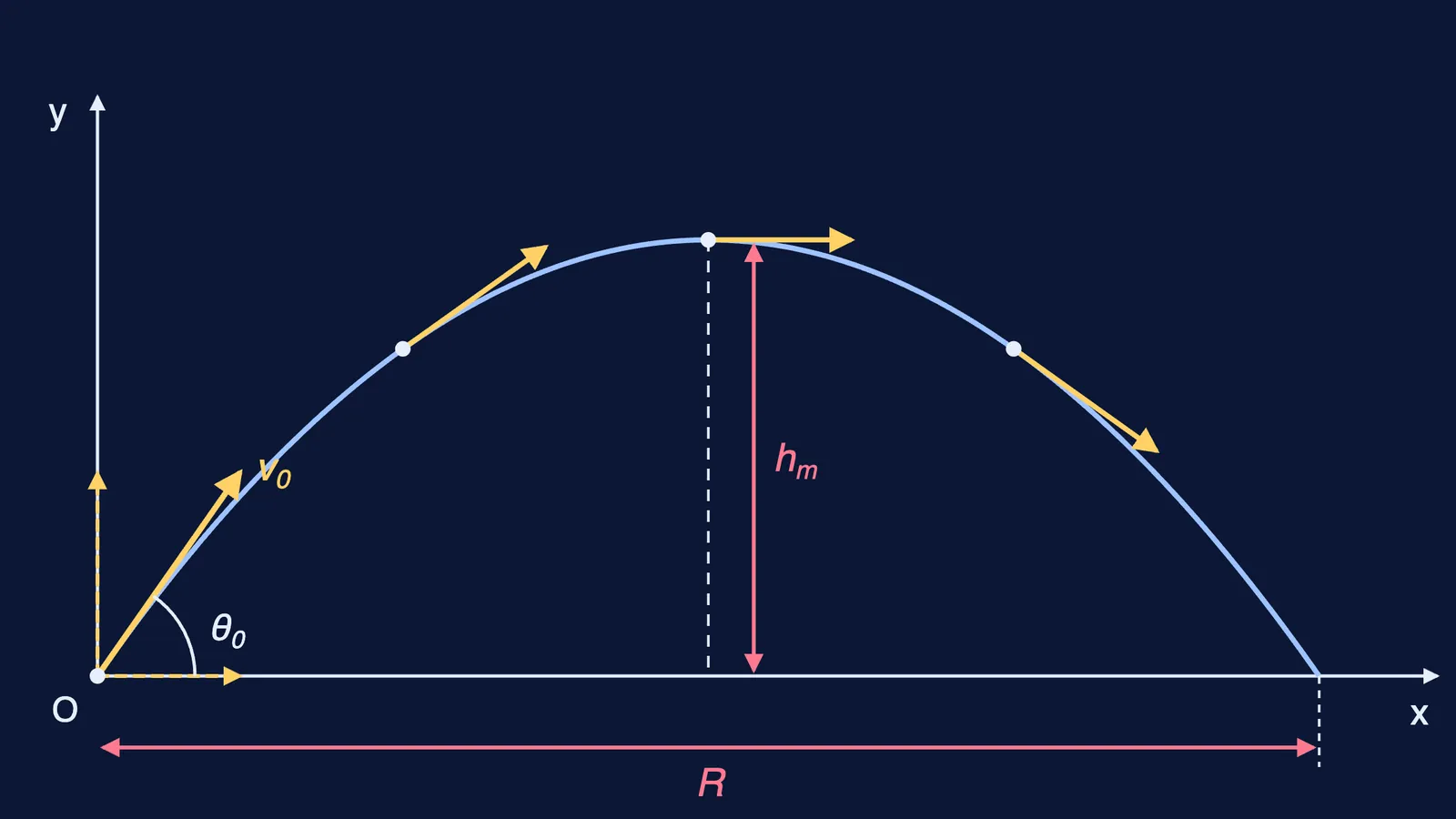
Setup: a ball leaves the origin with speed v₀ at angle θ₀ above the horizontal; air resistance is ignored, y points up, so aₓ = 0 and a_y = −g.
Split the launch velocity: v₀ cos θ₀ along x, v₀ sin θ₀ along y.
No horizontal acceleration: x = (v₀ cos θ₀)t.
Constant vertical acceleration −g: y = (v₀ sin θ₀)t − ½gt².
From step 2, t = x/(v₀ cos θ₀); put it into step 3.
Result: y = (tan θ₀)x − gx²/(2v₀² cos²θ₀), of the form y = ax + bx², a parabola.
Where students slip: squaring only v₀ in the second term. All of (v₀ cos θ₀) is squared, because t was squared.
Time of flight and maximum height: T_f = 2v₀ sin θ₀/g, hₘ = (v₀ sin θ₀)²/2g
Setup: the same launch, with vertical velocity v_y = v₀ sin θ₀ − gt and landing at the launch level.
At the top the motion is purely sideways, so v_y = 0: tₘ = v₀ sin θ₀/g.
Landing means y = 0. Divide (v₀ sin θ₀)t − ½gt² = 0 by t, which is not zero: T_f = 2v₀ sin θ₀/g = 2tₘ.
Put t = tₘ into y: hₘ = (v₀ sin θ₀)²/g − (v₀ sin θ₀)²/2g.
Result: T_f = 2v₀ sin θ₀/g and hₘ = (v₀ sin θ₀)²/2g.
In NCERT Example 3.8, a ball thrown at 28 m/s and 30° gives hₘ = 10.0 m and T_f = 2.9 s with g = 9.8 m/s².
Where students slip: using T_f when the landing level differs, as for the stone thrown off a cliff in Example 3.7. These formulas need landing at launch height.
How far does a projectile go?
Setup: the range R (here not a resultant) is the horizontal distance covered in the time of flight.
The horizontal speed stays v₀ cos θ₀, so R = (v₀ cos θ₀)T_f.
Substitute T_f: R = (v₀ cos θ₀)(2v₀ sin θ₀)/g.
Use 2 sin θ₀ cos θ₀ = sin 2θ₀.
sin 2θ₀ is largest, 1, when θ₀ = 45°.
Result: R = v₀² sin 2θ₀/g, with the largest range v₀²/g at θ₀ = 45°.
Because sin(90° + 2α) = sin(90° − 2α), launches at 45° + α and 45° − α land equally far (NCERT Example 3.6).
Where students slip: writing sin θ₀ or sin²θ₀ for sin 2θ₀, which moves the best angle.
Centripetal acceleration: a_c = v²/R = ω²R
Setup: an object moves at constant speed v on a circle of radius R (here the radius). In a short time Δt the radius turns through a small angle Δθ.
Velocity is tangent, so perpendicular to the radius; it also turns through Δθ.
The triangle of the two radii and chord Δr, and the triangle of v, v′ and Δv, are isosceles with the same apex angle Δθ, so similar: Δv/v = Δr/R.
Divide by Δt: Δv/Δt = (v/R)(Δr/Δt).
As Δt → 0 the chord matches the arc, so Δr/Δt → v, and Δv points to the centre.
Put v = ωR, with ω the angular speed, and ω = 2πν, with ν the frequency.
Result: a_c = v²/R = ω²R = 4π²ν²R, directed towards the centre.
Where students slip: saying the acceleration is zero because the speed is constant. The velocity's direction changes, so there is acceleration; its size is fixed but it keeps turning to face the centre, so it is not constant either.
How should you practise Motion in a plane derivations?
Draw the figure first. Mark θ between the tails of the vectors, the axes and the sign of g; many wrong signs start in a careless figure.
Derive the projectile results as one chain. Write the two component equations, then get the path, tₘ, T_f, hₘ and R in order. Forget one and you can rebuild it from the step before.
Test special cases. θ = 90° should give R = √(A² + B²), θ₀ = 90° should give zero range, and for any launch hₘ divided by the range equals (tan θ₀)/4.
Watch the components change. Fermi Simulation Lab has interactive simulations for ideas that are easier to see than to read. The diagram at the top shows the one to picture here: the horizontal velocity stays the same while the vertical one shrinks, then grows downward.
Then use the derivations in longer problems with the Motion in a plane case study questions for Class 11.