On this page
Morphology of Flowering Plants is Chapter 5 of the NCERT Class 11 Biology textbook (Reprint 2026-27). The CBSE Class XI Biology syllabus for 2026-27 lists root, stem, leaf, inflorescence, flower, fruit and seed, plus a description of family Solanaceae. For a chapter overview, see our Morphology of Flowering Plants Class 11 guide.
The current chapter has no sections on root, stem or leaf modifications; older notes on Fabaceae and Liliaceae go beyond it.
Root and stem: what are the key terms?
Tap root system: the primary root, grown straight from the radicle, plus its lateral branches. Example: mustard; most dicots.
Fibrous root system: many roots arising from the stem base after the short-lived primary root dies away. Example: wheat; most monocots.
Adventitious roots: roots that grow from any part other than the radicle. Example: grass, *Monstera*, the banyan tree.
Root cap: a thimble-shaped cover that shields the tender root tip as it pushes through soil.
Root tip regions: above the root cap come the region of meristematic activity (small, repeatedly dividing cells), the region of elongation (cells lengthen fast) and the region of maturation (cells differentiate; some epidermal cells form root hairs that absorb water and minerals).
Node and internode: a node is where a leaf arises on the stem; an internode is the stretch between two nodes.
What are the parts and types of a leaf?
Leaf base, petiole and lamina: a leaf's attachment, stalk and green blade.
Axillary bud: a bud in the angle between leaf and stem that can grow into a branch.
Venation: the pattern the veins and veinlets make across the lamina. Reticulate forms a net (most dicots); parallel runs side by side (most monocots).
Simple vs compound leaf: in a simple leaf any cuts in the lamina stop short of the midrib; in a compound leaf they reach it, splitting the blade into leaflets. Tip: a bud sits in the axil of the petiole, never of a leaflet.
Pinnately compound: leaflets along a common axis, the rachis. Example: neem. Don't confuse with: palmately compound, leaflets joined at the petiole tip, as in silk cotton.
Phyllotaxy: the leaf pattern set by how many leaves arise per node: one (alternate; china rose, mustard), a facing pair (opposite; *Calotropis*, guava) or three or more (whorled; *Alstonia*).
Inflorescence and flower: what do the terms mean?
Inflorescence: the way a plant's flowers are grouped along the floral axis. In racemose types the main axis keeps growing and flowers form in acropetal order, oldest at the base. Don't confuse with: cymose, where the axis ends in a flower and flowers form in basipetal order.
Thalamus (receptacle): the swollen tip of the pedicel that carries the four floral whorls.
Perianth: calyx and corolla that cannot be told apart, as in lily.
Bisexual vs unisexual: both stamens and carpels vs only one of them.
Actinomorphic: splits into two equal halves along any plane through the centre. Example: mustard, datura, chilli. Don't confuse with: zygomorphic, only one such plane (pea, *Cassia*).
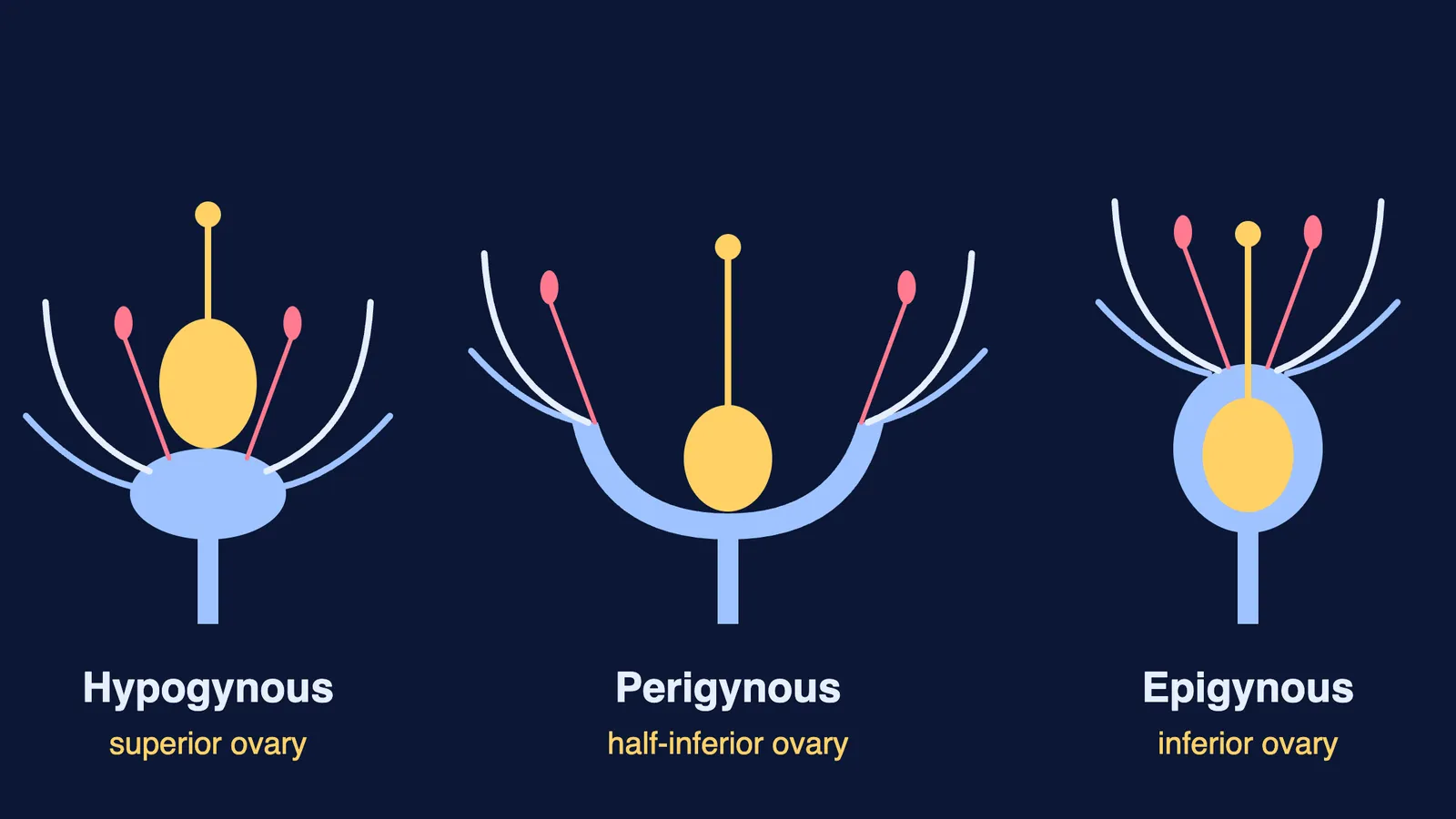
Hypogynous, perigynous, epigynous: the ovary is superior, half inferior or inferior, judged by where the other floral parts attach. Examples: mustard, rose, guava.
Gamosepalous / gamopetalous: sepals or petals joined. Don't confuse with: polysepalous or polypetalous, which are free.
Aestivation: how sepals or petals sit in the bud: valvate (edges just touch, *Calotropis*), twisted (each overlaps the next, china rose), imbricate (overlap in no fixed direction, gulmohur) or vexillary (standard over wings over keel, pea).
What are androecium and gynoecium terms?
Stamen: filament plus anther; each anther usually has two lobes of two pollen sacs each. A sterile stamen is a staminode.
Epipetalous: stamens attached to petals (brinjal). Don't confuse with: epiphyllous, attached to the perianth (lily).
Monoadelphous, diadelphous, polyadelphous: stamens joined in one bundle (china rose), two (pea) or more than two (citrus).
Carpel: stigma, style and ovary; ovules sit on the placenta inside the ovary.
Apocarpous vs syncarpous: free carpels (lotus, rose) vs fused carpels (mustard, tomato).
Placentation: where and how the ovules attach inside the ovary: marginal (pea), axile (china rose, tomato), parietal with a false septum (mustard), free central (*Dianthus*) or basal (sunflower, marigold).
Which fruit and seed terms should you know?
Fruit: what the ovary becomes once it ripens after fertilisation. A parthenocarpic fruit forms without fertilisation.
Pericarp: the fruit wall; when fleshy, it has an outer epicarp, a middle mesocarp and an inner endocarp.
Drupe: a one-seeded fruit from a monocarpellary superior ovary. Example: mango (stony endocarp) and coconut (fibrous mesocarp).
Testa and tegmen: the outer and inner layers of the seed coat.
Hilum: the scar where the seed was attached to the fruit. Don't confuse with: the micropyle, a small pore just above it.
Endospermic vs non-endospermous: food stored in endosperm (castor, maize) vs no endosperm in the mature seed (bean, gram, pea).
Aleurone layer: the protein-rich outer layer of the endosperm in a maize grain.
Scutellum: the single large, shield-shaped cotyledon of a cereal embryo; its plumule and radicle are sheathed by the coleoptile and coleorhiza.
How are floral formulas and Solanaceae described?
Floral formula: a one-line code for a flower. K, C, P, A and G stand for calyx, corolla, perianth, androecium and gynoecium; a bracket around a number shows fusion.
Floral diagram: the whorls drawn as concentric rings, calyx outside and gynoecium in the centre, with a dot at the top marking the mother axis. NCERT's worked example is mustard (Brassicaceae).
Solanaceae: the potato family, the only family the chapter describes. Its flowers are bisexual and actinomorphic, with five united sepals, five united petals, five epipetalous stamens and a bicarpellary, syncarpous superior ovary with axile placentation.
See our step-by-step post on how to draw a floral diagram.
How to learn these terms
Learn the pairs together: racemose vs cymose, apocarpous vs syncarpous, hilum vs micropyle.
Tie terms to plants: china rose alone covers alternate phyllotaxy, twisted aestivation, monoadelphous stamens and axile placentation.
Sketch the three ovary positions and five placentation types from memory, then check NCERT.
Test yourself with our Morphology of Flowering Plants practice questions.
If a term feels abstract, the Fermi Concept Library covers every concept in biology, each with its own lesson and its place in the map.