On this page
Eight new JEE Advanced-style questions, easy to hard. Each solution ends with the trap, the most tempting wrong option.
What does JEE Advanced ask from mole concept?
The official JEE (Advanced) 2026 syllabus lists mole concept, balanced equations, calculations on redox, neutralisation and displacement reactions, and mole fraction, molarity, molality and normality. For the theory, read our guide on how to prepare mole concept and stoichiometry for JEE Advanced.
How should you use this set?
Hide the solutions; allow 3 minutes per easy question, 6 per hard.
In multiple-correct questions, judge each option alone.
Use H = 1, C = 12, O = 16, Na = 23, Ca = 40, Ag = 108.
Easy: can you convert, weigh and displace?
Q1 (easy, single correct). Aqueous methanol has a CH₃OH mole fraction of 0.20. Its molality is closest to
(A) 11.1 mol kg⁻¹
(B) 13.9 mol kg⁻¹
(C) 0.25 mol kg⁻¹
(D) 7.81 mol kg⁻¹
Answer: (B). In 1 mol of solution, 0.20 mol methanol sits in 0.80 mol (14.4 g) of water. Molality = 0.20 ÷ 0.0144 = 13.9 mol kg⁻¹. Trap: (A) treats the whole 1 mol as water.
Q2 (easy, single correct). What mass of H₂C₂O₄·2H₂O must be dissolved in 250 mL of solution so that 20.0 mL of it neutralises 25.0 mL of 0.100 M NaOH?
(A) 3.94 g
(B) 1.41 g
(C) 1.97 g
(D) 0.984 g
Answer: (C). NaOH = 2.50 mmol; the diprotic acid needs half, 1.25 mmol per 20.0 mL. So 250 mL holds 0.0156 mol × 126 = 1.97 g. Trap: (A) uses a 1 : 1 ratio; (B) drops the water of crystallisation.
Q3 (easy, numerical value). 0.327 g of a divalent metal M displaces 1.080 g of silver from excess AgNO₃ solution. The molar mass of M, in g mol⁻¹, is ____.
Answer: 65.4. Ag = 1.080 ÷ 108 = 0.0100 mol. M gives 2 electrons and each Ag⁺ takes 1, so M = 0.00500 mol and 0.327 ÷ 0.00500 = 65.4. Trap: 32.7 is the equivalent mass.
Medium: can you handle density, back-titration and two titres?
Q4 (medium, one or more options correct). Aqueous NaOH is 20.0% by mass, density 1.20 g mL⁻¹. Which statements are correct?
(A) Its molarity is 6.00 M.
(B) Its molality is 5.00 mol kg⁻¹.
(C) The mole fraction of NaOH is 0.101.
(D) 10.0 mL of it is exactly neutralised by 30.0 mL of 1.00 M H₂SO₄.
Answer: (A), (C), (D). 1 L weighs 1200 g and holds 240 g = 6.00 mol NaOH. The water is 960 g = 53.3 mol, so molality = 6.00 ÷ 0.960 = 6.25 mol kg⁻¹ and x = 6.00 ÷ 59.3 = 0.101. 10.0 mL holds 60.0 mmol, needing 30.0 mmol H₂SO₄. Trap: (B) divides by 1 kg of solution, not of water.
Q5 (medium, single correct). 2.50 g of impure limestone is dissolved in 50.0 mL of 1.00 M HCl, and the excess acid needs 12.0 mL of 0.500 M NaOH. If only CaCO₃ reacts, its percentage is
(A) 76.0%
(B) 88.0%
(C) 94.0%
(D) 12.0%
Answer: (B). HCl used = 50.0 − 6.00 = 44.0 mmol. CaCO₃ + 2HCl → CaCl₂ + H₂O + CO₂, so CaCO₃ = 22.0 mmol = 2.20 g, or 88.0%. Trap: (A) reads 12.0 mL as 12.0 mmol and skips the 0.500 M.
Q6 (medium, numerical value). 25.0 mL of an acidified solution of Fe²⁺ and Fe³⁺ needs 15.0 mL of 0.0200 M KMnO₄. A second 25.0 mL, after zinc reduces all iron to Fe²⁺ and is removed, needs 40.0 mL. The percentage of the iron present as Fe³⁺ is ____.
Answer: 62.5. MnO₄⁻ takes 5 electrons, each Fe²⁺ gives 1. First titre: Fe²⁺ = 5 × 0.300 = 1.50 mmol. Second titre: total Fe = 5 × 0.800 = 4.00 mmol. Fe³⁺ = 2.50 mmol, or 62.5%. Trap: 37.5 is Fe²⁺.
Hard: can you read gas volumes and double-indicator titres?
Q7 (hard, one or more options correct). 10 mL of a gaseous hydrocarbon is exploded with 80 mL of O₂. Back at the starting temperature and pressure (water condensed), 65 mL of gas remains; KOH solution reduces it to 35 mL. Which statements are correct?
(A) The hydrocarbon is C₃H₆.
(B) The volume of O₂ consumed is 35 mL.
(C) The 65 mL is 30 mL of CO₂ and 35 mL of O₂.
(D) The vapour density of the hydrocarbon is 42.
Answer: (A), (C). KOH absorbs 30 mL CO₂, so x = 3. O₂ used, 45 mL, equals 10(x + y/4), so y = 6. Trap: (B) is the oxygen left over. (D) is the molar mass; the vapour density is 21.
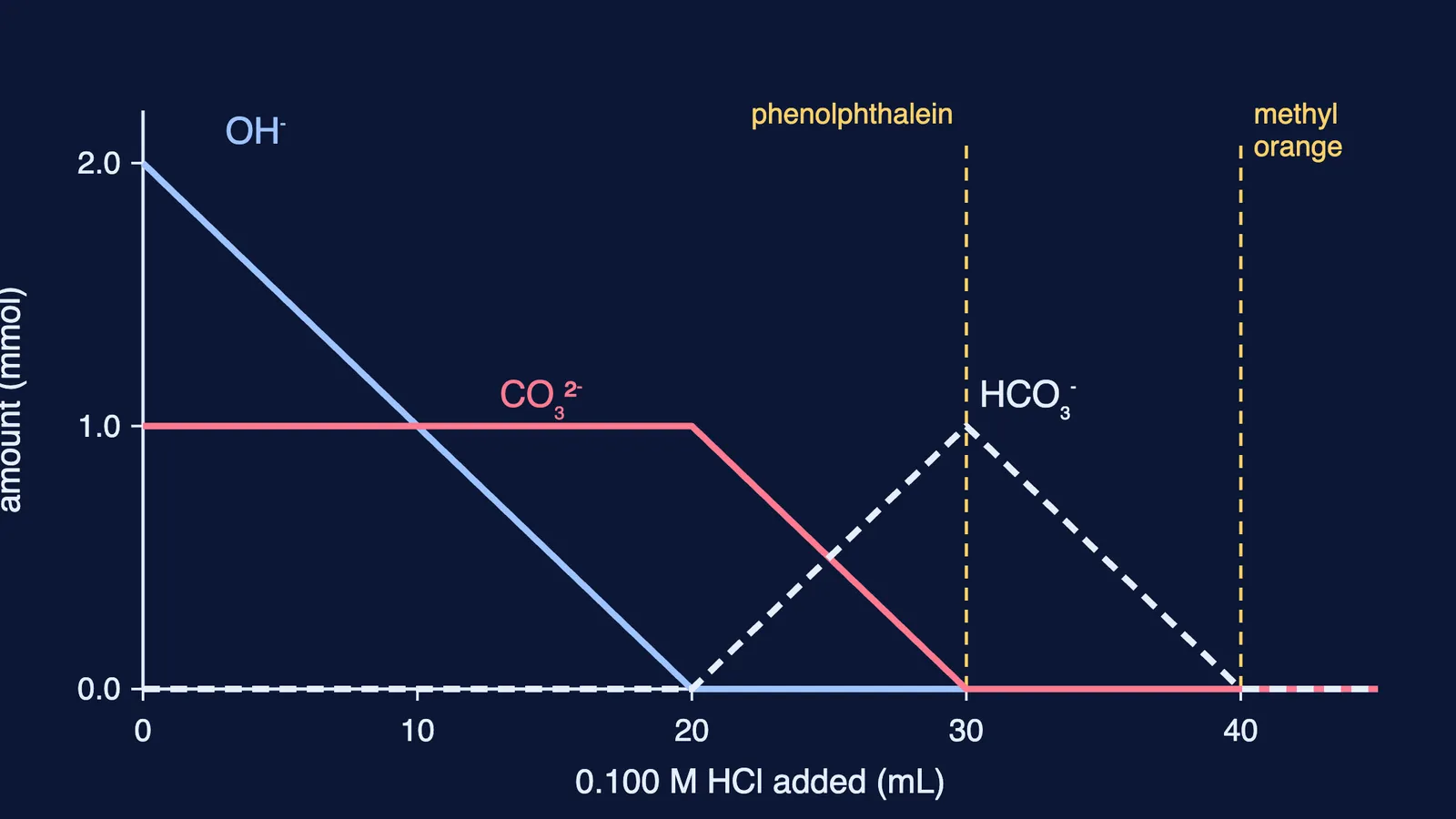
Q8 (hard, list match). 25.0 mL of NaOH plus Na₂CO₃ is titrated with 0.100 M HCl. The phenolphthalein end point (OH⁻ neutralised, CO₃²⁻ to HCO₃⁻) comes at 30.0 mL. With methyl orange, 10.0 mL more turns HCO₃⁻ to CO₂. Match List-I with List-II.
List-I: (P) [NaOH], (Q) [Na₂CO₃], (R) [Na⁺], (S) HCl needed by a fresh 25.0 mL with methyl orange alone
List-II: (1) 0.0400 M, (2) 0.0800 M, (3) 0.120 M, (4) 0.160 M, (5) 40.0 mL
(A) P→2, Q→1, R→4, S→5
(B) P→3, Q→1, R→4, S→5
(C) P→2, Q→1, R→3, S→5
(D) P→1, Q→2, R→4, S→5
Answer: (A). The second stage gives CO₃²⁻ = 1.00 mmol (0.0400 M). Of the first 3.00 mmol, 1.00 went to carbonate, leaving NaOH = 2.00 mmol, 0.0800 M. Na⁺ = 4.00 mmol (0.160 M), also the total HCl: 40.0 mL. Trap: (B) counts the whole first titre as NaOH; (C) gives Na₂CO₃ one Na⁺.
How did you do?
Score a multiple-correct question only if you chose every true option and no false one. For how the exam itself scores them, see partial marking in multiple-correct questions.
7 or 8: move to mixed physical chemistry sets.
4 to 6: redo misses in three days.
3 or fewer: work through the mole concept JEE Main practice set first.
If a step keeps breaking, the Fermi Problem Library has worked problems with a step-by-step solver that explains the reasoning rather than printing an answer.