On this page
Mole concept looks easy, but at Advanced level it is the arithmetic behind much of physical chemistry. Here is the syllabus, what it adds over JEE Main, three solved problems and a plan.
What is in the JEE Advanced mole concept syllabus?
Under "General topics", the official JEE (Advanced) 2026 syllabus lists: "Concept of atoms and molecules; Dalton's atomic theory; Mole concept; Chemical formulae; Balanced chemical equations; Calculations (based on mole concept and stoichiometry) involving common oxidation-reduction, neutralisation, and displacement reactions; Concentration in terms of mole fraction, molarity, molality and normality." The same document notes that the 2026 syllabus is the same as 2025. The 2027 syllabus has not been published yet (as of 19 November 2026).
What is announced: JEE (Advanced) 2027 will be held on 23 May 2027 (Sunday), organised by IIT Delhi. To appear, you must be among the top 2,50,000 successful candidates in the B.E./B.Tech. paper of JEE (Main) 2027, along with the other criteria on that page.
How is JEE Advanced stoichiometry different from JEE Main?
The JEE (Main) 2027 syllabus covers mole concept, empirical formulae and stoichiometry in its first unit, and molality, molarity and mole fraction under Solutions. Normality appears in the Advanced list but not in the Main one. Main covers redox balancing (Unit 7) and KMnO₄ titrations (Unit 20), but only Advanced names stoichiometric calculations for redox, neutralisation and displacement reactions. That means n-factors and equivalents. After our mole concept guide for JEE Main, close these gaps.
JEE (Advanced) 2026 had two compulsory papers of three hours each (2026 Information Brochure). Question types and marking are announced in the paper itself, so practise single-correct, multiple-correct and numerical answers. Our post on partial marking in multiple-correct questions explains why each option needs its own check.
Three habits matter most:
Find the n-factor from the reaction, not the formula.
Count equivalents on both sides. Oxidant equals reductant; acid equals base.
Check the extremes. For a mixture, solve for each pure component; the real answer lies between.
Worked examples at Advanced level
All three problems and their numbers are our own. Molar masses: FeC₂O₄ 143.86, Na₂C₂O₄ 134.00, H₂SO₄ 98.07, Zn 65.38, Cu 63.55 g/mol.
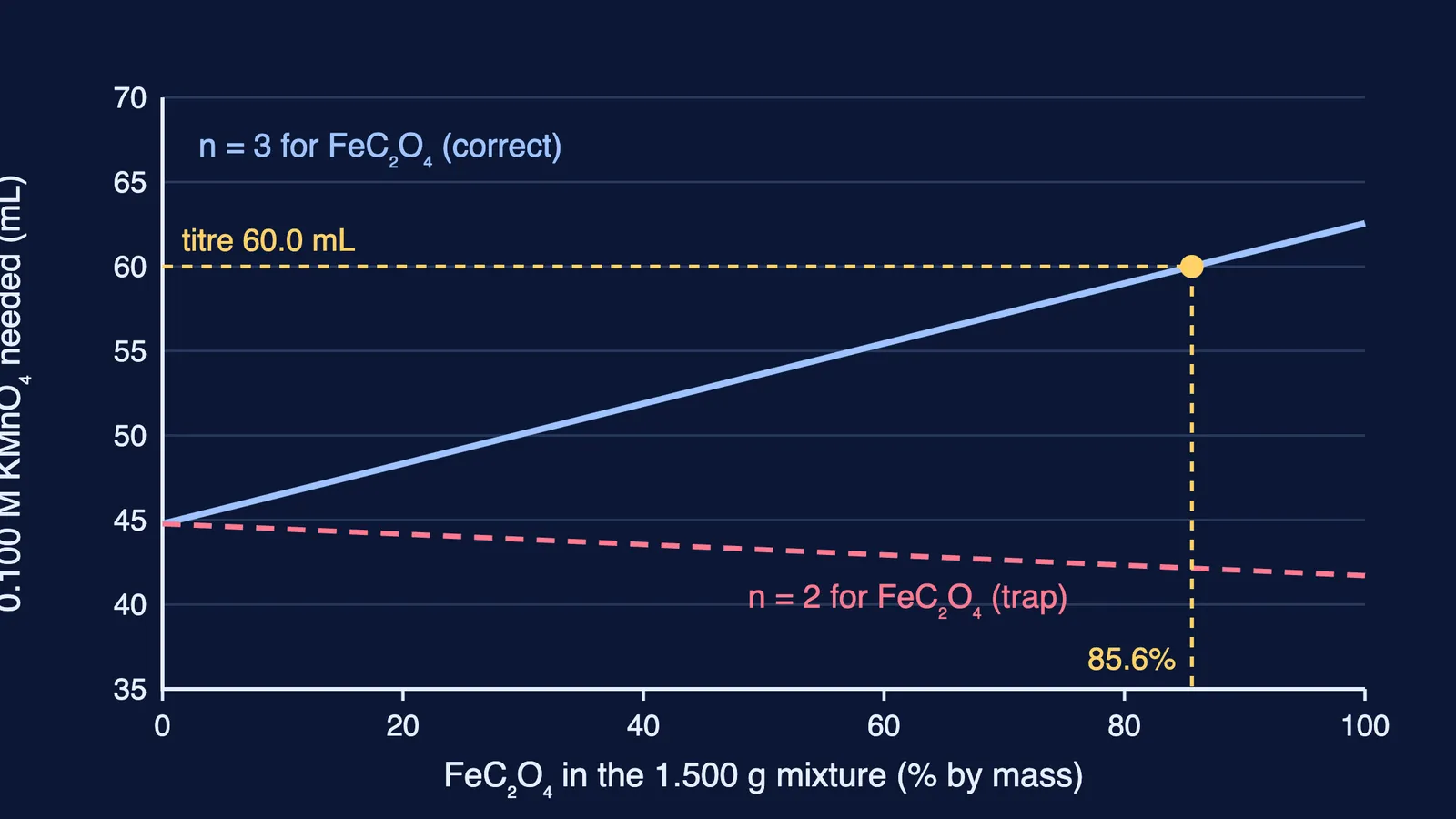
1. A mixture with two n-factors. A 1.500 g mixture of FeC₂O₄ and Na₂C₂O₄ needs 60.0 mL of 0.100 M KMnO₄ in acid. Find the mass of FeC₂O₄. MnO₄⁻ gains 5 electrons, so the titre is 5 × 0.100 × 0.0600 = 0.0300 equivalents. In FeC₂O₄ both Fe²⁺ (one electron) and oxalate (two) are oxidised, so n = 3; for Na₂C₂O₄, n = 2. With a and b moles: 3a + 2b = 0.0300 and 143.86a + 134.00b = 1.500. So a = 0.008926 mol: 1.284 g of FeC₂O₄ (85.6%) and 0.216 g of Na₂C₂O₄. Extremes check: pure Na₂C₂O₄ would need 44.8 mL and pure FeC₂O₄ 62.6 mL, and 60.0 mL lies between.
2. Converting concentration terms. An H₂SO₄ solution is 2.00 mol/kg with density 1.12 g/mL. Take 1 kg of water: the solution weighs 1196.1 g and fills 1068.0 mL. Molarity = 2.00/1.068 = 1.87 M. Mole fraction of acid = 2.00/(2.00 + 55.51) = 0.0348. For full neutralisation n = 2, so normality = 3.75 N, and 3.34 mL neutralises 25.0 mL of 0.500 M NaOH. Dilute check: molarity tends to molality times water's density.
3. Displacement with a limiting reagent. 1.635 g of Zn (0.0250 mol) is added to 100 mL of a solution that is 0.100 M CuSO₄ and 0.200 M HCl. Zn is in excess, so all 0.0100 mol Cu²⁺ and 0.0200 mol H⁺ react: 0.636 g Cu deposits and 0.0100 mol H₂ forms. Zn used = 0.0200 mol, leaving 0.327 g, so the solid at the end weighs 0.963 g and [Zn²⁺] = 0.200 M. Equivalents check: Zn lost 0.0400; Cu²⁺ and H⁺ together gained 0.0400.
Want to see why a step works, not just the final number? The Fermi Problem Library has worked problems with a step-by-step solver that explains the reasoning rather than printing an answer.
How should you practise mole concept for JEE Advanced?
Revise definitions with our Class 11 Some Basic Concepts of Chemistry guide if any feel shaky.
Week one: concentration conversions with density, in both directions.
Week two: n-factors in redox and acid-base reactions, including partial neutralisation.
Week three: mixtures and back-titrations, set as multiple-correct statements you test one by one.
On every problem, write the equivalents equation first and check one extreme.
Practice:
Find the molarity and solute mole fraction of 0.250 mol/kg aqueous NaOH, density 1.010 g/mL.
25.0 mL of a solution of Fe²⁺ and Fe³⁺ needs 18.0 mL of 0.0200 M K₂Cr₂O₇ in acid. After zinc reduces all the iron to Fe²⁺, another 25.0 mL needs 30.0 mL. Find [Fe³⁺].
10.0 mL of H₃PO₄ is converted to Na₂HPO₄ by 20.0 mL of 0.150 M NaOH. Find its molarity and its normality for full neutralisation.
Answers: 0.250 M and 0.00448; 0.0576 M; 0.150 M and 0.450 N.