On this page
Mechanical properties of solids and of fluids are Chapters 8 and 9 of NCERT Class 11 Physics Part 2 (Chapter 8, Chapter 9), in Unit VII of the CBSE 2026-27 physics syllabus. Chapter guides: mechanical properties of solids and mechanical properties of fluids.
Left out: the beam-bending formula (applications of elasticity are "qualitative idea only" in the syllabus); NCERT gives critical speed no formula.
Which formulas cover stress, strain and the elastic moduli?
Stress: σ = F/A, in Pa (N m⁻²); F is force (N), A area (m²).
Strains (no unit): longitudinal ΔL/L; shearing Δx/L = tan θ ≈ θ (radians, small θ); volume ΔV/V.
Hooke's law: stress = modulus of elasticity × strain (modulus in Pa), in the linear part of the stress-strain curve only.
Young's modulus: Y = (F/A)/(ΔL/L) = FL/(AΔL), in Pa, for tension or compression.
Shear modulus: G = (F/A)/(Δx/L) = F/(Aθ), in Pa, F parallel to the face; for most materials G ≈ Y/3 (the syllabus asks only a qualitative idea of G).
Bulk modulus: B = −p/(ΔV/V), in Pa, p the pressure increase (Pa); the minus sign keeps B positive.
Compressibility: k = 1/B, in Pa⁻¹.
Worked example: a steel wire 2.0 m long, 0.60 mm in diameter, holds 5.0 kg (g = 9.8 m s⁻², Y = 2.0 × 10¹¹ Pa as in NCERT Example 8.1). F = 49 N and A = π(0.30 × 10⁻³ m)² = 2.83 × 10⁻⁷ m², so stress = 1.73 × 10⁸ Pa, strain = 8.67 × 10⁻⁴ and ΔL = 1.73 mm.
Watch for: putting the diameter into πr²; halve it first.
Poisson's ratio and elastic energy formulas
Poisson's ratio (ν here): ν = (Δd/d)/(ΔL/L), no unit; d is diameter. NCERT gives 0.28 to 0.30 for steels.
Elastic energy of a stretched wire: U = ½ × stress × strain × volume = ½ F ΔL, in J, within the elastic limit.
Energy per unit volume: u = ½ σε, in J m⁻³ (ε is strain).
Worked example: the same wire with ν = 0.29 thins by Δd = ν × strain × d = 1.5 × 10⁻⁷ m and stores U = ½ F ΔL = 0.042 J.
Watch for: U = F ΔL. Force grows from zero during stretching, hence the ½.
How do you find pressure in a fluid column?
Pressure P = F/A (Pa), F normal to A; density ρ = m/V (kg m⁻³).
Pressure at depth: P = Pa + ρgh, in Pa, so gauge pressure P − Pa = ρgh; Pa is atmospheric pressure, h depth below the free surface (m). Fluid at rest, uniform density.
Hydraulic lift (Pascal's law): F₂ = F₁(A₂/A₁), in N; A₂/A₁ is the mechanical advantage, ignoring friction.
Worked example: a jack with pistons of 4.0 × 10⁻⁴ m² and 0.080 m² gets a 150 N push: P = 3.75 × 10⁵ Pa and F₂ = 150 N × 200 = 3.0 × 10⁴ N.
Watch for: measuring h up from the bottom instead of down from the surface.
What do continuity, Bernoulli's and Torricelli's laws say?
Continuity: A₁v₁ = A₂v₂ (Av = constant, in m³ s⁻¹); steady, incompressible flow.
Bernoulli's equation: P + ½ρv² + ρgh = constant, in Pa, along a streamline; h is height (m). Steady, non-viscous, incompressible flow.
Efflux from a closed tank: v = √(2gh + 2(P − Pa)/ρ), in m s⁻¹, P the pressure above the liquid, hole much smaller than the tank.
Torricelli's law: v = √(2gh), in m s⁻¹, open tank, h the hole's depth.
Dynamic lift: ΔP = ½ρ(v₂² − v₁²), in Pa (v₂ over the upper surface); lift = ΔP × A, in N.
Worked example: a 2.0 cm² hole 1.8 m below an open tank's surface gives v = √(2 × 9.8 × 1.8) = 5.94 m s⁻¹ and flow rate Av = 1.19 × 10⁻³ m³ s⁻¹.
Watch for: √(2gh) on a pressurised tank; add the 2(P − Pa)/ρ term.
Viscosity, Stokes' law and terminal velocity formulas
Viscosity: η = (F/A)/(v/l) = Fl/(vA), in Pa s (N s m⁻², or poiseuille, Pl); v/l is the strain rate (s⁻¹).
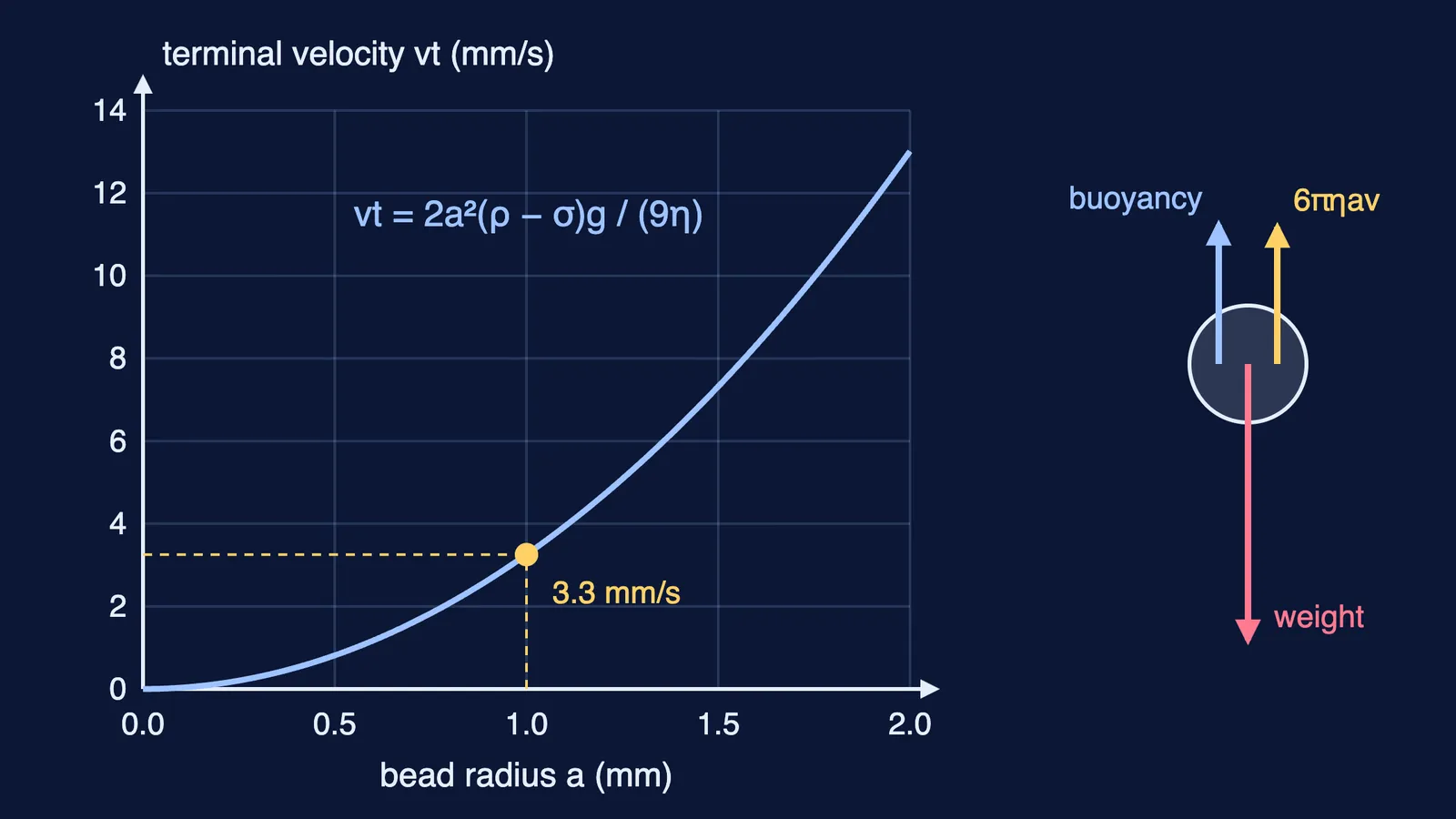
Stokes' law: F = 6πηav, in N; a is radius (m), v speed (m s⁻¹); small sphere, slow smooth flow.
Terminal velocity: vt = 2a²(ρ − σ)g/(9η), in m s⁻¹; ρ and σ are the densities of sphere and fluid (kg m⁻³).
Worked example: a glass bead (a = 1.0 mm, ρ = 2500 kg m⁻³) sinking in glycerine (σ = 1260 kg m⁻³, η = 0.83 Pa s, NCERT Table 9.2's 830 mPl at 20 °C) reaches vt = 3.3 × 10⁻³ m s⁻¹.
Watch for: ρ in place of (ρ − σ); mPl × 10⁻³ = Pa s.
Surface tension, excess pressure and capillary rise formulas
Surface tension: S = F/l, in N m⁻¹; a two-sided film gives S = F/2l. S also equals surface energy per unit area (J m⁻²).
Angle of contact θ: Sla cos θ + Ssl = Ssa, with liquid-air, solid-liquid and solid-air surface tensions (N m⁻¹).
Drop, or air bubble in a liquid: Pi − Po = 2S/r, in Pa, r the radius (m).
Soap bubble in air (two surfaces): Pi − Po = 4S/r, in Pa.
Capillary rise: h = 2S cos θ/(ρga), in m, a the tube radius (m); rises for θ < 90°, falls for θ > 90° (mercury in glass).
Worked example: a glass tube of radius 0.40 mm in water at 20 °C (S = 0.0727 N m⁻¹ per NCERT Table 9.3, θ ≈ 0°, ρ = 1000 kg m⁻³) gives h = 0.037 m (3.7 cm).
Watch for: 2S for a drop, 4S for a soap bubble. Count surfaces first.
How to revise this formula sheet
Write Y, G and B on one line as "stress over strain", naming each strain: length, angle or volume.
Derive Torricelli's law from Bernoulli and terminal velocity from the force balance; our Class 11 fluids derivations, step by step shows each.
Convert to SI before substituting (mm, cm², mPl), then check the answer's unit.
Picture what each formula predicts. The Fermi Simulation Lab has interactive simulations for ideas that are easier to see than to read.