On this page
Chapter 9 of the NCERT Class 11 Physics Part 2 textbook (Reprint 2026-27) builds most results from force balance, the work-energy theorem or surface energy. The CBSE 2026-27 Physics syllabus covers all six results below, which the chapter derives as follows. For formulas and numericals, see our Mechanical Properties of Fluids Class 11 guide.
Pressure at depth: why is P = Pa + ρgh?
Setup: liquid of density ρ at rest; an imaginary vertical cylinder of it with base area A and height h, point 1 at the top, point 2 at the bottom (NCERT Fig. 9.3).
At rest, vertical forces balance: P1A down on the top, P2A up on the bottom, weight mg. So (P2 − P1)A = mg.
The mass is m = ρhA. Substitute and cancel A: P2 − P1 = ρgh.
Put the top at the open surface, where P1 = Pa, the atmospheric pressure.
Result: P = Pa + ρgh; the gauge pressure ρgh depends only on depth, not on the vessel's shape.
Where students slip: using the total liquid height instead of depth below the free surface, or mixing gauge and absolute pressure.
Bernoulli's equation: why is P + ½ρv² + ρgh constant?
Setup: incompressible, non-viscous fluid in steady flow through a pipe; section 1 has area A1, speed v1, pressure P1, height h1, and section 2 has A2, v2, P2, h2 (Fig. 9.9).
Continuity: in time Δt, mass ρA1v1Δt enters and ρA2v2Δt leaves. Nothing piles up, so A1v1 = A2v2. Call this volume ΔV.
Fluid behind section 1 does work P1ΔV on it; fluid ahead of section 2 does work −P2ΔV. Net work is (P1 − P2)ΔV.
In effect, mass ρΔV moves from section 1 to section 2. Its kinetic energy changes by ½ρΔV(v2² − v1²) and its potential energy by ρgΔV(h2 − h1).
Work-energy theorem: set net work equal to the sum of those two changes, divide by ΔV, and put each section's terms on its own side.
Result: P1 + ½ρv1² + ρgh1 = P2 + ½ρv2² + ρgh2, so P + ½ρv² + ρgh is constant along a streamline.
Where students slip: using it for viscous or turbulent flow. With zero speeds it gives the depth result.
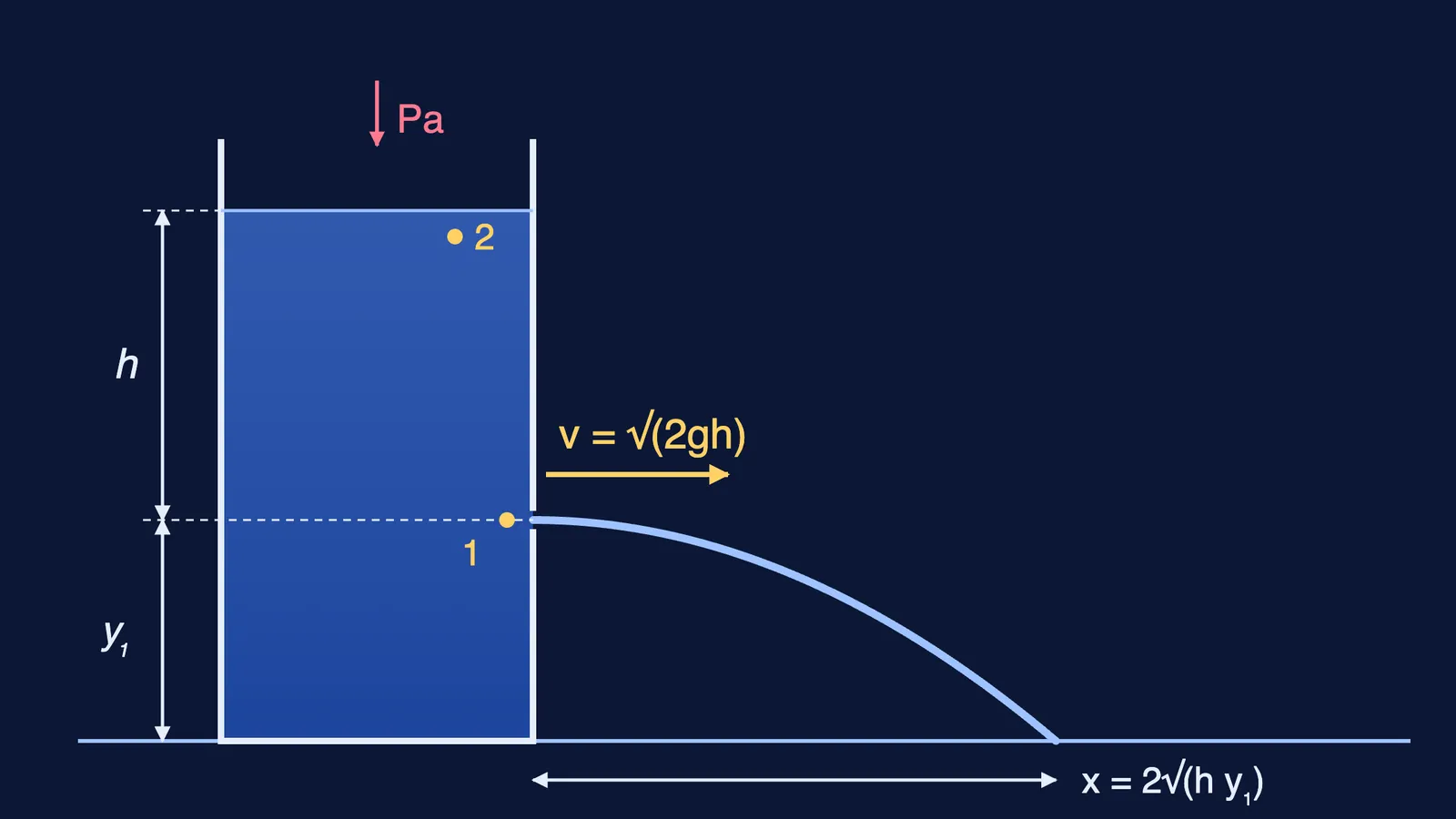
Torricelli's law: why is the speed of efflux √(2gh)?
Setup: a wide tank with a small side hole at height y1 (point 1); the free surface (point 2) is at height y2, a height h above the hole, with air above it at pressure P (Fig. 9.10).
Continuity gives v2 = (A1/A2)v1. The tank is much wider than the hole, so v2 ≈ 0.
The jet leaves into open air, so the pressure at the hole is Pa.
Bernoulli between 1 and 2: Pa + ½ρv1² + ρgy1 = P + ρgy2.
Put y2 − y1 = h and solve: v1² = 2gh + 2(P − Pa)/ρ. For an open tank, P = Pa.
Result: v1 = √(2gh) for an open tank, the speed of free fall through h.
Where students slip: measuring h from the tank's bottom instead of from the hole up to the free surface.
Terminal velocity: why is vt = 2a²(ρ − σ)g/9η?
Setup: a small sphere of radius a and density ρ falling through a fluid of density σ and viscosity η. NCERT states Stokes' law, F = 6πηav, without deriving it.
Forces: weight (4/3)πa³ρg down; buoyancy (4/3)πa³σg and drag 6πηav up. Drag grows with speed until the net force is zero, at speed vt.
Balance: 6πηavt + (4/3)πa³σg = (4/3)πa³ρg, so 6πηavt = (4/3)πa³(ρ − σ)g.
Divide both sides by 6πηa.
Result: vt = 2a²(ρ − σ)g / 9η; terminal velocity grows as the radius squared and falls as viscosity rises.
Where students slip: dropping buoyancy, or using diameter for a. NCERT Example 9.9 (a copper ball of radius 2.0 mm falling at 6.5 cm/s through oil) gives η ≈ 0.99 Pa s.
Excess pressure: why is it 2S/r in a drop and 4S/r in a bubble?
Setup: a spherical drop of radius r and surface tension S, pressure Pi inside and Po outside (Fig. 9.18).
Let the radius grow by a tiny Δr. The area grows from 4πr² to 4π(r + Δr)², an increase of about 8πrΔr.
Extra surface energy: 8πrΔr S.
Work done by the pressure difference pushing the surface out: (Pi − Po)4πr²Δr.
In equilibrium these are equal; cancel 4πrΔr.
A soap bubble has two surfaces, so its surface energy term doubles.
Result: Pi − Po = 2S/r for a drop (or a cavity), and 4S/r for a soap bubble.
Where students slip: using 2S/r for a soap bubble, or keeping the (Δr)² term.
Capillary rise: why is h = 2S cos θ/(ρga)?
Setup: a glass tube of radius a dipped in water, with an acute angle of contact θ, so the meniscus is concave (Fig. 9.19).
The meniscus is part of a sphere of radius a/cos θ.
The concave (air) side is at higher pressure by 2S ÷ (a/cos θ). So water just under the meniscus is at Pa − (2S/a) cos θ.
A point in the tube level with the outside surface is at Pa.
The column of height h makes up the difference: hρg = (2S/a) cos θ.
Result: h = 2S cos θ / ρga; thinner tubes give higher rise, and mercury, with an obtuse θ, is depressed instead.
Where students slip: using the meniscus radius in place of the tube radius, or forgetting cos θ. NCERT's worked check: taking θ = 0, water in a tube of radius 0.05 cm rises about 2.98 cm.
How to practise derivations in this chapter
Name the principle first: force balance (depth, terminal velocity, capillary rise), work-energy (Bernoulli, Torricelli) or energy balance (drops, bubbles).
Draw the figure each time, with every symbol labelled.
Run limit checks: capillary rise at θ = 90° must be zero.
Check units: 2S/r is N/m ÷ m = Pa; 2a²(ρ − σ)g/9η comes out in m/s.
Flow is easier to see than read: the Fermi Simulation Lab has interactive simulations for ideas like this.
Then try our Class 11 case study questions on mechanical properties of fluids and the harder fluids and elasticity practice questions with solutions.