On this page
What do fluids case-study questions test?
A case-study question gives a short real-life passage and asks linked questions on it. Class 11 exams are set by your school, not the board, so treat these as case-based practice, not a paper pattern.
The CBSE Physics curriculum 2026-27 lists the chapter's content: pressure due to a fluid column, Pascal's law, viscosity and terminal velocity, streamline flow, Bernoulli's theorem and surface tension. Every case stays inside that list and NCERT Class 11 Physics Chapter 9 (Reprint 2026-27). For formulas and derivations, see our Mechanical Properties of Fluids Class 11 guide.
Take g = 9.8 m s⁻², water density 1000 kg m⁻³ and atmospheric pressure 1.013 × 10⁵ Pa, as in NCERT.
Case 1: The rooftop tank in a Jaipur apartment
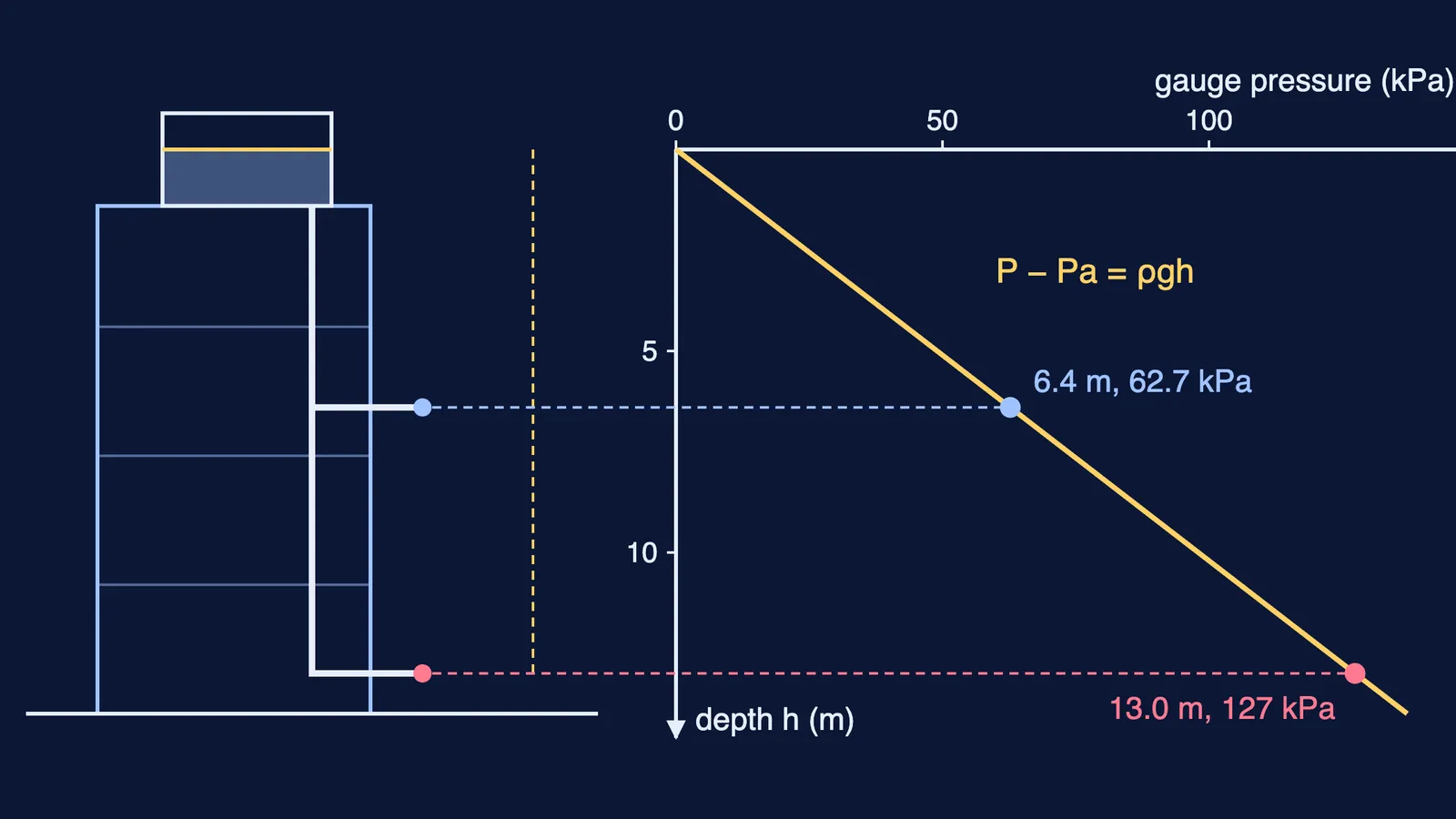
A Jaipur housing society stores water in a rooftop tank. When it is full, the water surface is 13.0 m above Ravi's ground-floor kitchen tap. A second-floor tap is 6.4 m below the surface. Each tap opening has an area of 1.2 cm². Ravi wonders whether the tank's size matters. The society plans to replace the wide tank with a taller, narrower one of the same volume, raising the water surface by 0.6 m.
(i) The gauge pressure at a tap depends on: (a) the volume of water in the tank (b) the shape of the tank (c) the vertical depth of the tap below the water surface (d) the width of the pipe
(ii) Find the gauge pressure at Ravi's tap.
(iii) What force must Ravi's thumb exert to block his open tap? Compare it with the second-floor tap.
(iv) A neighbour says the new tank cannot change the tap pressure because it holds the same water. Is he right? Find the new gauge pressure at Ravi's tap.
Answers.
(i) (c). P − Pa = ρgh, where h is the vertical depth.
(ii) P − Pa = 1000 × 9.8 × 13.0 ≈ 1.27 × 10⁵ Pa.
(iii) Air pushes on the outside of his thumb with Pa, so only the gauge pressure counts: F = 1.274 × 10⁵ × 1.2 × 10⁻⁴ ≈ 15 N. On the second floor, ρgh = 6.27 × 10⁴ Pa, so F ≈ 7.5 N, about half.
(iv) No. Pressure depends only on depth, not on the volume or shape of the container. The new depth is 13.6 m, so P − Pa = 1000 × 9.8 × 13.6 ≈ 1.33 × 10⁵ Pa, about 4.6% higher.
Case 2: A garden hose in Chennai
Anjali waters her terrace garden in Chennai with a hose of inner diameter 2.4 cm, in which water moves at 0.75 m s⁻¹. To reach the far pots she fits a nozzle of diameter 0.8 cm, and the water shoots out much faster. The flow from the tap stays the same throughout. Her brother, waiting with a 12-litre bucket, asks why a narrower opening makes water faster, not slower. Treat the hose and nozzle as horizontal and the water as incompressible and non-viscous, in streamline flow.
(i) The equation of continuity is a statement of conservation of: (a) energy (b) mass (c) momentum (d) pressure
(ii) Find the speed of water leaving the nozzle.
(iii) How long does it take to fill the bucket?
(iv) Find the pressure difference between the hose and the nozzle. Where is it higher, and why?
Answers.
(i) (b) mass.
(ii) A1v1 = A2v2 and area ∝ diameter², so v2 = 0.75 × (2.4/0.8)² = 6.75 m s⁻¹.
(iii) Flow rate = π × (0.012)² × 0.75 ≈ 3.39 × 10⁻⁴ m³ s⁻¹, or 0.339 L s⁻¹. Time = 12/0.339 ≈ 35 s.
(iv) Along a horizontal streamline P + ½ρv² is constant, so P1 − P2 = ½ × 1000 × (6.75² − 0.75²) = 2.25 × 10⁴ Pa. The pressure is higher in the wide hose: the water speeds up entering the nozzle, which needs a net push from behind.
Case 3: Checking a cough syrup in a Hyderabad lab
A quality-control lab in Hyderabad checks how thick a batch of cough syrup is. A technician drops a glass bead (radius 1.0 mm, density 2.5 × 10³ kg m⁻³) into a tall, wide jar of syrup of density 1.3 × 10³ kg m⁻³. She starts timing only when the bead passes a mark well below the surface. It takes 8.0 s to fall between two marks 10.0 cm apart. She will repeat the test with a glass bead of radius 2.0 mm, but the afternoon is getting warmer.
(i) Between the marks the bead moves at constant speed because: (a) gravity stops acting (b) the net force is zero (c) the syrup is as dense as the glass (d) the viscous force exceeds the weight
(ii) Find the terminal velocity of the bead.
(iii) Find the coefficient of viscosity of the syrup.
(iv) Assuming Stokes' law still holds, predict the fall time between the marks for the 2.0 mm radius bead at the same temperature. How will a warmer room change it?
Answers.
(i) (b). Weight = buoyant force + viscous drag, so there is no acceleration.
(ii) vt = 0.100/8.0 = 0.0125 m s⁻¹ (1.25 cm s⁻¹).
(iii) η = 2a²(ρ − σ)g/(9vt) = 2 × (1.0 × 10⁻³)² × 1200 × 9.8/(9 × 0.0125) ≈ 0.21 Pa s.
(iv) vt ∝ a², so doubling the radius gives 5.0 cm s⁻¹ and a time of 2.0 s. The viscosity of liquids decreases with temperature, so in a warmer room the bead falls faster and takes less than 2.0 s.
How do you answer fluids case-study questions?
Say which pressure you mean. Gauge pressure is ρgh; absolute adds Pa.
Convert to SI first. Change cm², mm and litres to m², m and m³.
Continuity before Bernoulli. Find each speed from A1v1 = A2v2, then the pressure.
Use proportions. Area ∝ d², vt ∝ a², and tap pressure depends only on depth.
Give the reason in a sentence. "A soap bubble has two surfaces, so its excess pressure is 4S/r" earns the explanation part.
For the general method, read our guide to case-based questions in board exams, then try harder JEE Advanced fluids and elasticity practice questions. If flow is hard to picture, the Fermi Simulation Lab has interactive simulations for the ideas that are easier to see than to read.