On this page
We checked each definition below against the Reprint 2026-27 NCERT chapter. The CBSE Class XII Physics curriculum 2026-27 covers the bar magnet, field lines, the dipole in a field, magnetisation and para-, dia- and ferromagnetic materials. For answer-writing and a revision plan, read our Magnetism and Matter Class 12 board exam guide.
The current chapter drops the earth's magnetic elements (dip, declination), hysteresis and Curie's law, so we skip them.
What are poles, dipoles and field lines?
North and south pole: the two ends of a freely hung bar magnet; the north pole is the end that turns towards geographic north. Like poles repel; unlike attract.
Magnetic monopole: an isolated north or south pole. None is known to exist: cut a bar magnet in two and you get two smaller magnets, each with both poles.
Magnetic dipole: the simplest magnetic source, such as a small current loop or a compass needle.
Magnetic moment (m): a vector that measures how strong a dipole is and which way it points, from south to north pole; unit A m², as the NCERT chapter lists.
Magnetic field lines: curves whose tangent gives the direction of B at each point; where they crowd together, B is stronger. They form closed loops (south to north inside the magnet) and never cross. NCERT avoids the older name "lines of force", since the force on a moving charge is perpendicular to B. Don't confuse with: electric field lines, which start on positive charge and end on negative charge.
Equivalent solenoid: a bar magnet acts like a current-carrying solenoid of the same magnetic moment; far away, their fields match.
What happens to a bar magnet in a magnetic field?
Torque on a dipole: a uniform field twists a magnet towards the field direction, with τ = m × B, so τ = mB sin θ (NCERT). The net force is zero.
Magnetic potential energy: U = −m·B, zero when m is perpendicular to B.
Stable and unstable equilibrium: with m along B (θ = 0°), energy is lowest and the magnet returns if nudged; with m opposite to B (θ = 180°), energy is highest and any nudge flips it.
Axial and equatorial field: far from a short magnet, the field on its axis is twice as strong as at the same distance on its perpendicular bisector, and the equatorial field points opposite to m. Don't swap the two.
Electrostatic analog: swap E for B, p for m and 1/ε0 for μ0 to turn electric dipole formulas into magnetic ones.
What is Gauss's law for magnetism?
Magnetic flux (φB): B·ΔS summed over an area; unit weber, 1 Wb = 1 T m².
Gauss's law for magnetism: the total flux B·ΔS over any closed surface is zero, because every field line that leaves also enters. Don't confuse with: Gauss's law in electrostatics, where the flux equals the enclosed charge divided by ε0.
Tesla and gauss: units of B; 1 T equals 10⁴ gauss, per the chapter's table of quantities.
Magnetisation, intensity, susceptibility and permeability
Magnetisation (M): the magnetic moment a sample carries per unit volume (net moment ÷ volume); unit A m⁻¹.
Magnetic intensity (H): the part of the field set up by outside causes, such as the solenoid current (H = nI inside a long solenoid); unit A m⁻¹. Don't confuse M with H: same unit, but M comes from the material and H from the outside source. The total field is B = μ0(H + M).
Magnetic susceptibility (χ): a pure number telling how strongly a material responds, M = χH. It is small and positive for paramagnets and small and negative for diamagnets.
Permeability of free space (μ0): the constant in the Biot-Savart law, with μ0/4π = 10⁻⁷ T m A⁻¹ (NCERT).
Relative permeability (μr): μr = 1 + χ, a pure number, the magnetic counterpart of the dielectric constant; see our post on susceptibility and relative permeability.
Permeability (μ): μ = μ0μr, with B = μH. Any one of χ, μr, μ gives the other two.
How are dia-, para- and ferromagnetic materials different?
Diamagnetic material: χ negative; it is weakly pushed from strong field towards weak field, and the field inside drops slightly. Examples: bismuth, copper, water. Diamagnetism is in every material but is usually masked.
Paramagnetic material: χ small and positive; each atom has its own permanent moment, so the sample is weakly pulled towards strong field. Examples: aluminium, sodium, oxygen at STP. Don't confuse with diamagnetic: NCERT puts χ near +10⁻⁵ here and −10⁻⁵ there, a tiny gap with opposite behaviour.
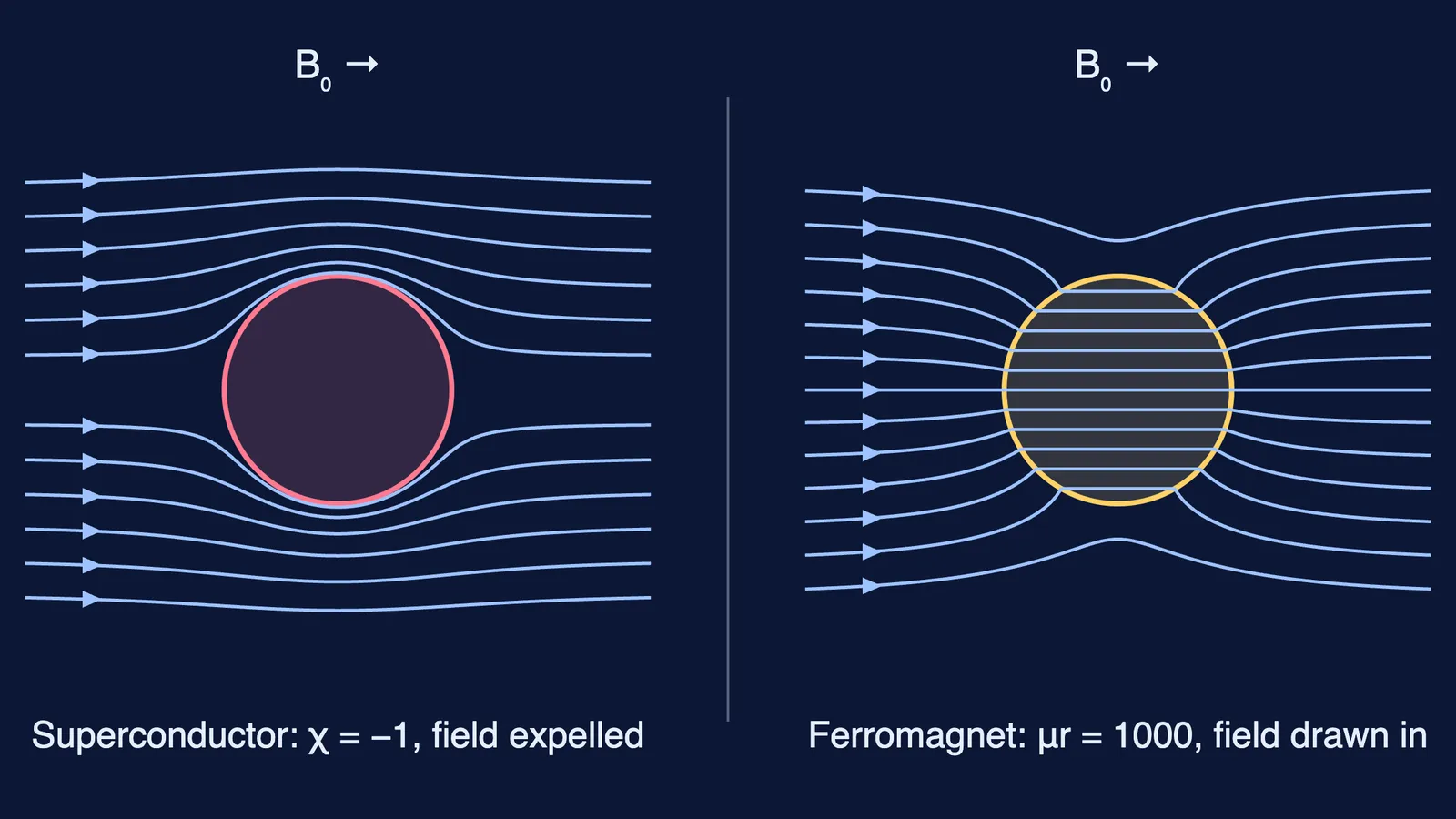
Ferromagnetic material: χ large and positive, strongly pulled towards strong field, μr above 1,000. Examples: iron, cobalt, nickel, gadolinium.
Domain: a region where atomic moments line up by themselves; NCERT gives a typical size of about 1 mm and about 10¹¹ atoms (chapter text). An outside field turns the domains and grows the aligned ones.
Saturation: every dipole lined up with the field, so M cannot grow further.
Hard and soft ferromagnets: hard ones (Alnico, lodestone) keep their magnetisation after the field is removed, making permanent magnets; soft ones (soft iron) lose it.
Effect of temperature: a paramagnet magnetises more when cooled; a ferromagnet heated enough loses its domains and turns paramagnetic.
Superconductor and Meissner effect: some metals, when made very cold, expel a magnetic field entirely, so χ = −1 and μr = 0: a perfect diamagnet. This expulsion is called the Meissner effect.
How to learn these terms
Sketch a bar magnet and a solenoid side by side with closed field-line loops.
Make a three-column card for dia, para and ferro: sign of χ, range of μr, pull or push, two examples each.
Learn the chain M = χH, μr = 1 + χ, μ = μ0μr, B = μH, with units.
Say aloud which angle is stable and why U = −mB there.
Field lines bending into iron and around a superconductor are easier to see than to read about; the Fermi Simulation Lab has interactive simulations for ideas like this.
For the formulas with worked examples, see Magnetism and Matter Class 12 formulas.