On this page
What Chapter 22 of the new Class 9 PE book covers, how it is assessed, and original questions to test yourself.
What does Yogamaya Jīvana cover in Class 9 PE?
Yogamaya Jīvana (Lifestyle for Holistic Health) is Chapter 22 of *Khel Praveen*, NCERT's Class 9 Physical Education and Well-being book, first edition April 2026 (Unit 6 PDF, NCERT).
Its central idea: well-being grows from small habits repeated daily. The book shows this through V. Nanammal, the Padma Shri yoga practitioner from Tamil Nadu who practised from childhood and stayed strong and calm into her nineties.
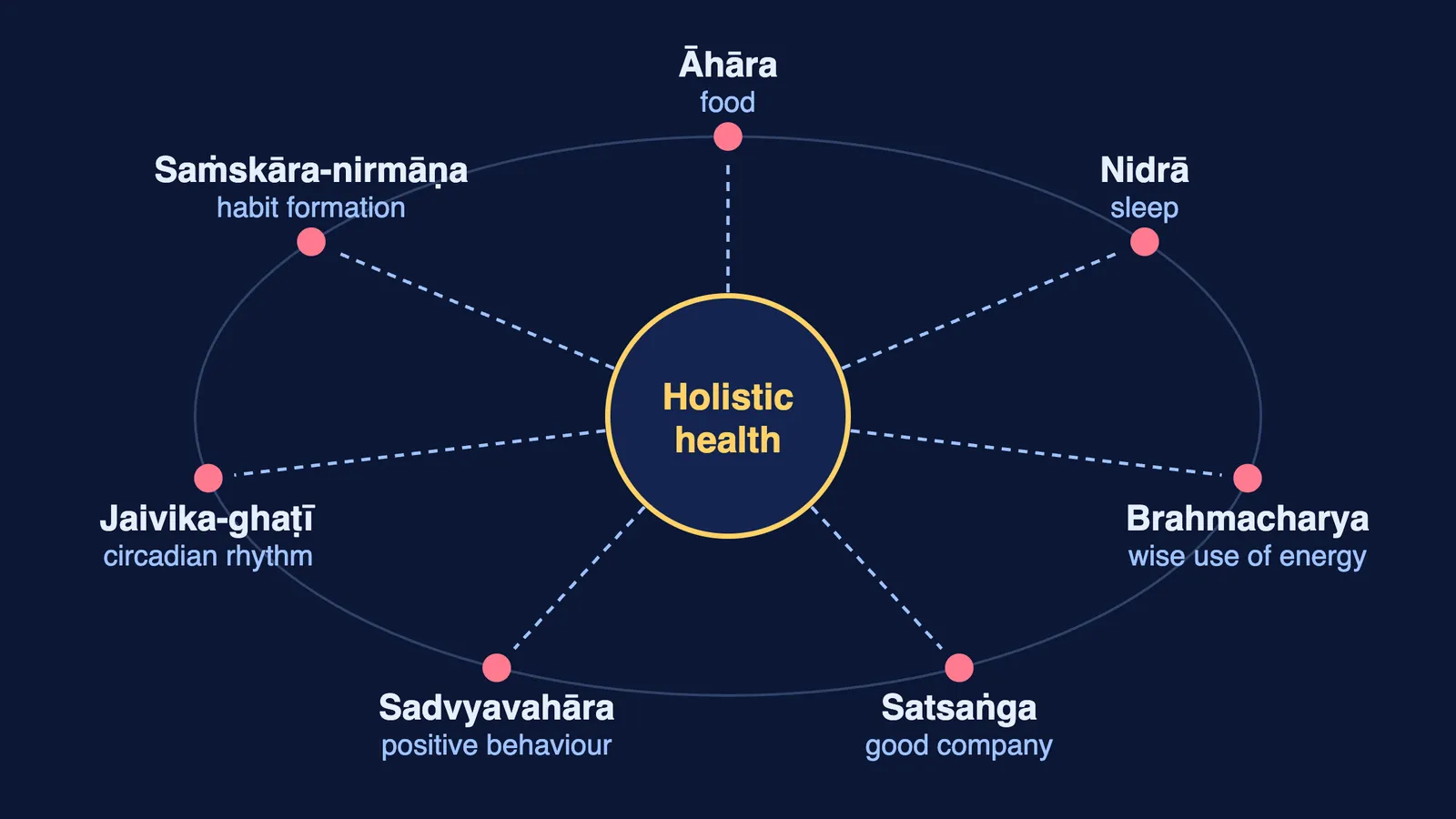
The chapter names seven lifestyle factors:
Āhāra: what you eat and how you eat it
Nidrā: the quality of your sleep
Brahmacharya: using time and energy wisely
Satsaṅga: good company
Sadvyavahāra: positive behaviour
Jaivika-ghaṭī: the circadian rhythm
Saṁskāra-nirmāṇa: habit formation
It then covers adolescence, which the book defines as 10–19 years, and menstrual health.
How many marks is Lifestyle for Holistic Health worth?
CBSE's 2026-27 curriculum gives Physical Education and Well-being 20 theory marks and 80 practical marks (CBSE curriculum PDF). Every unit carries 2 theory marks through MCQ, objective or short-answer questions, which makes 2 marks × 8 units = 16, and a viva adds 4 marks.
The curriculum numbers yoga as Unit 7 (14 hours: 3 theory, 11 practical), while the book prints it as Unit 6. Those 2 marks cover the whole yoga unit, so Chapters 21, 22 and 23 share them. Your school assesses it.
What are sāttvika, rājasika and tāmasika foods?
The split comes from Bhagavad-Gītā Chapter 17.
Sāttvika: fresh, light and natural foods such as fruit, vegetables, grains, nuts, milk and ghee. They support a calm, focused mind.
Rājasika: spicy, sour, salty or stimulating foods such as fried snacks, tea, coffee and fast food. A little gives energy; too much brings restlessness.
Tāmasika: stale, reheated, heavily processed or long-stored foods that leave the body heavy and the mind dull.
For students, the book suggests mostly sāttvika food, rājasika in moderation for activity and growth, and not too much tāmasika.
Mitāhāra means moderate eating. The book cites the Haṭha-Yoga-Pradīpikā (1.58), which advises leaving a quarter of the stomach empty. It adds mindful eating: slowly, without screens, stopping once you feel comfortably full.
How do sleep, brahmacharya and good company fit together?
The book compares nidrā to charging a phone. Its two-week activity: five minutes of prāṇāyāma and slow breathing at bedtime, no screens for at least an hour before sleeping, a light dinner, and a morning note on sleep quality and energy.
Brahmacharya here means balance, not strict rules: notice where your time and energy drain away (social media, gaming, junk food) and moderate one area at a time.
Satsaṅga connects the two: the people around you shape your habits. The book's example is young Narendranath, later Swami Vivekananda, and his time with Sri Ramakrishna.
Jaivika-ghaṭī is your internal 24-hour clock. The book's four ways to follow it: a fixed sleep and wake time, study when you are most alert, exercise in high-energy periods, and regular mealtimes.
How does yoga help with the challenges of adolescence?
The chapter pairs five groups of adolescent challenges with practices:
Physical and health: āsanas such as Tāḍāsana and Vṛikṣāsana, with sound diet and sleep
Emotional and mental: prāṇāyāma such as Anuloma-Viloma and Bhrāmarī, dhyāna, Śhavāsana
Social and behavioural: a balanced routine, group practice, sevā
Moral and value-based: Yama, Niyama and self-reflection
Overall balance: regular practice of 15–20 minutes a day
The menstrual health section gives a routine graded by level. Learn these practices from your teacher in class.
Source for Tele MANAS: PIB release.
Practice questions for Chapter 22
Mark labels are our suggestion; your school sets the paper.
(1 mark) Which of these is not one of the chapter's seven lifestyle factors? (a) Nidrā (b) Satsaṅga (c) Prāṇāyāma (d) Saṁskāra-nirmāṇa
(1 mark) Meera eats noodles cooked two days ago and reheated. Which food type is this, by the chapter's grouping?
(2 marks) Kabir games until 1 a.m. on weeknights and skips breakfast. Name two lifestyle factors from the chapter he is neglecting and suggest one change for each.
(2 marks) Arjun's lunch is fresh dal, rice and salad, followed by two cups of strong tea. Sort the items into the chapter's food types and say whether the meal fits the book's guidance for students.
(Viva) Why does the chapter link good company with brahmacharya?
Answers: 1 (c), a practice, not a factor; 2 tāmasika; 3 nidrā and jaivika-ghaṭī, fixed bedtime and regular meals; 4 dal, rice and salad are sāttvika, tea is rājasika, so it fits if tea stays moderate; 5 company shapes how you use time and energy.
More guides: yoga in Class 11 physical education, psychology, adolescence and sport in Class 11 and yoga for lifestyle diseases in Class 12.
Not sure where to begin your revision? Fermi's AI tutor works out what you already know and builds a plan for the session.