On this page
If you are preparing for both JEE Main and NEET-UG, Laws of Motion is one of the easiest units to plan for. The official syllabus text is almost word for word the same in both exams. What changes is the question format and, in practice, how much working a question asks of you.
Is the Laws of Motion syllabus different for JEE Main and NEET?
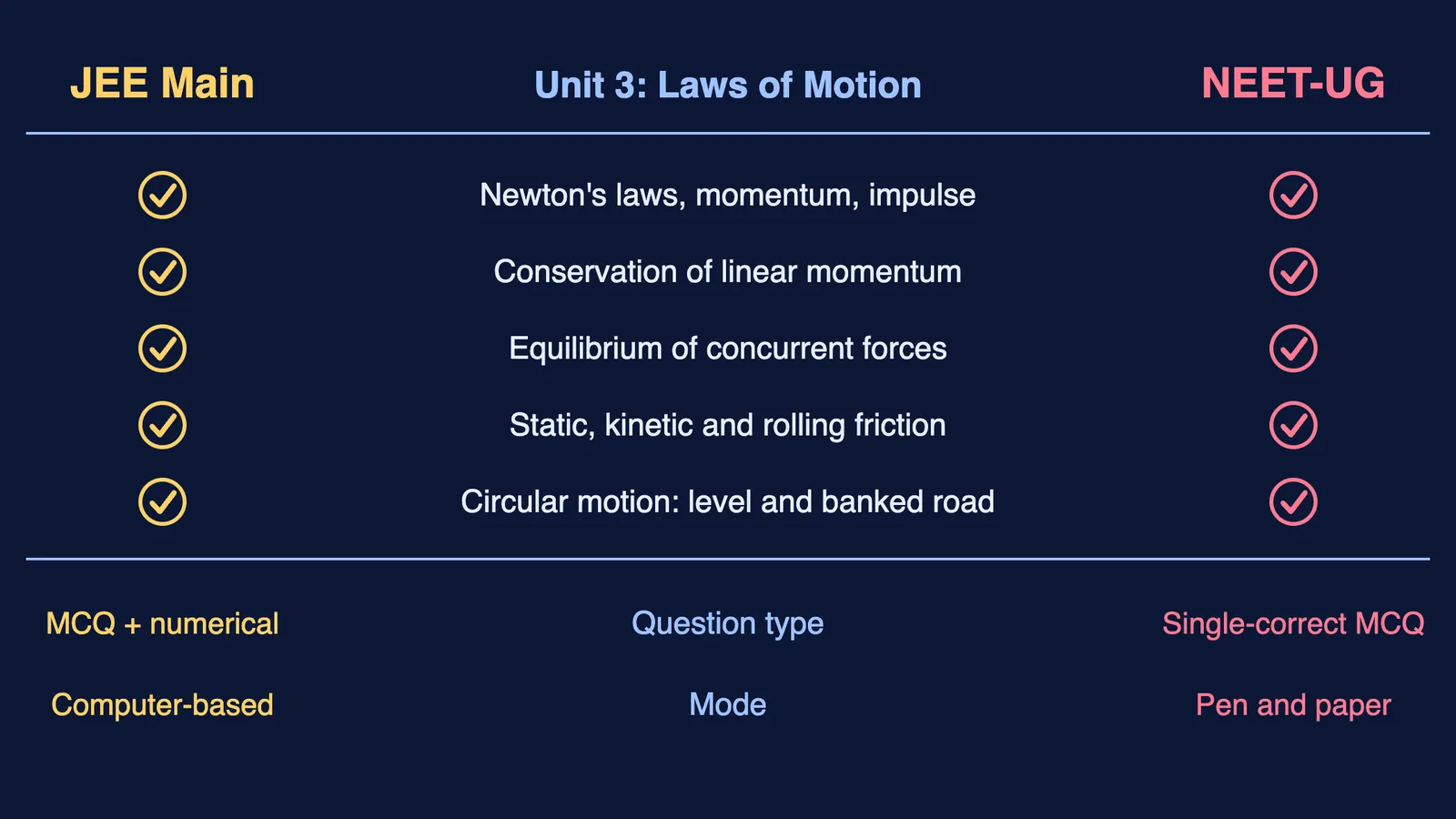
No. In both documents it is Physics Unit 3, and the sub-topics match line by line.
The Syllabus for JEE (Main) 2027, published by NTA, lists "Force and inertia, Newton's first law of motion, momentum". The NMC syllabus for NEET (UG)-2026, dated 22 December 2025, opens its Unit 3 with the same words, with slightly different capitals and punctuation. Going through the rest:
Newton's second and third laws: in both.
Impulse: "impulse" in JEE Main, "Impulses" in NEET. Same idea.
"Law of conservation of linear momentum and its applications": in both.
"Equilibrium of concurrent forces": in both.
"Static and Kinetic friction, laws of friction, rolling friction": identical wording.
"Dynamics of uniform circular motion", centripetal force, "vehicle on a level circular road, vehicle on a banked road": in both.
No sub-topic appears in one list and not the other. Both exams draw on the same textbook chapter, NCERT Class 11 Physics Part I, Chapter 4: Laws of Motion (Reprint 2026-27). Pulleys, connected blocks and lifts are not named in either syllabus. They are common settings for questions on these laws.
How is the question format different?
The JEE (Main) 2027 Information Bulletin gives Paper 1 Physics 20 multiple-choice questions in Section A and 5 numerical-value questions in Section B. For Section B you type the answer on an on-screen keypad, rounded off to the nearest integer. Both sections carry +4 for a correct answer and −1 for a wrong one. The paper is a computer-based test.
The NEET (UG)-2026 Information Bulletin gives Physics 45 questions, all MCQs "with four options and single correct answer/best option". Marking is also +4 and −1. The bulletin sets NEET (UG)-2026 as a pen-and-paper exam, with 180 compulsory questions in 180 minutes.
So within Physics, the main difference in question type is the numerical-value section (the two exams also differ in mode: computer-based versus pen and paper). In JEE Main you cannot work backwards from options there, and a wrong number still costs a mark.
How do the questions feel different?
These are tendencies you will notice in official past papers, not rules.
NEET questions on this unit tend to be short. They often hinge on one statement from the NCERT chapter, such as static friction being self-adjusting up to its limit (NCERT writes it as fs ≤ µs N). The test is whether you apply that statement correctly at speed.
JEE Main questions tend to add a step or two: a force at an angle, a second body, or a condition you must check before you write the equation. The physics is the same. The difference is how many decisions sit between the question and the answer.
Two original examples on the same idea
Both examples test one idea: static friction takes whatever value is needed, up to µs N, and points whichever way stops slipping. Take g = 10 m/s². We checked both answers in Python.
NEET style. A 2 kg block is held at rest against a rough vertical wall by a horizontal push of 50 N. The coefficient of static friction is 0.6. What is the friction force on the block?
(A) 30 N (B) 20 N (C) 50 N (D) 12 N
Answer: (B). The push is the normal force, so the most friction can give is 0.6 × 50 = 30 N. The block only needs 2 × 10 = 20 N upward to stay put, so friction is 20 N. Trap: (A) treats the maximum, µs N, as the actual friction.
JEE Main style (numerical value). A 3 kg block is held against a rough vertical wall by a force F, directed into the wall at 37° above the horizontal (sin 37° = 0.6, cos 37° = 0.8). The coefficient of static friction is 0.5. Find the largest F, in newtons, for which the block stays at rest.
Answer: 150.
Normal force: N = F cos 37° = 0.8F, so friction can be at most 0.5 × 0.8F = 0.4F.
The upward part of the push is F sin 37° = 0.6F. As F grows, this exceeds the 30 N weight, and the block tends to slide up. Friction now points down.
At the limit: 0.6F = 30 + 0.4F, so 0.2F = 30 and F = 150 N.
Trap: entering 30. That is the smallest F, found by keeping friction pointing up (0.6F + 0.4F = 30). The block stays at rest for any F from 30 N to 150 N.
How to prepare for both
Learn the chapter once, from NCERT. The syllabus is shared, so one careful pass through Chapter 4 serves both exams. Mark each statement about friction, impulse and circular motion that could become an option.
Draw a free-body diagram for every question. Our JEE Main guide to Laws of Motion sets out a five-step method for drawing them.
Always ask "is it about to slip?" before writing µN. It is the check behind both examples above.
Train speed for NEET. Do timed sets of short MCQs and practise eliminating options with units and limiting cases. The NEET guide to Laws of Motion has worked examples and a seven-day plan.
Train integer answers for JEE Main. Solve some problems with the options covered, then round to the nearest integer as the bulletin asks. Try the numerical question in our JEE Main practice questions on laws of motion.
Log every miss by type: diagram, friction direction, sign or arithmetic. Redo the log at the end of the week.
Keep getting the friction direction wrong? The Fermi Problem Library has worked problems with a step-by-step solver that explains the reasoning rather than printing an answer.