On this page
Laws of motion questions in JEE Main test whether you drew every force on the right body. Take g = 10 m/s², sin 37° = 0.6 and cos 37° = 0.8 throughout.
What does JEE Main ask from laws of motion?
Laws of Motion is Unit 3 of Physics in the NTA syllabus for JEE (Main) 2027. It lists Newton's laws, impulse, momentum conservation, equilibrium of concurrent forces, friction, and uniform circular motion on level and banked roads. The same ideas fill Chapter 4 of the NCERT Class 11 Physics Part I textbook. New to the chapter? Start with our guide to preparing laws of motion for JEE Main.
How should you use this practice set?
The JEE (Main) 2027 information bulletin gives Physics 20 multiple-choice questions in Section A and 5 numerical-value questions in Section B, with +4 for a correct answer and −1 for a wrong one in both sections.
Allow 25 minutes. Q6 asks for a number, as in Section B.
Draw a free-body diagram for every body first.
Commit to an option before reading the solution.
Easy: can you apply Newton's laws in one step?
Q1 (easy). A 60 kg student stands on a weighing scale in a lift that is accelerating downward at 2 m/s². What does the scale read?
(A) 720 N (B) 600 N (C) 480 N (D) 120 N
Answer: (C). Taking down as positive, mg − N = ma, so N = 60 × (10 − 2) = 480 N. Trap: (A) is the reading for upward acceleration.
Q2 (easy). A 2 kg block rests on a smooth floor. A horizontal force on it rises steadily from 0 to 10 N in 4 s. What is the block's speed at 4 s?
(A) 5 m/s (B) 10 m/s (C) 20 m/s (D) 2.5 m/s
Answer: (B). Impulse is the area under the force-time graph: ½ × 4 × 10 = 20 N s. Speed = 20 / 2 = 10 m/s. Trap: (C) multiplies the peak force by the time, as if the force were 10 N throughout.
Q3 (easy). A 3 kg lamp hangs from two strings. One makes 37° with the horizontal ceiling, the other 53°. What is the tension in the 53° string?
(A) 18 N (B) 24 N (C) 30 N (D) 15 N
Answer: (B). Horizontally, T₁ cos 37° = T₂ cos 53°, so T₂ = 4T₁/3. Vertically, 0.6T₁ + 0.8T₂ = 30, giving T₁ = 18 N and T₂ = 24 N. Trap: (A) is the shallower string's tension; the steeper string carries more weight.
Medium: can you handle ropes, explosions and circles?
Q4 (medium). A uniform 4 kg rope, 2 m long, lies on a smooth floor. One end is pulled horizontally with 20 N. What is the tension 0.5 m from the pulled end?
(A) 5 N (B) 10 N (C) 15 N (D) 20 N
Answer: (C). The rope accelerates at 20 / 4 = 5 m/s². The 1.5 m behind that point has mass 3 kg, so T = 3 × 5 = 15 N. Trap: (A) measures the 0.5 m from the free end.
Q5 (medium). A 4 kg object at rest explodes into three pieces: 1 kg flies east at 12 m/s and 1 kg flies north at 16 m/s. What is the speed of the 2 kg piece?
(A) 10 m/s (B) 14 m/s (C) 20 m/s (D) 7 m/s
Answer: (A). Total momentum stays zero, so the third piece carries √(12² + 16²) = 20 kg m/s. Speed = 20 / 2 = 10 m/s. Trap: (C) is that momentum read as a speed, forgetting the 2 kg mass.
Q6 (medium, numerical). A 0.5 kg bob on a 1 m string moves in a horizontal circle as a conical pendulum, with the string at 60° to the vertical. Find the tension in the string, in newtons.
Answer: 10. Vertically, T cos 60° = mg, so T = 5 / 0.5 = 10 N. Trap: entering 5, as if the string held only the bob's weight.
Hard: can you find where friction gives way?
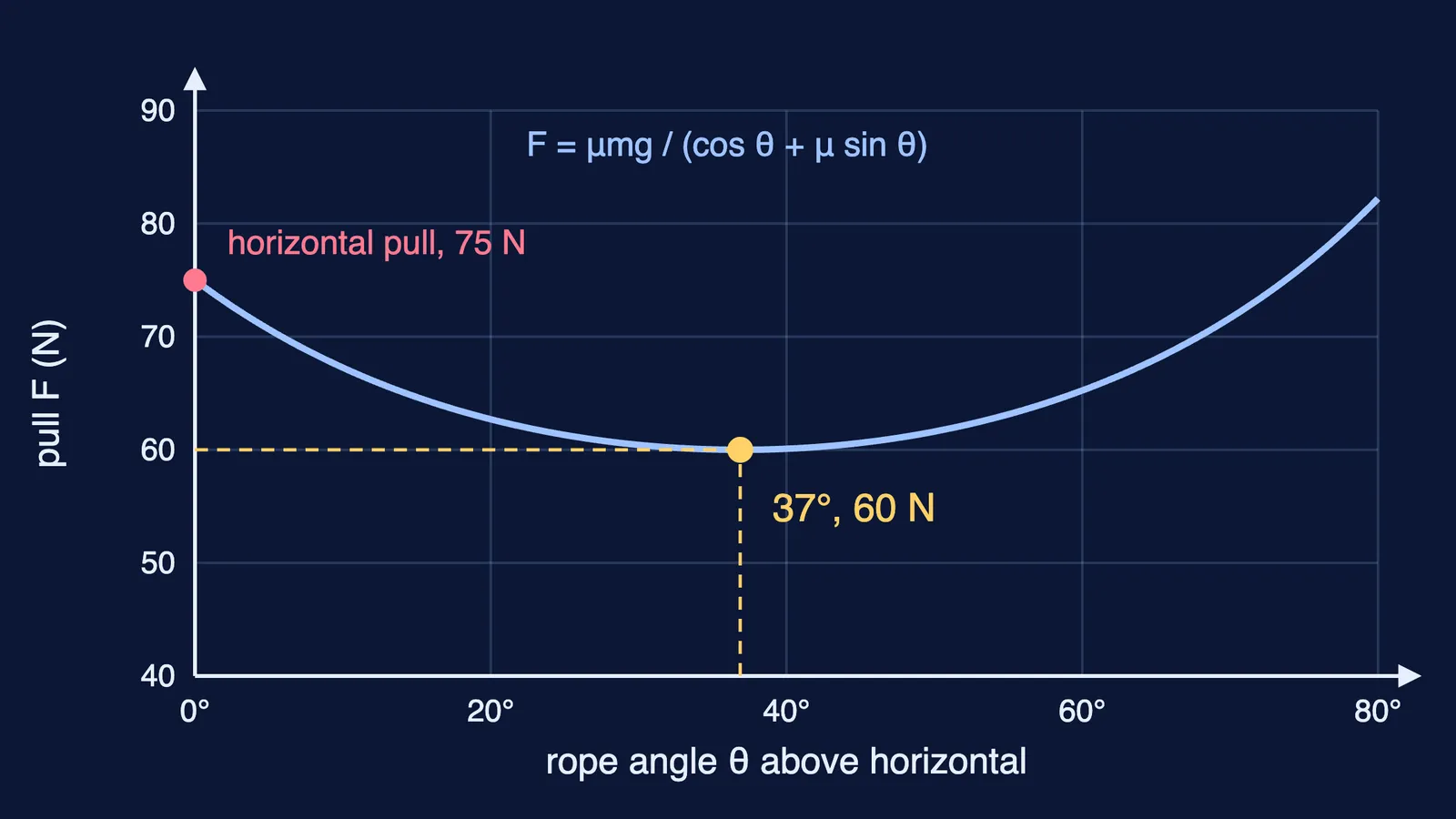
Q7 (hard). A 10 kg box rests on a floor with μ = 0.75. You pull it with a rope at the angle above the horizontal that needs the least force to just move it. What is that force?
(A) 75 N (B) 60 N (C) 45 N (D) 93.75 N
Answer: (B). At angle θ, the normal force is mg − F sin θ, so F cos θ = μ(mg − F sin θ), giving F = μmg / (cos θ + μ sin θ). This is least when tan θ = μ, here θ = 37°: F = 75 / (0.8 + 0.75 × 0.6) = 60 N. Trap: (D) tilts the rope to 37° but keeps the normal force at mg; (A) pulls horizontally.
Q8 (hard). A 2 kg block sits on a 3 kg plank on the floor. The friction coefficient is 0.4 between block and plank and 0.2 between plank and floor. A horizontal 42 N force pulls the plank. What is the plank's acceleration?
(A) 6.4 m/s² (B) 8 m/s² (C) 9.3 m/s² (D) 11.3 m/s²
Answer: (B). If they moved together, a = (42 − 0.2 × 50) / 5 = 6.4 m/s². Friction can give the block at most 0.4 × 10 = 4 m/s², so the block slips. On the plank: 42 − 8 − 10 = 3a, so a = 8 m/s². Trap: (C) takes floor friction from the plank's weight alone; the floor supports both bodies.
What should you do after this set?
Write each miss as one line: question, trap, correct step. Missed Q4 or Q8? Redo them with one diagram per body.
When a wrong method keeps coming back, the Fermi Problem Library has worked problems with a step-by-step solver that explains the reasoning rather than printing an answer. For the next chapter, try our work, energy and power JEE Main practice questions, or revise with our Laws of Motion Class 11 physics notes.