On this page
These terms come from Chapter 4, Laws of Motion, of the NCERT Class 11 Physics Part I textbook (Reprint 2026-27), Unit III of the CBSE 2026-27 Class XI Physics syllabus. Pseudo forces and non-inertial frames are not in this chapter, so they are left out. For the full chapter, see our Laws of Motion Class 11 guide.
What do force and inertia mean in Class 11 physics?
Source: NCERT sections 4.3, 4.4.
Force: a push or pull from some agency that can change a body's velocity. SI unit: newton (N).
Net external force: the vector sum of all forces that other bodies exert on the body. Don't confuse with: internal forces between parts of the same body, which cannot accelerate it as a whole.
Inertia: a body's resistance to change in its state of rest or uniform motion. Example: when a bus starts suddenly, standing passengers jerk backwards.
Newton's first law: a body stays at rest or in uniform motion unless a net external force acts on it. Don't confuse with: "no forces act". A book on a table feels forces that cancel.
How are momentum, the second law and impulse linked?
Source: NCERT section 4.5.
Momentum (p): mass times velocity, p = mv, a vector. SI unit: kg m s⁻¹.
Newton's second law: the rate of change of momentum equals the net external force and points the same way. For constant mass this becomes F = ma.
Newton (N): the force that gives 1 kg an acceleration of 1 m s⁻², so 1 N = 1 kg m s⁻².
Impulse: force multiplied by the time it acts, which equals the change in momentum. SI unit: N s. Example: a fielder draws the hands back while catching, so stopping the ball takes longer and needs less force.
Impulsive force: a very large force lasting only an instant, like a bat striking a ball. Don't confuse with: impulse, which is the product of force and time, not a force.
What does action and reaction really mean?
Source: NCERT sections 4.6 and 4.7.
Newton's third law: forces always come in pairs. The force on A by B is equal in size and opposite in direction to the force on B by A.
Action-reaction pair: the two forces of that pair. They act together, on different bodies, and neither causes the other. Don't confuse with: two balanced forces on one body. Weight and the table's push on a book are not a third-law pair.
Isolated system: bodies with no external force on them.
Law of conservation of linear momentum: the total momentum of an isolated system of interacting bodies stays constant.
Recoil: the backward motion of a gun when it fires. Gun and bullet gain equal and opposite momenta.
Which forces and diagrams does the chapter use?
Source: NCERT sections 4.8, 4.9 and 4.11.
Equilibrium of a particle: zero net external force, so the particle is at rest or moves with constant velocity.
Concurrent forces: forces whose lines of action meet at one point. Three such forces in equilibrium can be drawn head to tail as a closed triangle.
Contact force: a force that arises from touching another solid or fluid, such as friction or buoyancy. Don't confuse with: gravity, which acts at a distance.
Normal reaction (N): the part of a contact force perpendicular to the surfaces. Don't confuse with: weight. N = mg for a body at rest on a level table, not in an accelerating lift.
Tension (T): the pull inside a taut string, the same throughout a massless string.
Spring force: the restoring force of a stretched or compressed spring, F = −kx, where k is the force constant in N m⁻¹.
Free-body diagram: a sketch of one chosen body showing every force acting on it, but not the forces it exerts.
What is the difference between static and kinetic friction?
Source: NCERT section 4.9.1.
Friction: the part of a contact force parallel to the surfaces that opposes relative motion, whether actual or about to happen.
Impending motion: the motion that would happen if there were no friction.
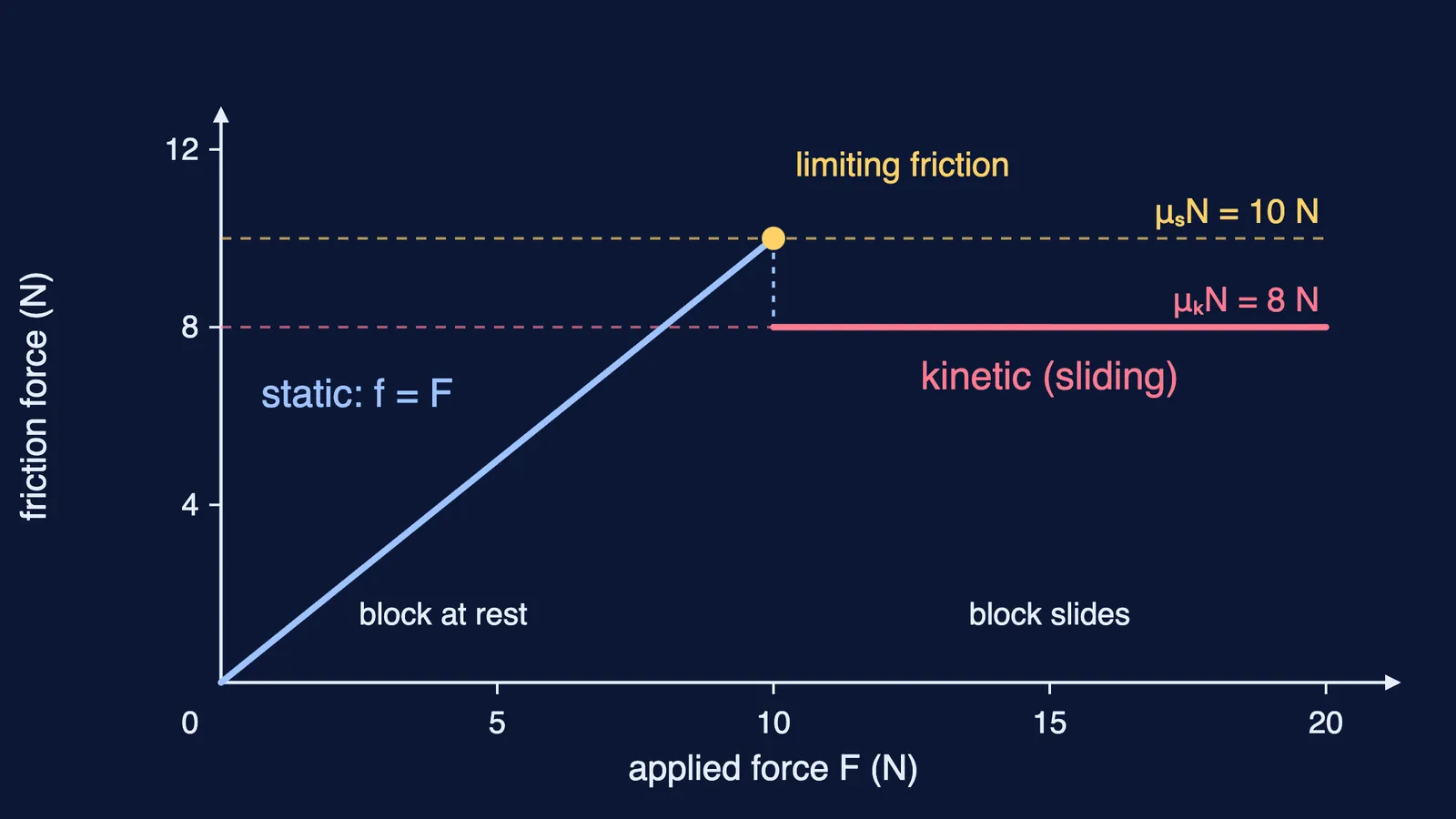
Static friction (fs): friction that stops surfaces slipping, adjusting itself to match the applied force up to a limit.
Limiting friction: that largest value of static friction, (fs)max = μsN. Do not write fs = μsN unless the body is just about to slip.
Coefficient of static friction (μs): a unitless number set by the pair of surfaces, not the area of contact. A block on an incline starts to slide when tan θ = μs.
Kinetic (sliding) friction (fk): friction once surfaces slide, fk = μkN. Don't confuse with: static friction; μk is less than μs.
Rolling friction: resistance to rolling, from slight squashing at the contact; much smaller than sliding friction for the same weight.
Lubrication: reducing kinetic friction between moving parts with oil or grease.
Which terms describe circular motion on roads?
Source: NCERT section 4.10. Revise circular motion in our Motion in a Plane Class 11 guide.
Centripetal force: the net inward force mv²/R needed to keep a body on a circle of radius R. It is a role, not a new force. Example: tension for a whirled stone, gravity for a planet, friction for a car on a level turn.
Maximum safe speed on a level road: v = √(μsRg), the fastest a car can turn on static friction alone, whatever its mass.
Banked road: a curved road tilted at angle θ so part of the normal reaction pushes the car towards the centre.
Optimum speed: v₀ = √(Rg tan θ), the speed on a banked road at which no friction is needed, so tyres wear little.
How to learn these terms
Learn them in pairs: static and kinetic friction, impulse and impulsive force, action-reaction and balanced forces.
Write the SI unit beside every symbol.
Draw free-body diagrams for a book on a table, a block on an incline and a car on a banked road, labelling each force.
Sketch the friction graph from memory, marking limiting and kinetic friction.
Test yourself with our Laws of Motion JEE Main questions with solutions.
If an idea still feels shaky, the Fermi Concept Library gives every physics concept its own lesson and its place in the map.