On this page
Chapter 4 of the rationalised NCERT Class 11 Physics Part I, Laws of Motion (Reprint 2026-27), covers momentum, the second law, impulse, the third law, conservation of momentum, friction and circular motion, the same topics the CBSE 2026-27 Physics curriculum lists for Unit III. For the concepts, read our Laws of Motion Class 11 guide to FBDs, friction and banked roads.
What are the momentum and second law formulas?
Momentum: p = m v, where p is momentum (kg m s⁻¹), m is mass (kg) and v is velocity (m s⁻¹); a vector along v.
First law: if the net external force F = 0 (N), the acceleration a = 0 (m s⁻²).
Second law: F = dp/dt (N), the rate of change of momentum.
For constant mass: F = m a (N), with 1 N = 1 kg m s⁻².
Components: Fx = m ax, Fy = m ay, Fz = m az (N).
Worked example: a 1,500 kg car slows from 25 m s⁻¹ to 10 m s⁻¹ in 5 s. Δp = 1,500 × (10 − 25) = −22,500 kg m s⁻¹, so F = −22,500 / 5 = −4,500 N, against the motion.
Watch for: never draw "ma" as an extra force on the free-body diagram.
Impulse and the third law
Impulse: J = F Δt = Δp = m v − m u, where J is impulse (N s, same as kg m s⁻¹), F the average force (N), Δt the contact time (s), u and v the velocities before and after (m s⁻¹).
Third law: F_AB = −F_BA (N), where F_AB is the force on body A by body B and F_BA the force on B by A. The two forces act on different bodies, so they never cancel each other.
Worked example: a 0.16 kg ball reaches a bat at 30 m s⁻¹ and leaves straight back at 40 m s⁻¹ after 0.008 s. Taking outgoing as positive, J = 0.16 × (40 − (−30)) = 11.2 N s, so the average force is 11.2 / 0.008 = 1,400 N. By the third law, the ball pushes the bat with an average force of 1,400 N the other way.
Watch for: when velocity reverses, one velocity is negative, so the speeds add (70 m s⁻¹ here).
When is momentum conserved, and when is a body in equilibrium?
Conservation: p′_A + p′_B = p_A + p_B (kg m s⁻¹), primes for after. Condition: isolated system, no net external force.
Recoil from rest: v_g = −m_b v_b / m_g (m s⁻¹), where m_b and m_g are the bullet and gun masses (kg) and v_b and v_g their velocities just after firing.
Equilibrium of concurrent forces: F₁ + F₂ + … + Fₙ = 0 (N), or ΣFx = 0, ΣFy = 0, ΣFz = 0 (N).
Worked example: a 4 kg gun fires a 20 g bullet at 300 m s⁻¹. v_g = −0.020 × 300 / 4 = −1.5 m s⁻¹, so the gun recoils at 1.5 m s⁻¹.
Watch for: convert grams to kilograms first. Using 20 for the bullet gives a recoil a thousand times too large.
What are the friction formulas in Class 11?
Static friction: f_s ≤ μ_s N (N), where μ_s is the coefficient of static friction (no unit) and N the normal force (N).
Limiting friction: (f_s)max = μ_s N (N).
Kinetic friction: f_k = μ_k N (N), μ_k with no unit. Condition: surfaces sliding; experiments show μ_k is less than μ_s.
Sliding under a horizontal push F (N) on a level floor: a = (F − f_k) / m (m s⁻²).
Angle of repose: tan θ_max = μ_s, θ_max (degrees) being the steepest incline where a block stays at rest.
Box on the floor of an accelerating truck: the largest acceleration without slipping is a_max = μ_s g (m s⁻²), g = 9.8 m s⁻².
The NCERT chapter calls these empirical, approximate laws, independent of the area of contact. Rolling friction and lubrication are described there without formulas.
Worked example: a 10 kg crate on a floor with μ_s = 0.5 and μ_k = 0.4. (f_s)max = 0.5 × 10 × 9.8 = 49 N, so a 45 N push does not move it and friction is 45 N, not 49 N. A 60 N push makes it slide: f_k = 39.2 N and a = (60 − 39.2) / 10 = 2.08 m s⁻².
Watch for: static friction matches the push; μ_s N is only its upper limit.
Circular motion on level and banked roads
Centripetal force: f_c = m v² / R (N), towards the centre; v is speed (m s⁻¹), R the radius (m). Condition: uniform circular motion.
Level road: v² ≤ μ_s R g, so v_max = √(μ_s R g) (m s⁻¹), independent of mass.
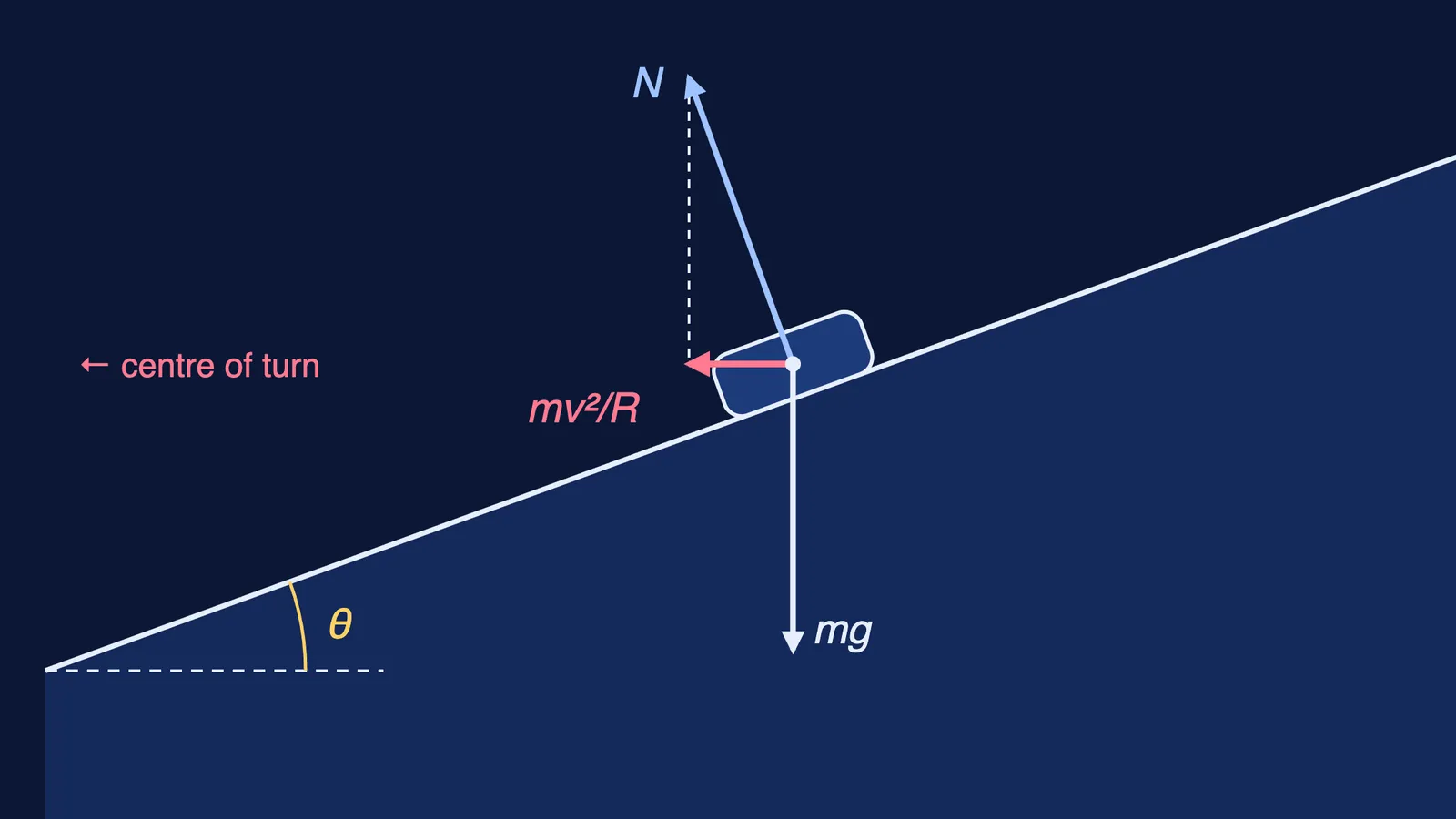
Banked road at angle θ: v_max = √[R g (μ_s + tan θ) / (1 − μ_s tan θ)] (m s⁻¹). Condition: μ_s tan θ < 1.
Optimum speed, no friction needed: v₀ = √(R g tan θ) (m s⁻¹).
Worked example: a curve of radius 120 m banked at 10°, μ_s = 0.25, g = 9.8 m s⁻². v₀ = √(120 × 9.8 × tan 10°) ≈ 14.4 m s⁻¹ (about 52 km h⁻¹) and v_max ≈ 22.9 m s⁻¹ (about 82 km h⁻¹). A flat curve would allow only √(0.25 × 120 × 9.8) ≈ 17.1 m s⁻¹.
Watch for: calculator in degree mode, and divide km h⁻¹ by 3.6 before comparing speeds.
The banked-road results are worked out in our step-by-step Laws of motion Class 11 derivations. If the tilted normal force is hard to picture, the Fermi Simulation Lab has interactive simulations for ideas that are easier to see than to read.
How to revise this formula sheet
Write each formula with its units and condition on one card.
Check limits: μ_s = 0 in the banked-road result gives v₀; θ = 0 gives the level road.
For each friction question, first say "at rest, about to slip, or sliding".
Redo the five worked examples with new numbers, keeping signs and units on every line.
Then try our Laws of motion case study questions for Class 11.