On this page
What do Laws of Motion case-study questions test?
Class 11 exams are set by your school, not the board, so treat these as practice in the case-based style. The CBSE 2026-27 Physics curriculum lists for this chapter: Newton's three laws, momentum and impulse, conservation of momentum, equilibrium of concurrent forces, static and kinetic friction, rolling friction and lubrication, and vehicles on level and banked roads.
Every case stays inside that list and NCERT Class 11 Physics Chapter 4 (Reprint 2026-27). For free-body diagrams and revision notes, read our Laws of Motion Class 11 guide first.
Case 1: Catching mangoes in a bedsheet
At an orchard near Ratnagiri, Anaya and her cousins stretch a bedsheet under a mango tree. A 300 g mango falls 5.0 m into the sheet. The sheet sags and brings the mango to rest in about 0.15 s. A mango that misses lands on the hard-packed ground and stops in about 0.010 s, and its skin splits. Take g = 10 m s⁻² and ignore air resistance.
(i) The sheet protects the mango mainly because it: (a) reduces the change in momentum (b) increases the time over which the momentum changes (c) reduces the mass of the mango (d) increases the impulse
(ii) What is the momentum of the mango just before it is caught?
(iii) Find the impulse given by the sheet and the average net force on the mango while it stops.
(iv) Compare the average net force when the mango hits the ground. Why must the sheet actually push up with slightly more than the net force?
Answers.
(i) (b). Same change in momentum, longer time, smaller force.
(ii) v = √(2gh) = √(2 × 10 × 5.0) = 10 m s⁻¹, so p = 0.30 × 10 = 3.0 kg m s⁻¹, downward.
(iii) Impulse = change in momentum = 3.0 N s, upward. Average net force = 3.0/0.15 = 20 N.
(iv) On the ground, F = 3.0/0.010 = 300 N, 15 times larger. The net force is the sheet's push minus the weight, so the sheet must push with 20 + 0.30 × 10 = 23 N.
Case 2: Coupling wagons in a goods yard
In a railway goods yard in Nagpur, a shunting engine releases a loaded wagon of mass 25 t. It rolls along a level track at 1.2 m s⁻¹ and couples with a stationary empty wagon of mass 15 t. The coupling takes 0.50 s, after which the two move together. The brakes then give a steady total retarding force of 6.0 kN on the pair. Ignore track friction during the coupling. The yard staff want to know how hard the coupling jolts and how far the pair rolls.
(i) During the coupling, which quantity is the same before and after for the two-wagon system? (a) speed of the loaded wagon (b) total momentum (c) force on each wagon (d) acceleration
(ii) Find the common speed just after coupling.
(iii) Find the average force on the empty wagon during coupling, and the force on the loaded wagon.
(iv) How far do the coupled wagons roll after the brakes are applied, and for how long?
Answers.
(i) (b). The coupling forces are internal and cancel in pairs.
(ii) 25 000 × 1.2 = (25 000 + 15 000)V, so V = 30 000/40 000 = 0.75 m s⁻¹.
(iii) The empty wagon gains 15 000 × 0.75 = 11 250 kg m s⁻¹ in 0.50 s, so F = 22 500 N (22.5 kN) forward. By the third law, the loaded wagon feels 22.5 kN backward; its momentum falls by the same 11 250 kg m s⁻¹.
(iv) a = 6000/40 000 = 0.15 m s⁻² (retardation). Distance = v²/2a = 0.75²/(2 × 0.15) ≈ 1.9 m; time = v/a = 0.75/0.15 = 5.0 s.
Case 3: A hairpin bend after the monsoon rain
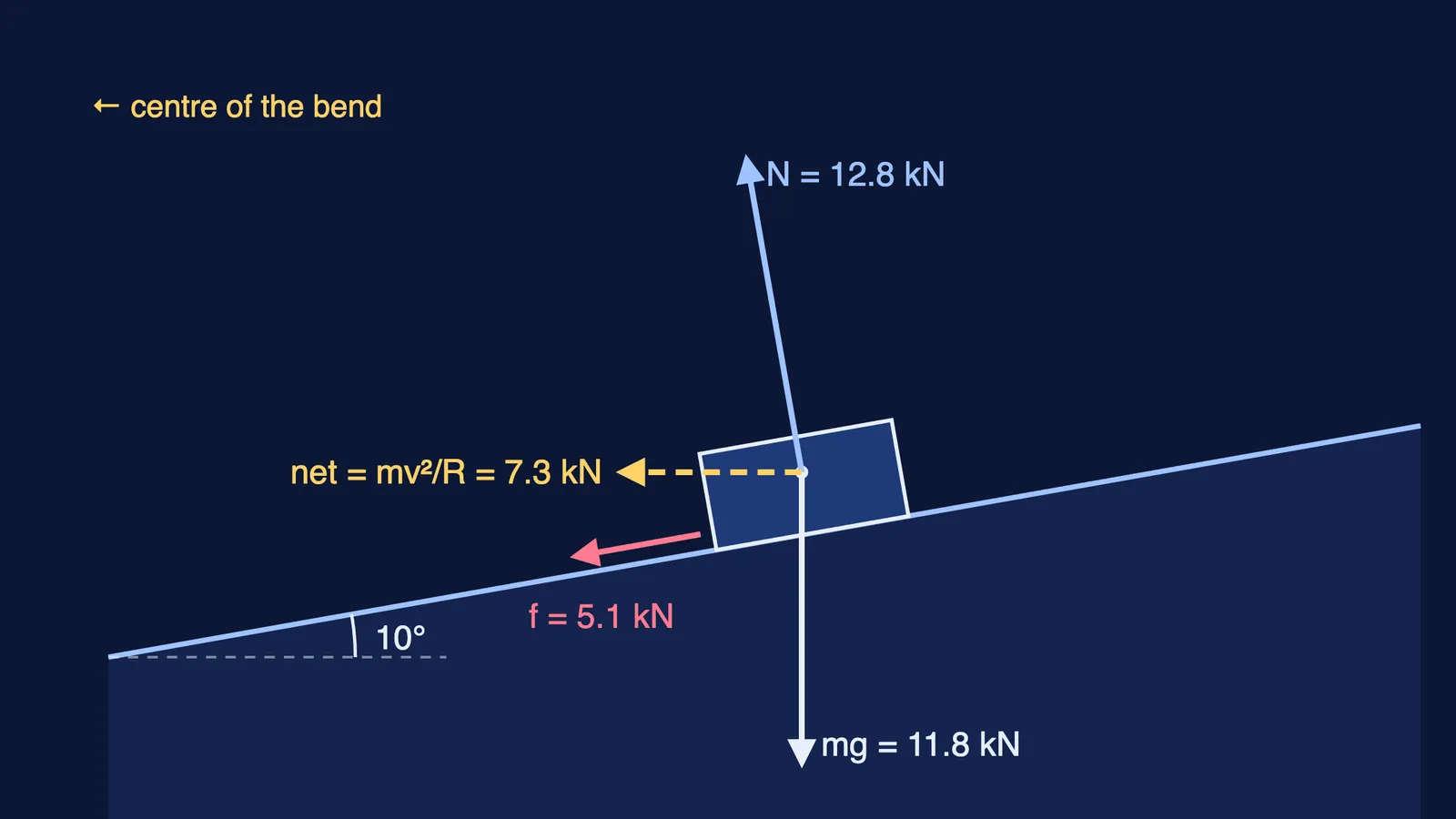
A hairpin bend on a ghat road in the Western Ghats has a radius of 50 m, and the road is banked at 10° towards the centre of the bend. A 1,200 kg car takes the bend. On a dry day the coefficient of static friction between tyres and road is 0.40; after heavy rain it drops to 0.20. A signboard at the bend shows a 40 km/h speed limit. Take g = 9.8 m s⁻² and treat the car as a particle.
(i) At the optimum speed on a banked road, the centripetal force comes from: (a) friction alone (b) the horizontal component of the normal reaction (c) the weight (d) the vertical component of the normal reaction
(ii) Find the optimum speed of the bend.
(iii) Find the maximum safe speed on a dry day.
(iv) Find the maximum safe speed after the rain. Is the 40 km/h limit safe in the rain, and what would the maximum safe wet-road speed be if the same bend were flat?
Answers.
(i) (b). At the optimum speed no friction is needed.
(ii) v₀ = √(Rg tan θ) = √(50 × 9.8 × 0.176) ≈ 9.3 m s⁻¹ ≈ 33 km/h.
(iii) v_max = √[Rg(μs + tan θ)/(1 − μs tan θ)] = √[490 × 0.576/0.929] ≈ 17.4 m s⁻¹ ≈ 63 km/h.
(iv) With μs = 0.20: v_max = √[490 × 0.376/0.965] ≈ 13.8 m s⁻¹ ≈ 50 km/h, so 40 km/h is still safe. On a flat wet bend, v_max = √(μs Rg) = √(0.20 × 490) ≈ 9.9 m s⁻¹ ≈ 36 km/h, below the limit. Banking raises the safe speed.
How do you attack case-study questions on Laws of Motion?
Draw the free-body diagram before any formula. List only real forces; there is no "centrifugal" force on a banked road.
Separate net force from a single force. In Case 1, the sheet's push (23 N) is not the net force (20 N).
Choose the system on purpose. Two coupling wagons are one system for momentum, but two separate bodies for the third law.
Convert units first: tonnes and grams to kilograms, km/h to m s⁻¹.
Static friction is "up to" μsN. It reaches μsN only when slipping begins.
For the general method, read case-based questions in board exams, then try our assertion-reason questions on laws of motion. If banking is hard to picture, the Fermi Simulation Lab has interactive simulations for the ideas that are easier to see than to read.