On this page
Chapter 4 of the rationalised NCERT Class 11 Physics Part I textbook builds its results on three laws. Below are five key derivations it works through, rewritten step by step, with the slip to watch for in each. For the full chapter overview, start with our Laws of Motion Class 11 guide.
Which derivations are in the NCERT Laws of Motion chapter?
The CBSE 2026-27 Physics syllabus covers momentum, impulse, the three laws, conservation of momentum, friction and vehicles on level and banked roads. Within that list, the NCERT chapter derives these results:
Second law in the form F = dp/dt = ma (Section 4.5)
Conservation of momentum for two colliding bodies (Section 4.7)
Angle of repose, tan θmax = μs (Example 4.8)
Maximum speed on a level circular road (Section 4.10)
Maximum and optimum speed on a banked road (Section 4.10)
Newton's second law: F = dp/dt = ma
Setup: a body of fixed mass m, velocity v, acted on by a net external force F.
Define momentum p = mv, a vector.
The law says force is proportional to the rate of change of momentum: F ∝ Δp/Δt, so F = k Δp/Δt, with k a constant.
In the limit Δt → 0, Δp/Δt turns into dp/dt, so F = k dp/dt.
With m constant, dp/dt = d(mv)/dt = m dv/dt = ma, so F = kma.
The newton is defined so that k = 1: 1 N gives 1 kg an acceleration of 1 m s⁻².
Multiply F = dp/dt by a short time Δt: FΔt = Δp. This product is the impulse.
Result: F = dp/dt = ma, and impulse FΔt equals the change in momentum.
Where students slip: forgetting that F is the net external force, not any one force.
Conservation of momentum: p′A + p′B = pA + pB
Setup: two bodies A and B with momenta pA and pB collide, with no external force on the pair, and leave with momenta p′A and p′B.
Let FAB be the force on A by B, and FBA the force on B by A, both acting over the same contact time Δt.
Second law for A: FAB Δt = p′A − pA.
Second law for B: FBA Δt = p′B − pB.
Third law: FBA = −FAB, so p′B − pB = −(p′A − pA).
Rearrange: p′A + p′B = pA + pB.
Result: with no external force, the pair ends the collision with the same total momentum it started with.
Where students slip: applying it while an external force acts, or adding magnitudes instead of signed vectors.
Angle of repose: tan θmax = μs
Setup: a block of mass m rests on a plane tilted at angle θ; static friction fs acts up the slope.
Resolve the weight mg along and perpendicular to the plane.
Perpendicular: N = mg cos θ. Along the slope: fs = mg sin θ.
As θ grows, fs grows until it reaches its limit, μs N, at θ = θmax.
Divide: mg sin θmax / mg cos θmax = μs N / N.
Result: tan θmax = μs, so θmax = tan⁻¹ μs, whatever the block's mass.
Where students slip: using μs N for friction at every angle; below θmax, friction is only as large as needed.
Car on a level road: vmax = √(μs R g)
Setup: a car of mass m takes a flat circular turn of radius R at speed v; forces are mg, N and static friction f towards the centre.
No vertical acceleration, so N = mg.
The only horizontal force is friction, so it must supply mv²/R: f = mv²/R.
Static friction cannot exceed μs N, so mv²/R ≤ μs mg.
Cancel m: v² ≤ μs R g.
Result: vmax = √(μs R g), which does not depend on the car's mass.
Where students slip: drawing a separate "centripetal force" arrow. Here friction is the centripetal force, not an extra one.
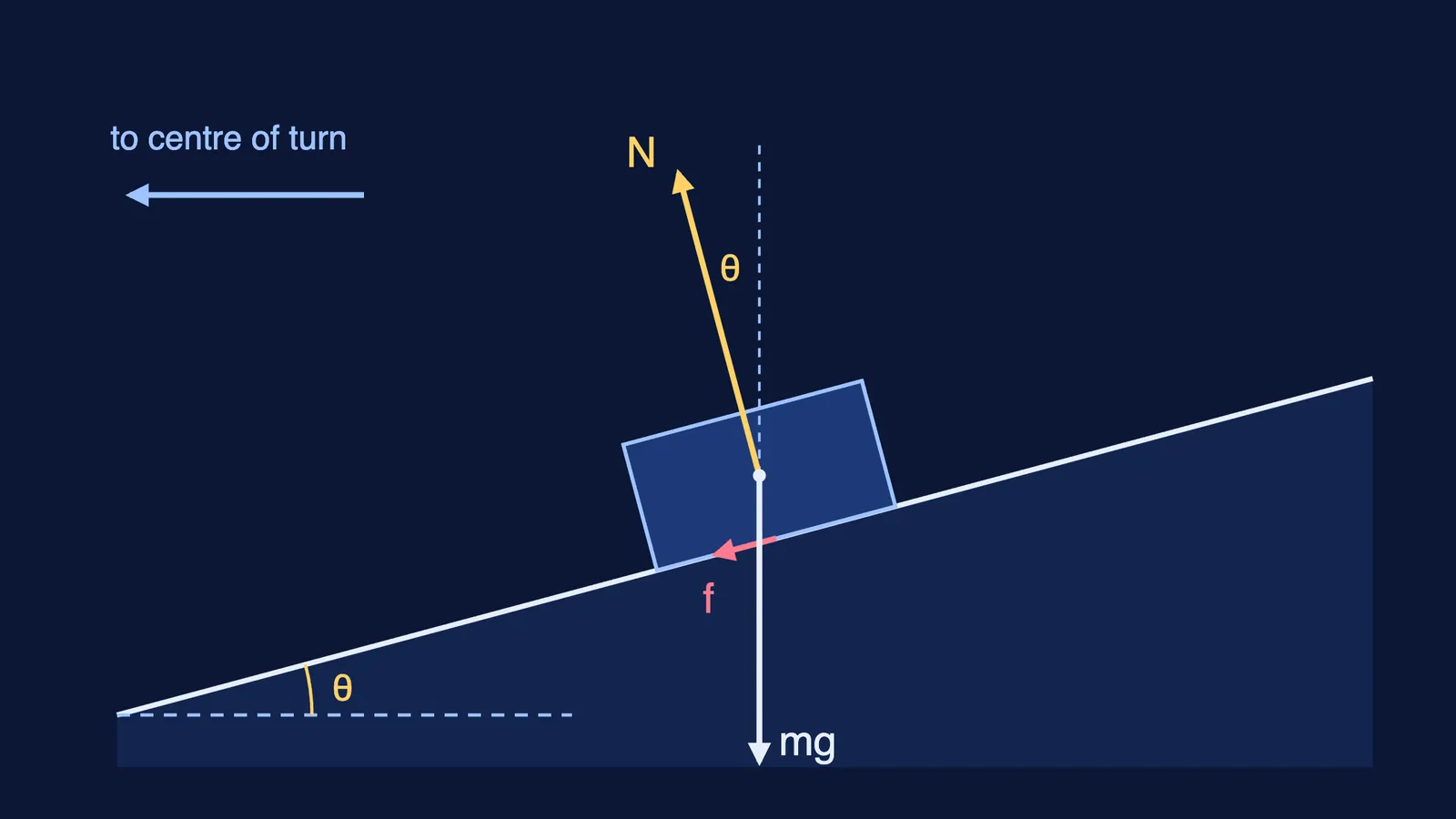
Car on a banked road: vmax = √[Rg(μs + tan θ)/(1 − μs tan θ)]
Setup: the road is tilted at θ, with the centre of the turn on the lower side. At maximum speed, friction f = μs N acts down the slope.
Vertical balance: N cos θ = mg + f sin θ.
Horizontal components point to the centre: N sin θ + f cos θ = mv²/R.
Put f = μs N in step 1 and solve: N = mg / (cos θ − μs sin θ).
Substitute N in step 2: mg(sin θ + μs cos θ)/(cos θ − μs sin θ) = m vmax²/R.
Divide top and bottom by cos θ and take the square root.
Set μs = 0 for the speed that needs no friction: vo = √(R g tan θ).
Result: vmax = √[Rg(μs + tan θ)/(1 − μs tan θ)], larger than on a flat road, and the optimum speed is vo = √(R g tan θ).
Where students slip: keeping friction up the slope. At vmax the car tends to slide outwards and up, so friction points down the slope.
NCERT's Example 4.11 uses R = 300 m, θ = 15°, μs = 0.2 and g = 9.8 m s⁻², giving vo = 28.1 m s⁻¹ (NCERT Chapter 4). Putting the same numbers into the vmax formula gives about 38.1 m s⁻¹, against about 24.2 m s⁻¹ on a flat road of the same radius.
How should you practise these derivations?
Rewrite each derivation with the book shut, then compare line by line.
Redraw the banked-road diagram at vmax (friction down the slope) and below vo (friction up the slope); note which signs flip.
Check limits after each result: μs = 0 must give vo; θ = 0 must give the level-road answer √(μs R g).
Plug in NCERT's own numbers (Examples 4.8, 4.10 and 4.11) to test your algebra, then try the questions in our Laws of Motion case-study set and assertion-reason questions.
If resolving forces feels abstract, try it on screen: the Fermi Simulation Lab has interactive simulations for ideas that are easier to see than to read.