On this page
Chapter 3 of NCERT's Practical Work in Geography Part I is short, and most questions on it are a definition or a time sum. Here are the rules, six worked sums and practice questions.
How many marks is Latitude, Longitude and Time in Class 11?
The CBSE Geography curriculum for 2026-27 gives this chapter a weightage of 4 in the 30-mark practical (25 written, 3 practical file, 2 viva). It keeps three topics: drawing parallels and meridians, longitude and time, and the International Date Line.
What are latitude and longitude?
All definitions and figures in this section are from the NCERT chapter (reprinted March 2026).
Latitude measures, as an angle, how far a place lies north or south of the equator. It runs from 0° at the equator to 90°N at the North Pole and 90°S at the South Pole.
Longitude is the angular distance of a place east or west of the Prime Meridian through Greenwich, from 0° to 180° on each side.
One degree of latitude is about 111 km, changing only slightly between the equator and the poles. One degree of longitude is 111.3 km at the equator, 79 km at 45° and 0 km at the poles, because meridians meet at the poles.
Parallels are circles, and only the equator is a great circle. Meridians are equal semicircles.
For the practical file, draw parallels by marking the angle from the equator line of a circle with a protractor; draw meridians on a circle seen from above the North Pole, where east lies to your left.
How do you calculate local time from longitude?
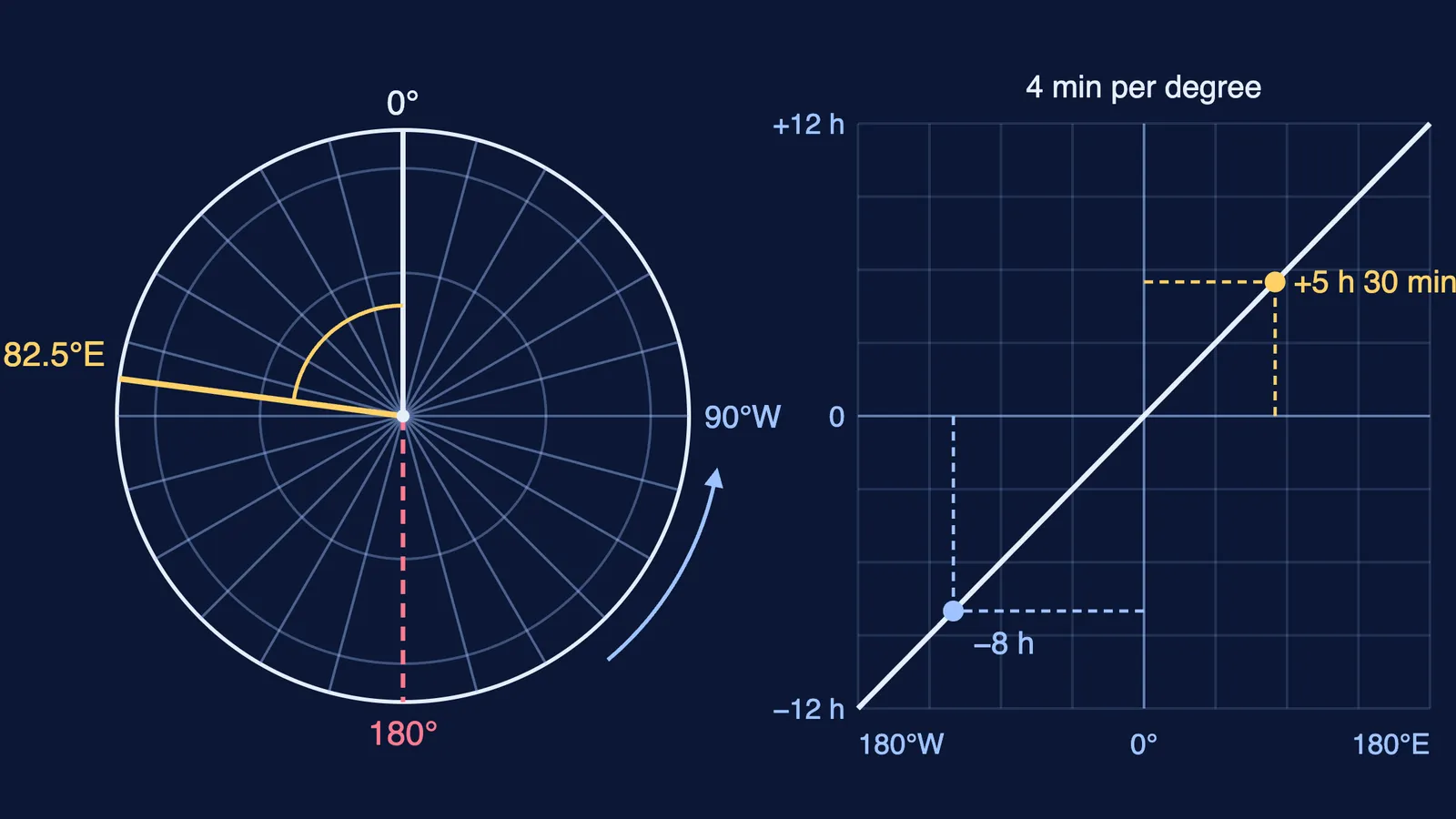
The Earth turns 360° in 24 hours, so 15° takes one hour and each degree of longitude equals 4 minutes of time (NCERT). Places east of Greenwich are ahead; places west are behind.
GMT is 9:00 a.m. Find the local time at 75°E. 75 × 4 = 300 minutes = 5 hours. East, so add: 2:00 p.m.
GMT is 9:00 a.m. Find the local time at 120°W. 120 × 4 = 480 minutes = 8 hours. West, so subtract: 1:00 a.m. the same day.
Place A (45°E) shows 3:00 p.m. Find the time at place B (30°W). The places are on opposite sides, so add the longitudes: 45 + 30 = 75°, and 75 × 4 = 300 minutes = 5 hours. B is west, so 10:00 a.m.
Local time is 4:00 p.m. when GMT is 12:00 noon. Find the longitude. The gap is 4 hours = 240 minutes, and 240 ÷ 4 = 60. The place is ahead, so it is 60°E.
Why is IST 5 hours 30 minutes ahead of GMT?
A country uses the local time of one central meridian as its standard time, chosen as a multiple of 7°30' so the gap from GMT is in whole or half hours (NCERT). India's is 82°30'E, passing through Mirzapur.
The offset is 82.5 × 4 = 330 minutes = 5 h 30 min, and 82.5 ÷ 7.5 = 11, a whole number.
Sum 5: IST is 8:00 p.m. Find GMT. Subtract 5 h 30 min: 2:30 p.m.
Sum 6: IST is 12:00 noon. Find the local time at 70°E. 82.5 − 70 = 12.5°, and 12.5 × 4 = 50 minutes. The place is west of 82°30'E, so 11:10 a.m.
The world has 24 major time zones, and Russia, Canada and the USA use more than one standard meridian. Our posts on why IST is offset by half an hour and India's location and the 82°30'E meridian take this further.
What is the International Date Line?
The International Date Line runs roughly along the 180° meridian, which is 12 hours from Greenwich whichever way you go (NCERT). A traveller crossing it eastward sets the calendar back one day, so Saturday becomes Friday. Crossing westward moves it forward a day, so Saturday becomes Sunday. More in crossing the International Date Line.
Practice questions for the practical exam
GMT is 6:00 a.m. Find the local time at 120°E.
GMT is 6:00 a.m. Find the local time at 105°W.
A place at 37°30'E shows 10:30 a.m. What is GMT?
Why do countries choose a standard meridian that is a multiple of 7°30'?
Why is the distance between two meridians greatest at the equator?
Answers: (1) 120 × 4 = 480 minutes = 8 h, so 2:00 p.m. (2) 105 × 4 = 420 minutes = 7 h; 6:00 a.m. minus 7 h is 11:00 p.m. on the previous day. (3) 37.5 × 4 = 150 minutes = 2 h 30 min; the place is east and ahead, so GMT is 8:00 a.m. (4) So that standard time differs from GMT by whole or half hours. (5) Meridians converge at the poles, so they are farthest apart at the equator.
Not sure where to begin? Fermi's AI tutor can work out what you already know and build a plan for the session. Start with practice question 3.