

On this page
Board an evening flight in Tokyo on a Monday, fly east across the Pacific, and you can land in Los Angeles on Monday morning, earlier on the clock than when you took off. Fly back and you lose most of a day. This is the International Date Line at work, and once you see why it has to exist, the time sums get easy.
What is the International Date Line?
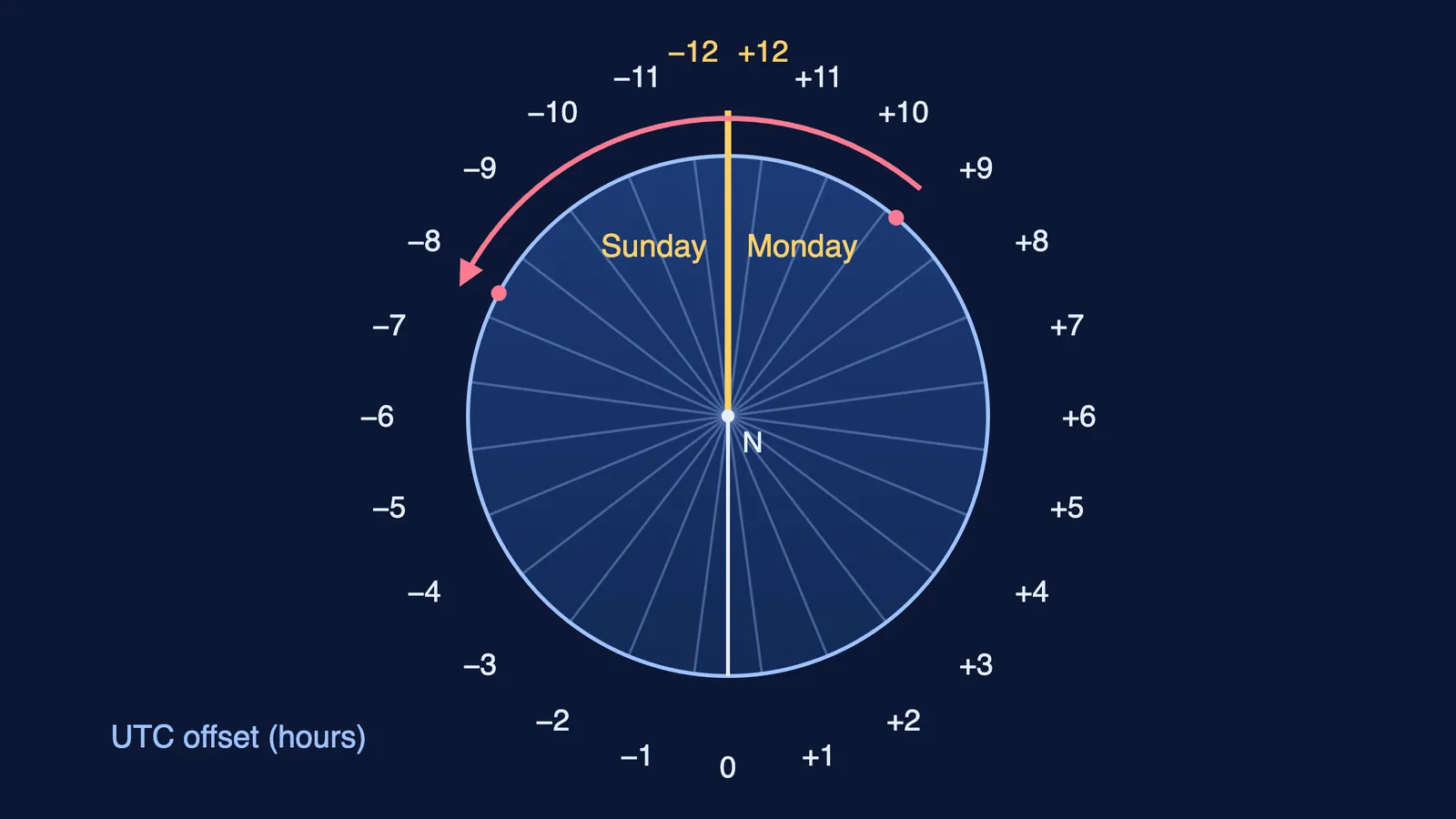
The International Date Line is an imaginary line that roughly follows the 180 degrees longitude line, halfway around the world from the prime meridian at Greenwich, England (NOAA).
It passes through the mid-Pacific, but it zigzags around political borders such as eastern Russia and Alaska's Aleutian Islands (NOAA). These detours generally follow the political and economic ties of the places involved (Wikipedia).
The line is a cartographic convention and is not defined by international law (Wikipedia).
Why do you gain or lose a day when you cross it?
A traveller going round the world changes their clock by one hour for every 15° of longitude crossed (Wikipedia), because Earth turns 360° in a day and 360 ÷ 24 = 15. Walk east from Greenwich and each 15° puts your clock one hour further ahead. By the time you reach 180°, you are 12 hours ahead. Walk west instead and you fall behind, one hour per 15°, until you are 12 hours behind at the same 180° line.
So at 180° the two counts meet, and they disagree by 24 hours: exactly one calendar day. Somewhere the date has to change, and the date line is where it changes.
The rule follows directly. Crossing the line westbound increases the date by one day, and crossing it eastbound decreases it by one day (Wikipedia).
Sailors ran into this long before the line was drawn. Magellan's expedition sailed westward around the world, and when it called at Cape Verde for provisions on what its log recorded as Wednesday, 9 July 1522, the locals said it was Thursday, 10 July (Wikipedia). The crew had recorded every day of the three-year voyage, yet they were a day behind.
What happens to the date on a Tokyo to Los Angeles flight?
Use one method every time: convert to UTC (the world reference time), add the flight time, convert back.
You need the offsets. Japan is 9 hours ahead of UTC and does not observe daylight saving time (Wikipedia). Los Angeles is on Pacific Standard Time, 8 hours behind UTC, after daylight saving ends on the first Sunday in November (Wikipedia). So in winter, Tokyo is 17 hours ahead of Los Angeles.
Take a made-up flight that leaves Tokyo at 17:00 on Monday and takes 10 hours.
Departure in UTC: 17:00 Monday minus 9 hours is 08:00 Monday UTC.
Add the flight: 08:00 plus 10 hours is 18:00 Monday UTC.
Arrival in Los Angeles: 18:00 minus 8 hours is 10:00 Monday.
You left at 5 pm Monday and landed at 10 am the same Monday, seven hours earlier on the clock. Flying east, you crossed the line and got a day back.
Now the return. Say you leave Los Angeles at 12:00 on Tuesday and the flight takes 11 hours.
Departure in UTC: 12:00 Tuesday plus 8 hours is 20:00 Tuesday UTC.
Add the flight: 20:00 plus 11 hours is 07:00 Wednesday UTC.
Arrival in Tokyo: 07:00 plus 9 hours is 16:00 Wednesday.
An 11-hour flight, but the clock jumped 28 hours: the 11 you flew plus the 17-hour offset. That is the day you "lose" flying west.
If you are practising these sums, our guide to calculating time differences with the 24-hour clock covers the borrowing and carrying across midnight. The Fermi Problem Library has worked problems with a step-by-step solver that explains the reasoning, which helps when you keep landing on the wrong day.
Have countries ever moved the date line?
Yes. Kiribati, whose islands straddled the line, removed Saturday, 31 December 1994 from the calendar of its eastern half so the whole country shared one date (Wikipedia). Samoa returned to the west side of the line in 2011: at the end of Thursday, 29 December it went straight to Saturday, 31 December, skipping Friday, 30 December entirely (Wikipedia).
Because of the zigzags, Kiribati's Line Islands keep the latest time on Earth, UTC+14, while the uninhabited US atolls of Howland and Baker Islands keep the earliest, UTC−12 (Wikipedia).
How to check any date line question
Write both cities' UTC offsets, with daylight saving if it applies.
Convert the departure to UTC, add the flight, convert to the arrival city.
Sense check: flying west across the Pacific should push the date forward; flying east should pull it back.
For India, start from IST, which is UTC+5:30 (Wikipedia).
If the rotating-Earth picture is hard to hold in your head, the Fermi Simulation Lab has interactive simulations for ideas that are easier to see than to read. Next, read why the pole star does not move and how it gives your latitude, or estimate the angular momentum of Earth's rotation in four steps.


