

On this page
This is a standard estimate in class 11 rotational motion, and it shows up in JEE-style questions. You need one formula, two numbers from NASA and a unit conversion that students often get wrong. Below is the full working, a check on the assumption, and the mistakes to avoid.
What formula gives Earth's angular momentum due to rotation?
For a rigid body spinning about a fixed axis, angular momentum is L = Iω, the rotational analogue of p = mv, as defined in the OpenStax College Physics chapter on angular momentum/10%3A_Rotational_Motion_and_Angular_Momentum/10.05%3A_Angular_Momentum_and_Its_Conservation). That chapter works this exact example by treating Earth as a uniform sphere with I = (2/5)MR², and it notes the answer is approximate because it assumes constant density.
If L = mvr for a single particle is still shaky, revise why L = mvr for a particle moving in a circle first.
How do you calculate it step by step?
Take the inputs from the NASA Earth Fact Sheet: Earth's mass is 5.9722 × 10²⁴ kg and its volumetric mean radius is 6371 km.
Convert the radius to metres: R = 6.371 × 10⁶ m, so R² = 4.059 × 10¹³ m².
Moment of inertia of a uniform sphere: I = 0.4 × 5.9722 × 10²⁴ × 4.059 × 10¹³ = 9.70 × 10³⁷ kg m².
Angular speed: one turn is 2π radians, and a day is 24 × 3600 = 86,400 s, so ω = 2π / 86,400 = 7.27 × 10⁻⁵ rad/s.
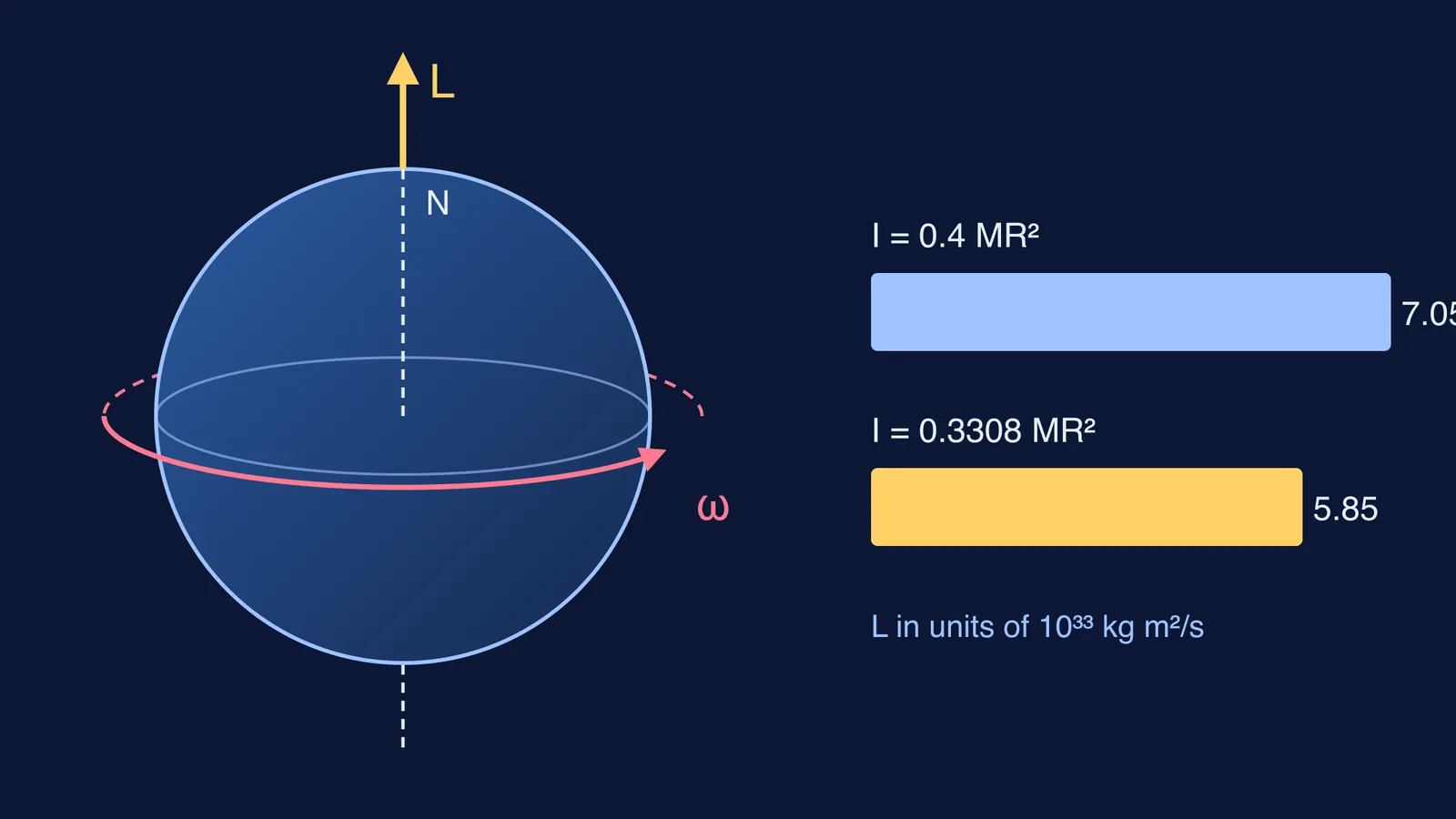
Multiply: L = Iω = 9.70 × 10³⁷ × 7.27 × 10⁻⁵ ≈ 7.05 × 10³³ kg m²/s.
That matches the 7.07 × 10³³ kg m²/s in the OpenStax worked example/10%3A_Rotational_Motion_and_Angular_Momentum/10.05%3A_Angular_Momentum_and_Its_Conservation), which uses slightly different values for mass and radius. Either way, write about 7 × 10³³ kg m²/s.
Should you use 24 hours or the sidereal day?
Earth turns once relative to the stars in 23.9345 hours, according to the NASA Earth Fact Sheet. That sidereal day is the true rotation period.
Using 86,164 s gives ω = 7.29 × 10⁻⁵ rad/s and L ≈ 7.07 × 10³³ kg m²/s. The difference is about 0.3%, so for an order-of-magnitude question either is fine. If a question gives you the period, use the number it gives.
Why is the real value lower than 7 × 10³³?
The uniform-sphere assumption is the weak link. The NASA Earth Fact Sheet lists Earth's moment of inertia as I/MR² = 0.3308, lower than the 0.4 of a uniform sphere.
A lower factor means more of Earth's mass sits towards the centre. That fits with dense material near the centre and lighter rock near the surface. Redo the working with 0.3308 instead of 0.4 and the sidereal ω:
I = 0.3308 × 5.9722 × 10²⁴ × 4.059 × 10¹³ ≈ 8.02 × 10³⁷ kg m²
L = 8.02 × 10³⁷ × 7.29 × 10⁻⁵ ≈ 5.85 × 10³³ kg m²/s
So the uniform-sphere estimate is about 21% too high, because 0.4 / 0.3308 ≈ 1.21. The full story behind the 0.3308 value is in our post on the moment of inertia of Earth and why 0.33 matters.
Which mistakes cost marks on this question?
Radius in km. Putting in 6371 instead of 6.371 × 10⁶ makes R² a million times too small.
Forgetting the 2/5. With the NASA Earth Fact Sheet values, MR²ω gives about 1.8 × 10³⁴ kg m²/s, which is 2.5 times too large.
Using the orbit. The Earth–Sun distance and a year give Earth's orbital angular momentum, not its spin. Read the question for "rotation" or "about its own axis".
Direction. L points along the axis towards the North Pole, because Earth spins anticlockwise when you look down on the North Pole.
Once you have L, the same idea answers a common follow-up: if Earth shrinks with no outside torque, L stays fixed, so a smaller I means a faster spin and a shorter day. We work through that in what happens to the length of day if Earth shrinks.
How can you practise this kind of estimate?
Try the same four steps on a problem you have not seen. One example: the angular momentum of a 10 kg solid ball of radius 0.1 m spinning at 5 revolutions per second. Then check your setup against a worked solution. The Fermi Problem Library has worked problems with a step-by-step solver that explains the reasoning rather than printing an answer, so you can see exactly where your working went off track.
If the gap is in the idea rather than the arithmetic, for example why a factor of 2/5 appears at all, the Fermi Concept Library gives each physics concept its own lesson and shows where it sits in the map.


