

On this page
L = mvr is true for a particle in a circle, but only about one point: the centre. Exam problems, including JEE ones, can ask for angular momentum about a point on the rim or on the axis, where the formula fails. Here is where it comes from, which way L points, and what changes about other points.
What is the angular momentum of a particle in circular motion?
The angular momentum of a particle about an origin is l = r × p, where r is its position from that origin and p = mv (OpenStax University Physics, section 11.2).
Its magnitude is l = rp sin θ, where θ is the angle between r and p (same OpenStax source).
Measured from the centre of a circle, r is always at right angles to v, so sin θ = 1 and L = mvr. HyperPhysics gives the same result for a circular orbit.
Since v = rω, L = mr²ω: the familiar L = Iω with I = mr² for one particle.
Which way does the angular momentum vector point?
The direction of l is given by the right-hand rule, perpendicular to the plane containing r and p (OpenStax). Curl the fingers of your right hand the way the particle goes round; your thumb points along L.
Anticlockwise seen from above: L points up the axis, out of the plane of the circle.
Clockwise seen from above: L points down the axis.
About the centre, L is constant in uniform circular motion. The rate of change of angular momentum equals the net torque when both are measured about the same origin (OpenStax, as above). The centripetal force points at the centre, along the line of r, so r × F = 0 and nothing changes L.
Why does angular momentum change about other points?
The magnitude of angular momentum depends on the choice of origin (OpenStax). Take a particle going anticlockwise round a circle of radius R, centre O.
A point Q on the circle itself. Let φ be the angle at O between OQ and the line to the particle. Working out r × p from Q gives L = mvR(1 − cos φ), still along the axis. When the particle passes through Q, L = 0, because its position from Q is zero. Opposite Q, L = 2mvR. The direction stays fixed; the size keeps changing.
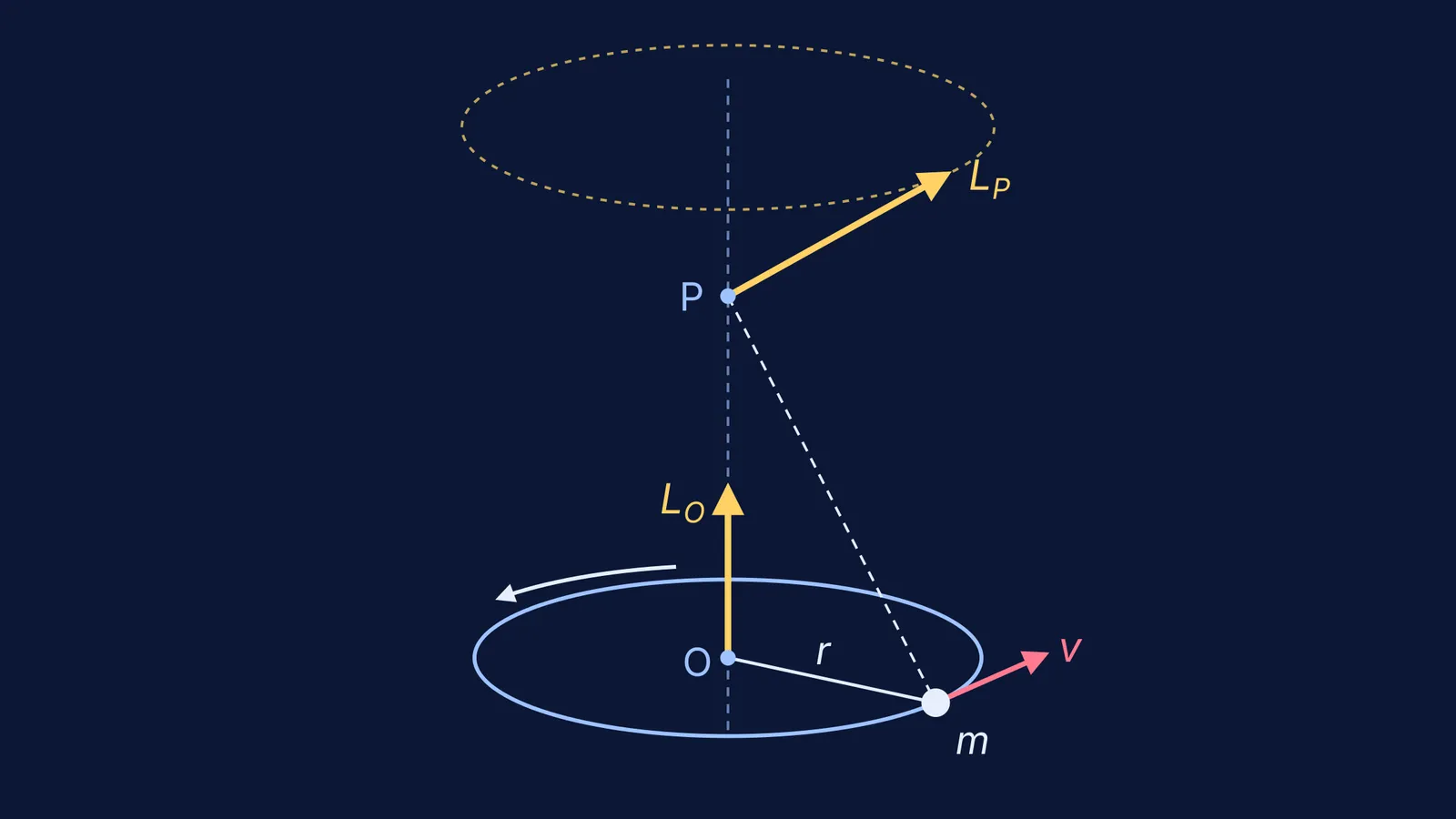
A point P on the axis, a height h above O. Now r from P also has a downward part, and L has two parts:
an axial part mvR, the same as about O;
a part of size mvh, parallel to the plane of the circle, pointing from the axis towards the particle.
The size, mv√(R² + h²), is constant, but the second part turns with the particle, so L about P sweeps out a cone, as the diagram shows. A changing L needs a torque: the centripetal force mv²/R does not pass through P, so its torque about P is (mv²/R) × h.
Worked example: numbers you can check
Take m = 0.2 kg, v = 3 m/s, R = 0.5 m, and P at h = 1.2 m above the centre, using the OpenStax relations above.
About O: L = 0.2 × 3 × 0.5 = 0.3 kg m²/s, pointing up for anticlockwise motion. Check: ω = v/R = 6 rad/s, and mR²ω = 0.2 × 0.25 × 6 = 0.3.
About Q on the rim: L = 0.3(1 − cos φ), from 0 at Q to 0.6 kg m²/s opposite Q.
About P: axial part 0.3, sideways part 0.2 × 3 × 1.2 = 0.72, size √(0.3² + 0.72²) = 0.78 kg m²/s.
Rate of change about P: the 0.72 part turns at 6 rad/s, so dL/dt = 4.32 N m. Torque: force 0.2 × 9 / 0.5 = 3.6 N, lever arm 1.2 m, torque 4.32 N m. The two agree, as they must.
Common mistakes to check for
Using mvr about a point that is not the centre.
Adding sizes of angular momenta that point in different directions.
Saying angular momentum is conserved without saying about which point.
Taking torque about one point and angular momentum about another.
Our post on five common rotational motion mistakes in JEE covers more of these. To choose a convenient point, see which point to take torque about, and for angular momentum in a real machine, read why helicopters need a tail rotor.
If you keep losing the reference point partway through a problem, the Fermi Problem Library has worked problems with a step-by-step solver that explains the reasoning rather than printing an answer. If the cross product itself feels shaky, the Fermi Concept Library gives each concept in physics and mathematics its own lesson.


